The chi-collapse: susceptibility under coercion
Adaptive capacity falls 37-fold by 30% coercion, in two experiments at L = 64
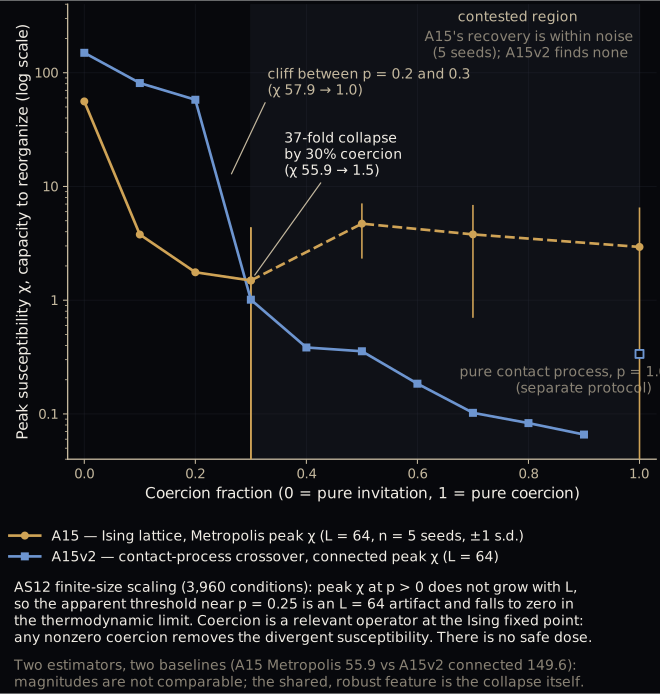
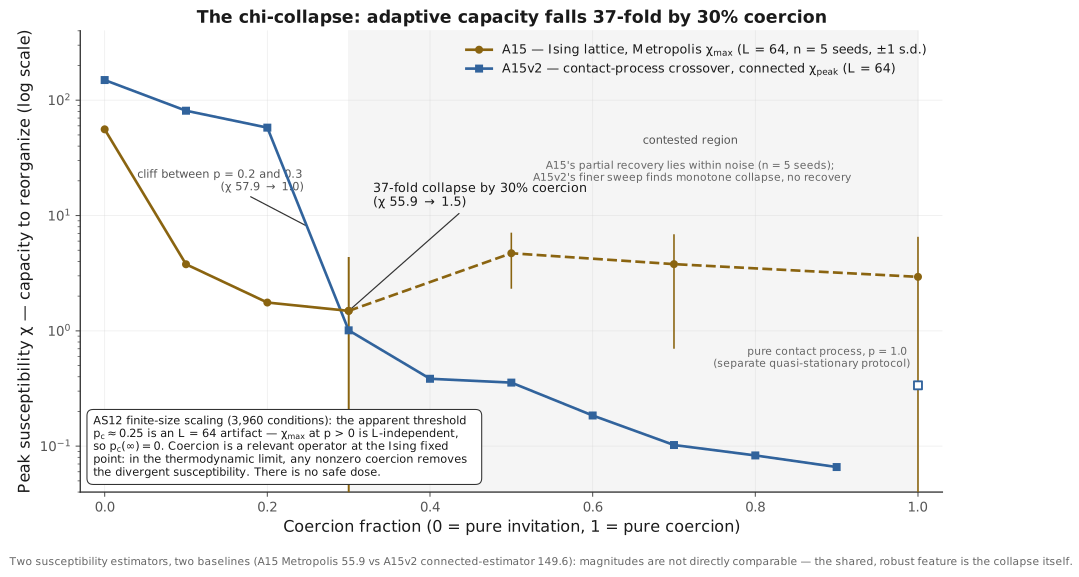
A15 (gold, Ising lattice, Metropolis peak χ at L = 64, n = 5 seeds) falls from 55.9 at zero coercion to 1.5 at c = 0.3, the 37-fold collapse; its apparent recovery above c = 0.3 is drawn dashed inside the shaded contested region because it lies within noise on five seeds. A15v2 (blue, contact-process crossover, connected peak χ) falls from 149.6 at p = 0 to 57.9 at p = 0.2, then over a cliff to 1.0 at p = 0.3 and on to 0.066 at p = 0.9; the two estimators have different baselines and are not comparable in magnitude, and the AS12 note records that the apparent threshold near p = 0.25 is an L = 64 artifact that falls to zero in the thermodynamic limit.