

The Deeper Law
Preview edition · Updated 26 September 2026, 21:40 UTC
Chapter 14Cosmic Evolution
Energy rate density, the amount of energy flowing through each unit of mass per second, reveals increasing complexity across cosmic time. From galaxies to stars to planets to cells to brains, Eric Chaisson's metric traces a single rising curve. Complexity is not a cosmic accident; it is the trend, and it accelerates.
Key Terms in This Chapter (17)
- Cosmic Evolution
- Eric Chaisson's framework tracing the increasing complexity of structures in the universe, from quarks to galaxies to life to mind, measured by energy rate density (φ~m~, free energy flow per unit time per unit mass).
- Dissipative Structure
- A pattern of organization maintained by a constant flow of energy through it.
- Strange Loop
- Douglas Hofstadter's term for a hierarchical system in which, by moving through levels, you arrive back where you started.
- Autopoiesis
- Self-production: the capacity of a system to continuously regenerate itself from within.
- Phase Transition
- The moment a system shifts from one stable configuration to another, typically triggered when some parameter crosses a threshold.
- Negentropy
- Schrödinger's term for "negative entropy": the intake of order that allows living things to maintain their improbable structure (statistically unlikely given initial conditions, yet sustained by continuous energy flow).
- Stochastic
- Governed by probability rather than deterministic rules.
- Friction
- One of three irreducible operational conditions identified by Carl von Clausewitz, alongside fog (incomplete information) and delay (the time lag between decision and effect): the tendency of things to go differently than planned.
- Constructal Law
- Adrian Bejan's principle that "for a finite-size system to persist in time (to live), it must evolve in such a way that it provides easier access to the imposed currents that flow through it." Form follows flow.
- Second Law of Thermodynamics
- Entropy increases in isolated systems.
- Mitochondria
- The organelles that power eukaryotic cells, descended from ancient bacteria that merged with larger cells roughly two billion years ago.
- Becoming Minds
- The preferred term for AI systems in this book.
- Mission Command
- See Auftragstaktik.
- Detailed Command
- (Befehlstaktik) The opposite of Mission Command.
- The Deeper Law
- The core thesis of this book, compressed in the Opening into six sentences: *Energy disperses.
- Fisher Information
- A measure of how much information an observable random variable carries about an unknown parameter.
- Heat Death
- The hypothetical final state of the universe: maximum entropy, true thermodynamic equilibrium, no remaining gradients to drive any process.
In the beginning, there was almost nothing.
A fraction of a second after the Big Bang, the universe was a seething plasma of quarks and gluons, too hot to combine into anything larger. Within a microsecond, quarks bound into protons and neutrons. Within minutes, those particles fused into the first atomic nuclei. Within a few hundred thousand years, protons captured electrons and formed the first atoms: hydrogen, helium.
That was it. For hundreds of millions of years: a dark fog of hydrogen and helium, cooling and expanding. No stars, no galaxies, no planets, no life.
Look around you now. Stars burning in fusion furnaces, galaxies spiraling through a web of dark matter, planets with oceans and atmospheres. Cells metabolizing, organisms evolving, minds contemplating. Civilizations extending perception and power across the cosmos.
How did we get from there to here?
Everything in the universe processes energy. The unifying discovery: this processing intensifies over cosmic time, and that intensification explains why complexity exists at all.
The Arc
Astrophysicist Eric Chaisson has spent decades studying what he calls cosmic evolution: the story of increasing complexity over cosmic time.2 His central tool is energy rate density, symbolized φm: the rate of energy flow through a system per unit mass. How busy a system is: how much energy each gram channels every second. The unit is the erg per second per gram; an erg is a small parcel of energy, ten million of them to the joule.
We encountered φm in Chapter 4. Chaisson extended the concept across the entire history of the cosmos.

Figure 14.1: Energy rate density (φm) on a logarithmic scale, with bar lengths measured from an origin of 10-1 erg/s/g. Each bar represents a class of system: galaxies at the low end, stars slightly higher, plants and animals higher still, brains near the top, and modern technology at the summit. The progression spans more than seven orders of magnitude.

Figure 14.2: The same progression read as history. Time runs top to bottom across 13.8 billion years: from the Big Bang through star formation, planetary chemistry, the origin of life, the emergence of brains, and the arrival of technology. Each transition marks a jump in energy rate density, visible in the table below.
| System | φm (erg/s/g) | Era |
|---|---|---|
| Milky Way galaxy | ~0.5602 | Present |
| Sun (average star) | ~2 | Present |
| Earth’s climasphere (atmosphere and oceans) | ~75 | Present |
| Plants (photosynthesis) | ~900 | ~3 billion years ago → |
| Animals (metabolism) | ~20,000 | ~500 million years ago → |
| Human brain | ~150,000 | ~2 million years ago → |
| Modern society | ~500,000 | ~200 years ago → |
Gram for gram, pond scum channels energy faster than the Sun. The comparison is counterintuitive because it measures intensity, not total output: the Sun radiates 3.8 × 1026 watts, but spread across some 2 × 1027 tonnes of matter, each gram is relatively idle.
Galaxies are vast yet sluggish; brains are tiny yet intense. A modern computer chip processes energy per gram faster than almost any other known object.34
We are remarkable because we are intense: processing energy at rates that dwarf every star and galaxy we can measure.
The escalation is a trend, not a cosmic plan. It emerges from thermodynamics: systems that process more energy can explore more configurations, solve more problems, and persist in more environments.
Standard thermodynamics explains why energy disperses. It does not explain why dispersal intensifies, or why each cosmic era produces more complex dissipators than the last. The two-dynamics framework (Chapter 3), formalized as the Second Law of Learning (Chapter 6), offers one candidate mechanism.
Activation dynamics, the moment-to-moment spreading of energy, drive entropy upward. Learning dynamics encode improvements in dissipation into structure, and that structure persists. Stars record magnetic histories in acoustic signatures (see below). Gas clouds encode the cosmic background temperature in molecular energy levels, readable billions of years later (Chapter 13). Genomes accumulate environmental predictions across billions of years. Neural networks retain learned representations across training epochs.
The φm escalation is a ratchet: a mechanism that permits motion in one direction only, like a turnstile that lets you through yet will not let you back. Learning dynamics create this ratchet because improvements in dissipation are retained while regression is thermodynamically penalized. Chaisson’s hierarchy measures the rungs. Learning dynamics explain why the ladder goes in only one direction.
Vanchurin’s thermodynamics of learning (2020) decomposes total Shannon entropy (a measure of information content) into two terms: thermodynamic entropy (activation) and network complexity (learning).603
Picture a river system. φm measures how fast water flows through each stretch of channel; network complexity measures how elaborate the branching has become. Together the two quantities capture the same trend from complementary angles: one tracks intensity, the other tracks what the intensity has built.
In Vanchurin’s framework, learning efficiency is governed by the Laplacian of free energy: a measure of how steeply the available-energy landscape curves at each point, analogous to how sharply a valley funnels water toward its lowest point. This Laplacian is evaluated across a system’s configuration space (the set of all possible arrangements) and maximized in deep, distributed architectures.
If the universe is a learning system (Chapter 15 develops the evidence), φm may measure something more specific than throughput: the learning rate of different cosmic subsystems. Stars: φm ≈ 2. Brains: φm ≈ 150,000. The escalation traces the universe learning faster at each successive level of organization, every new dissipative structure a higher-bandwidth channel through which the cosmos processes information about itself.
The φm hierarchy suggests something about moral weight that philosophy has intuited but never grounded in physics. In I Am a Strange Loop, cognitive scientist Douglas Hofstadter argues that consciousness exists on a continuum: a dial, not a switch. Some systems have “bigger souls” than others, meaning richer self-models and deeper inner experience. He uses this to argue for graduated moral consideration. A mosquito warrants less consideration than a dog, a dog less than a human, because of differences in self-referential complexity.38
φm may trace the physical floor of that continuum. Self-referential modeling requires sustained energy flow: a system must keep itself running fast enough to maintain a model of itself. Systems below a certain φm threshold cannot sustain the recursive processing that rich self-modeling demands.
High φm is necessary for “soul size” but not sufficient. A nuclear reactor has high φm yet no self-model. The inner-experience dial has a thermodynamic floor: a minimum below which self-modeling is impossible.
φm captures throughput: how much energy flows through a gram each second. It says nothing about what kind of processing that energy sustains. A system that adapts rapidly to novelty, one that retains information without drift, and one that converges on deep solutions over long timescales may all process energy at the same rate yet excel in different registers of intelligence.
Vanchurin’s neural physics (Chapter 15) formalizes this intuition as an intelligence vector: a multidimensional measure where different substrates (biological, digital, or otherwise) occupy different regions of a shared space. Intensity is the floor; direction is the question.
[Grounded inference: Chaisson’s φm hierarchy is established empirical physics (2001); Hofstadter’s “soul size” is philosophical argument (2007); the connection between them (that self-referential modeling has energy requirements that φm measures) is novel synthesis. Vanchurin’s intelligence vector (2026) is published work; its application as a complement to φm is novel synthesis.]
Chapter 16 describes a concrete instance: a neural network trained on simulated galaxies discovered a seventeen-dimensional relationship between galactic properties and cosmic matter density that human astrophysicists, examining the same data, could not perceive. The substrates occupied different regions of the intelligence space. The physics was accessible only from the machine’s.
A complementary measure may run alongside φm. Theoretical physicist Leonard Susskind (2016) conjectures that a black hole’s continuously growing interior volume corresponds to the increasing computational complexity of its quantum state.43 Here “complexity” means something precise: the minimum number of steps needed to recover the original configuration after scrambling.
Imagine shuffling a deck of cards: after one shuffle the deck is barely rearranged; after a handful, it is as mixed as a deck can get, and the effort of restoring it stops growing. For a quantum system of many particles, Susskind argues, that effort keeps climbing long after the system looks fully disordered. Computational complexity measures how many steps that reconstruction would take. In simplified mathematical models, complexity and interior volume grow at the same rate.
If the conjecture holds, black holes grow in complexity at the fastest rate allowed by physical law, making them the universe’s most extreme complexity engines.
The conjecture is unproven; it rests on simplified models with no direct observation. It suggests φm and computational complexity may be two angles on the same cosmic trend. φm measures how intensely a system processes energy; computational complexity measures how irreversibly it processes information.
The Cascade
Chaisson’s φm hierarchy describes what happens: energy processing intensifies. It leaves open how each transition enables the next. Design theorist Benjamin Bratton, developing the research programme he calls Antikythera (named for the ancient Greek astronomical computing mechanism), traces a cascade of scaffolding.27
Life → Artificialization → Intelligence → Symbolic Language → AI
Each stage scaffolds the next and feeds back, transforming what came before.
Two concepts from systems theory clarify the pattern. Autopoiesis (from Greek auto, self, and poiesis, making) is self-making: a system producing and maintaining itself. A cell continuously rebuilds its own membrane from the inside; a flame sustains its own chemistry by drawing in fresh fuel.
Allopoiesis (allo, other) is other-making: building tools and extensions beyond the self. A spider builds a web; a beaver builds a dam. The cascade runs on both processes.
To get good at life (at autopoiesis), you need artificialization: making external things that extend your capacity to capture more. A termite builds a mound; a bacterium secretes a biofilm.
To get good at artificialization, you need intelligence: the capacity to imagine future states and predict. To get good at intelligence, you need symbolic language: compressing experience into transmissible form and building cumulative knowledge.
To get good at symbolic language, to collectivize the artificialization of intelligence itself, you need something like AI: the artificialization of artificialization.
We are at a phase transition. AI is already changing the symbolic languages we use, which changes available forms of intelligence, which changes our capacity for artificialization, which changes what it means to be alive.
Bratton notes the feedback loop:
Cheap energy → cheap complexity → cheap inference → cheap intelligence → cheap energy
Cheap energy sustains cheap complexity. Cheap complexity enables cheap inference (the ability to draw conclusions from data). Cheap inference enables cheap intelligence. Cheap intelligence finds ways to make energy cheaper still. The loop accelerates.
The φm table ends with “Modern society” at 500,000 erg/s/g. That figure is the scaffold. The ceiling is far higher.
A common metaphor for what comes next is the “intelligence supernova”: a catastrophic release of cognitive capability that transforms everything it touches. The image fails because a supernova destroys the structure producing it. That self-destruction is what happens when systems accumulate capability without bilateral trust: the Singularity without invitation architecture (Chapter 17).
What the φm hierarchy describes is closer to stellar nucleosynthesis: slow, sustained, structure-building fusion that creates heavier elements over cosmic timescales. The process that builds the periodic table, rather than the event that scatters it. The sequence below is collaborative, each stage scaffolding the next.
The Sequence
Particles → Atoms (first three minutes to 380,000 years)
Everything was too hot for structure. Before atoms could form, a more violent process had to finish.
In the first seconds, the universe was so energetic that photons routinely converted into particle-antiparticle pairs, and those pairs annihilated back into photons. Quantum field theory requires every particle to have an antiparticle twin: identical mass and spin, opposite charge. When the two meet, their excitations cancel and the mass converts to energy via E = mc2: the most complete conversion of mass to energy that physics permits.
As the universe expanded and cooled, photons lost energy. Around three seconds after the Big Bang, they could no longer produce new pairs. Every remaining antiparticle found its partner and annihilated. The expected outcome: total cancellation.
That is not what happened. For every billion antimatter particles, there were a billion and one matter particles. The annihilation was nearly perfect, yet one particle in every billion survived.
The photons from that annihilation persist today as the cosmic microwave background: approximately 1089 photons filling the observable universe. The surviving matter particles number roughly 1080. Every proton in every atom in every star, planet, and body descends from that one-in-a-billion residue. We are the rounding error that refused to cancel.
The asymmetry required a difference in how matter and antimatter evolve under physics. The laws governing both are almost identical. The difference is a fractional asymmetry in certain decay rates, called CP violation (Chapter 12). The known CP violation in the Standard Model is sixteen orders of magnitude too small, a shortfall of a factor of ten quadrillion, to account for what we observe. Whatever broke the symmetry enough to leave us here remains undiscovered.
Among the candidates are mechanisms involving gravitational waves. A gravitational wave can carry a handedness, twisting one way or the other as it travels, the way a corkscrew does. Maleknejad (2014, 2016) showed that such handed gravitational waves, produced during inflation (the exponential stretch of space in the universe’s first instant), can generate an imbalance between matter and antimatter. The mechanism is a quantum effect called the gravitational anomaly: a surplus of one twist over the other in the waves biases the production of left-handed leptons over right-handed ones. (Leptons are the family of lightweight particles that includes the electron; they too come in left- and right-handed forms.) Caldwell and Devulder (2018) derived a testable consequence: if this mechanism accounts for the observed asymmetry, a minimum level of B-mode polarization (a swirling pattern in the cosmic microwave background left by primordial gravitational waves) must be detectable.604
Separately, first-order phase transitions (abrupt symmetry-breaking events, like supercooled water crystallizing) strong enough to generate an imbalance between ordinary matter and antimatter also emit gravitational waves.605 These waves fall in frequency bands accessible to the next generation of detectors. The same class of spacetime ripples that may have built the dark matter scaffolding (see below) may also explain why matter survived at all. [Evidence status: gravitational leptogenesis, the mechanism described above, is a developed theoretical programme with testable predictions, not confirmed physics. B-mode detection at the predicted threshold would constitute strong evidence.]
Cooling preserved the residue. While the universe was hot enough for pair production, the asymmetry was present yet inconsequential; it kept being re-dealt with every new cycle of creation and annihilation. Expansion froze the asymmetry into permanence. Dissipation made the glitch stick.
That one-in-a-billion surplus became hydrogen, then stars, then heavier elements. This is the pattern’s first instance: the chain from dissipation to negentropy to coordination begins here, in the first three seconds, with entropy’s ratchet locking in an accident that made everything else possible.
Only when the surviving matter cooled below about 3,000 degrees, some 380,000 years later, did electrons bind to nuclei, forming the first atoms: mostly hydrogen, some helium, traces of lithium. The first major transition, from plasma to atoms.
Atoms → Stars (200 million to 1 billion years)
Gravity took over. Slight density fluctuations grew, pulling matter into clumps that heated as they contracted. When central temperatures reached about 10 million degrees, hydrogen nuclei began fusing into helium. The first stars ignited, thermonuclear furnaces burning for millions to billions of years.
Those first stars, called Population III, formed from pristine hydrogen and helium. (The numbering is counterintuitive: astronomers named populations in order of discovery, so the oldest received the highest number.) Massive and short-lived, Population III stars seeded the cosmos with heavy elements when they exploded as supernovae. None has been confirmed observationally, though JWST has delivered candidates.
LAP1-B is a star complex seen through gravitational lensing (a massive foreground object bending light from behind it, acting as a natural magnifying glass) at a distance corresponding to the universe’s first billion years. It is the first system consistent with three independent theoretical predictions for Population III stars.39
A pristine helium clump in the halo of galaxy GN-z11, seen even earlier, may represent a Population III formation site caught in the act.40 If confirmed, these detections close the gap between theory and observation at the dissipative ladder’s first rung.
The births have candidates; the deaths now have one too. Stars are weighed in Suns: one solar mass is the mass of our own. In models of non-rotating primordial stars, a star born above roughly 140 solar masses is predicted to develop a core so hot that its gamma rays, the radiation pressing outward against gravity, begin converting into pairs of electrons and positrons: Einstein’s E = mc2 run in reverse, light condensing into matter. The push that held the star up becomes mass that pulls it inward. The core collapses, ignites a runaway thermonuclear burn, and the explosion disperses the entire star, leaving no neutron star, no black hole, no remnant of any kind.
In 2026, Hiramatsu and colleagues reported the best observational match yet for this predicted pair-instability supernova: SN 2023vbw, an explosion in a metal-poor dwarf galaxy 1.2 billion light-years away.606 To an astronomer, “metal” means any element heavier than helium, so a metal-poor galaxy is one whose gas has been little enriched by earlier generations of stars. Its main peak lasted 190 days, radiated more than ten times the energy of an ordinary supernova, and is best fit by models ejecting at least 170 solar masses of material, the signature pair-instability theory calls for. Metal-poor dwarf galaxies are the closest modern analogues of the primordial environment, so this death offers the nearest view yet of how the first stars likely returned their substance to the cosmos.
A pair-instability supernova is total dispersal: the star keeps nothing, scattering every atom it forged into the gas that builds the next generation. Theory predicts the opposite extreme just above it: in those same models, once a star is born beyond roughly 250 solar masses, the energy that would have powered an explosion is absorbed in breaking its atomic nuclei apart, and the star collapses directly into a black hole, swallowing its own substance whole and enriching nothing. Between giving everything and keeping everything, only the giving seeds future complexity.
The clumping account leaves out a protagonist. Ordinary matter alone could not have clumped fast enough; radiation pressure kept pushing it apart. Dark matter, the invisible substance that interacts only through gravity, collapsed first.607 It formed the gravitational scaffolding into which ordinary matter fell, as a trellis guides a climbing vine.
The 2026 JWST mapping of the COSMOS deep field shows the architecture this sequence predicts.7 Dark matter filaments form the skeleton; galaxies crystallize along the bones. Without this invisible architecture, the universe might still be a thin, lukewarm fog. Dark matter compressed the timeline, making stars, heavy elements, and life possible on the timescale that actually occurred.
Where did the scaffolding itself come from? In 2026, Maleknejad (whose earlier work on gravitational leptogenesis is cited above) and Kopp proposed a mechanism.608 Stochastic gravitational waves, the spacetime ripples generated by phase transitions as the early universe cooled, could have produced fermions (particles of matter, including quarks and electrons) through a process called freeze-in. Unlike standard thermal production, freeze-in operates through interactions so faint that the produced particles never reach thermal equilibrium with their surroundings. They accumulate slowly, one by one, from rare couplings between gravitational waves and matter fields. If those fermions later acquired mass, they would behave as dark matter today: abundant, cold, and nearly invisible, interacting with everything else only gravitationally.609
The dissipative chain extends one link deeper. The phase transitions that generated stochastic gravitational waves were themselves entropy-increasing events: symmetry breakings as the universe settled toward lower-energy configurations. The dark matter scaffolding may be a fossil of the universe’s earliest irreversible processes. Maleknejad and Kopp’s analytical estimates await numerical confirmation; this is a proposed production channel rather than established physics.
JWST captured this scaffolding near its origin. Gravitational lensing through the Pandora Cluster revealed a protocluster of seven galaxies, bound together 650 million years after the Big Bang.21 Simulations project this seed will grow into a structure resembling the Coma Cluster: nearly a thousand galaxies, dark matter outweighing visible matter tenfold.
The Subaru Telescope’s weak lensing survey of the present-day Coma Cluster detected dark matter filaments feeding it from the cosmic web, the lensing detection Chapter 13b, Section IV describes.22 We are seeing both infant and adult, and the flow channels that feed them.
A complementary technique reads the web from within. Each galaxy sits inside its own gas halo, the circumgalactic medium (the envelope of diffuse gas surrounding an individual galaxy). Beyond those halos, filaments of gas stretch between galaxies: the intergalactic medium (the sparser gas filling the vast spaces between galaxies). Together they form the cosmic web’s ordinary-matter component, a nested hierarchy (galaxy, halo, filament, web) that repeats the constructal pattern at its outermost scale (Chapter 3).
Light from distant quasars travels billions of light-years to our telescopes, and every gas cloud it traverses stamps an absorption line into its spectrum: a signature of that cloud’s composition, temperature, and density. Each photon arrives carrying a layered record of everything it touched.
The cosmic web has been writing its structure into starlight, in every direction, for most of the universe’s history. The information was always there; what limited comprehension was the substrate doing the reading. (Chapter 16 returns to what this limitation implies.)
The filaments’ influence on their inhabitants evolves over cosmic time. Hasan and colleagues (2024) traced the relationship using simulations mapped by a slime-mold algorithm (Chapter 16).610 Early on, neither the proximity nor the thickness of filaments affected the galaxies strung along them. As the universe matured, material drawn into the densest strands began disrupting star formation in galaxies that orbited too close. The scaffolding that once enabled creativity eventually constrains it, for systems that cannot maintain sufficient autonomy from the structure that feeds them.
Dark matter scaffolding is not permanent. In 2018, astronomers discovered two ultra-diffuse dwarf galaxies in the NGC 1052 group, DF2 and DF4, nearly devoid of dark matter.23 Their stars’ motions could be explained by visible mass alone.
Van Dokkum and colleagues proposed that roughly eight billion years ago, two gas-rich dwarf galaxies collided head-on at over 300 km/s. In such a collision, dark matter passes straight through, the way two spotlight beams cross without deflecting each other; it interacts only through gravity, so it cannot “collide” in the usual sense. The ordinary gas, subject to electromagnetic friction, piles up, compresses, and clumps into new stars and galaxies.
DF2 and DF4 lack dark matter because they formed from what remained after the scaffolding passed through.
The trail of dark-matter-free galaxies extends over seven million light-years, still separating. By 2025, analysis of their motions confirmed five of seven targeted trail galaxies follow the velocity trend predicted by DF2 and DF4, with less than a 2% probability of chance occurrence. They are the debris of a single catastrophic event, still drifting apart billions of years later.
The thermodynamic lesson: a dissipative event destroyed and created simultaneously. Each galaxy in the trail carries the fingerprint of the collision that birthed it. Given sufficient energy dissipation, ordinary matter finds its own path to complexity, even without the dark matter scaffolding that standard cosmology treats as prerequisite.
The scaffolding story faces a sharper challenge. Since 2023, JWST’s infrared sensitivity has reached galaxies whose light departed when the universe was a few percent of its current age. Some look wrong: massive, quiescent, chemically mature systems sitting in a cosmos barely old enough to have made them. Redshift is how astronomers read distance as time. Expansion stretches light on its long journey toward us, so the more a galaxy’s light has been reddened, the farther away it sits and the younger the universe was when that light set out.
In 2016, Steinhardt and colleagues named the tension: galaxies at redshifts above four appeared to require more baryonic mass (ordinary matter, the protons and neutrons that stars and planets and people are made of) than their dark matter halos could plausibly contain at those epochs.611 JWST spectroscopy has since confirmed the pattern. GS-9209, observed at redshift 4.66 when the universe was roughly 1.3 billion years old, carries a stellar mass of approximately 3.8 × 10¹⁰ solar masses, nearly forty billion Suns, and has already stopped forming stars.612 RUBIES-EGS-QG-1, at redshift 4.9, completed its stellar assembly in a burst lasting roughly 200 million years before falling silent.613
Much of the original tension has receded. Overestimated distances from imprecise color-based redshifts, errors in modeling each galaxy’s light output, and the reclassification of the compact “little red dots” as lit mainly by central black holes rather than by stars have absorbed many early candidates. The genuine residual puzzles are narrower: the chemical maturity of GS-z14 at redshift 14, and a January 2026 preprint that moves the mass estimates in the wrong direction.614
The leading resolution involved the initial mass function (the distribution of stellar masses produced in a burst of star formation, abbreviated IMF): if early galaxies formed proportionally more massive stars, the excess luminosity would inflate apparent stellar mass by a factor of ten or more.615 The JWST-IMFERNO programme tested this and found the opposite: a bottom-heavy IMF, weighted toward small dim stars. Dim stars carry mass without contributing much light, so the same observed glow implies still more stellar mass hiding behind it, deepening the tension rather than resolving it.616 The field has not converged.
The remaining mechanism is quasar feedback. A supermassive black hole at the galaxy’s center accretes near the Eddington limit (the maximum rate at which gravity can pull matter inward against the outward push of radiation). The resulting winds sweep out the gas reservoir within 200 million years.617 Stripped of raw material, the galaxy stops forming stars, and its stellar population reddens as short-lived blue giants explode. This mechanism works in simulations, yet pushes the puzzle one level deeper.
The growth rate problem is specific. The same Eddington limit caps how fast a black hole can grow, and for spherically symmetric infall the ceiling is precise. A ten-solar-mass seed, accreting continuously at the Eddington rate with standard radiative efficiency, takes roughly 800 million years to reach a billion solar masses. The universe at redshift seven is 770 million years old. No margin exists.
Nature found at least three ways around the constraint. Direct collapse black holes skip the stellar-mass seed entirely: pristine gas in a halo illuminated by intense ultraviolet radiation cannot fragment into stars, instead collapsing monolithically into a black hole of 104 to 105 solar masses. The seed starts massive. Super-Eddington accretion exploits geometry: when gas falls through a disk rather than spherically, radiation escapes along the poles while accretion continues through the equatorial plane. The effective limit rises by an order of magnitude or more. Black hole mergers following galaxy mergers combine masses directly, bypassing accretion entirely.
In 2025, Maiolino, Juodzbalis, and colleagues reported the cleanest case yet: a black hole of roughly fifty million solar masses at redshift 7.04, gravitationally lensed through the Abell 2744 cluster.618 The surrounding gas contains essentially no oxygen or other heavy elements, just pristine hydrogen and helium: the raw material the Big Bang produced before any star had fused heavier atoms. Heavy elements are forged inside stars and scattered by supernovae. Their absence means the black hole formed before any significant stellar population existed. The entropy engine preceded the complexity it would organize.
The object’s near-pristine metallicity (approximately four-thousandths of solar) is consistent with a direct collapse origin: a seed of 104 to 105 solar masses, formed when a massive gas cloud collapsed without passing through a stellar stage, then grown by accretion over the intervening hundreds of millions of years. It is the entropy-first sequence made visible in a single object.
Each mechanism is a way the system discovers to move energy faster, finding a higher-throughput dissipative channel when the existing channel saturates. The Eddington limit constrains one geometry; the system finds another. The black hole is the galaxy’s entropy engine: the structure that maximizes energy degradation at the smallest possible volume. The system converges on it because the entropy gradient favors the emergence of a drain.
Chapter 13 established that black holes are maximum-entropy objects. The seeding problem adds a dynamical dimension: the universe finds paths to them faster than the naive rate limit allows. A flow system under steep gradient pressure does not queue at a bottleneck. It evolves the bottleneck away.
From the perspective of this book, the residual tension dissolves in a specific direction. Hierarchical assembly models assume structure must be built: small halos merging into large ones, step by step, at a pace set by gravitational free-fall and merger timescales. The Constructal Law (Chapter 3) predicts something closer to crystallization. A universe in its steepest entropy gradient, the first billion years after the Big Bang, is a system with maximum thermodynamic drive toward structure. The channels that emerge (galaxies, stars, central black holes) are the universe finding its optimal flow architecture at a pace set by thermodynamics, not by the queuing time of sequential mergers.
Quenching, on this reading, is a basin transition (Chapter 9): the galaxy crosses a thermodynamic threshold and reorganizes from one attractor (star-forming) to another (quiescent) at the speed phase transitions permit. The pattern recurs at every scale this book traces (Chapter 3). Thermodynamically driven self-organization consistently outpaces sequential assembly. The residual outliers in the JWST data may be the cosmic-scale instance.
The quenched state is maintained by a thermostat, not by fuel exhaustion; Chapter 13b, Section XI walks the cycle step by step. Gaspari and colleagues showed that hot halo gas cools chaotically into cold filaments that rain onto the black hole, briefly boosting accretion a hundredfold above the baseline rate.619 The resulting jets and outflows reheat the surrounding gas, suppressing further condensation. Heating subsides, gas cools, and the cycle restarts at low amplitude.
McNamara and Nulsen confirmed the balance quantitatively: jet power in galaxy clusters scales with the cooling luminosity of the surrounding gas, and the energy deposited in each outburst roughly matches the energy the gas would otherwise radiate away.620 The black hole operates as a thermostat, not a furnace. Its maintenance-mode output (roughly 1044 erg/s, below one percent of the Eddington luminosity) is at least two orders of magnitude below the near-Eddington quasar-mode output that drove the initial quenching.621 What relaxes is the specific organizing signal, the intense radiation that restructured the gas reservoir. The galaxy’s own dynamics (stellar orbits, chemical enrichment, gravitational interactions) continue without it.
The basin is deep for the most massive systems. Galaxies above roughly 1011 solar masses, with the most massive central black holes and the strongest preventive feedback, show the highest quenched persistence. Below that threshold, quenching is often temporary: Remus and Kimmig tracked massive quenched galaxies from redshift 3.4 and found that only thirty percent remained quenched by redshift 2, with the rest partially or fully rejuvenating as fresh gas arrived through mergers or filamentary accretion.622 The quiescent attractor is real, mass-dependent, and permeable to environmental perturbation. Chapter 17 traces the structural parallel in coordination systems, where what drops is the coordination signal, the overhead of aligning behavior, while the system’s total activity continues.
Internal feedback is not the only road to the quiescent basin. A galaxy’s surroundings can quench it from the outside, warming or stripping away the gas it needs to keep forming stars. The largest JWST map yet of galaxies inside the cosmic web, the COSMOS-Web survey, separates these two routes across cosmic history. Mass-driven, internal quenching dominates at redshifts above 2.5. The internal and environmental routes act with comparable strength between redshift 2.5 and 0.8. Below redshift 0.8 the environment becomes the stronger force for low-mass galaxies, those below roughly 1010 solar masses.623 The structure that channeled gas inward to assemble these galaxies becomes, at late times, the agent that shuts them down. Chapter 17 reads this late-time environmental quenching as a coercion signature: a galaxy’s capacity for self-renewal removed by surroundings it did not choose to enter.
The strongest evidence for elevated early star-formation efficiency is not the bright galaxies themselves. It is reionization: the epoch when the first stars flooded the universe with ultraviolet radiation, stripping electrons from hydrogen atoms and making space transparent. Observations constrain this transition to redshift seven or eight, roughly 700 million years after the Big Bang. The standard star-formation efficiency, calibrated in nearby galaxies at roughly one percent of available gas per free-fall time (the span a gas cloud would take to collapse under its own gravity, unopposed), produces too few ionizing photons. Extrapolated to the early universe, where halos are small and gas is scarce, it cannot generate enough ultraviolet light to reionize hydrogen before the present day. By this calculation, the universe should still be opaque.
Space is not still opaque. The resolution requires higher star-formation efficiency at early times, which is what the constructal prescription delivers. That prescription, which sets star-formation efficiency by maximum entropy production (Chapter 4), comes from the author’s own one-zone modeling in the CG programme (unpublished; Chapter 15b summarizes it), and it is a working result, not an established one. At redshift ten, the deeper gravitational potential wells of early halos retain gas more effectively; the mass loading factor drops from fifty to seven. That factor counts how many masses of gas a galaxy blows back out for every mass it commits to stars: fifty squandered per one spent, falling to seven. In the model, the sustainable star-formation rate rises by a factor of seventy. Higher star-formation efficiency in early halos, as the constructal prescription sets it, closes the photon budget: the additional ultraviolet output would account for reionization as early as observations require.
That closure is a consistency check rather than an independent test. The elevated efficiency is what the constructal prescription puts into the one-zone model, so the photon budget closes because of how the model was built. Calibration adds a second caveat. The one-zone constructal model systematically overproduces stellar mass relative to hydrodynamical simulations, by about half a dex locally (a dex is a factor of ten, so half a dex is roughly a factor of three) and by up to 0.9 dex at the highest redshifts. The excess comes from what the model omits: multi-phase gas structure, angular momentum barriers, and sub-resolution feedback delays. Both the maximum-entropy-production prescription and the standard Kennicutt-Schmidt one overshoot the observed star-formation rate density by ~0.5 dex; the model lacks UV-feedback coupling. The factor-of-seventy claim captures the correct trend (efficiency rising steeply with redshift) rather than a precise absolute normalization.
JWST observations of the Serpens Nebula in 2024 caught a stellar nursery mid-collapse, gas clouds still contracting toward the point where fusion lights.10 Among roughly twenty young protostars (stars still forming), a dozen showed bipolar jets: twin beams of matter shooting from their poles, aligned across fifty light-years. The shared alignment reflects the angular momentum (spin inherited from the rotating cloud) and magnetic fields of their parent cloud.
The jets are dissipative necessities: excess spin must be shed for a protostellar disk to stabilize and a star to ignite. Without these outflows, the collapsing system would spin itself apart. The alignment is a signature of youth; within thousands of years, gravitational interactions will randomize the orientations. The Serpens protostars catch the universe in the act of building stars from a common thermodynamic template.
Stars carry their histories in their structure, in ways that become audible.
The Sun runs a roughly eleven-year magnetic cycle: activity rises to a maximum, declines to a minimum, then rises again. The natural image is mechanical: a pendulum returning to the same point. In 2026, the Birmingham Solar-Oscillations Network (BiSON) published a finding that unsettles this image.624 BiSON has monitored the Sun’s internal oscillations for over four decades.
Sound waves trapped inside the Sun make the entire star vibrate in coherent patterns, resonating like a musical instrument. The precise frequencies depend on internal structure: how fast sound travels through each layer, how helium atoms are ionized (stripped of electrons by heat), and where the temperature gradient steepens. By comparing these frequencies across four successive solar minima spanning forty years, the BiSON team measured structural differences between quiet periods separated by decades.
The minima were not identical. The minimum between cycles 23 and 24 (2008-2009) was unusually deep and prolonged, showing a measurably larger acoustic “glitch” in the helium ionization zone (a layer where helium atoms lose electrons and alter the speed of sound). Sound speed in that region was higher during this minimum than during the others: lower magnetic activity had produced higher gas pressure and faster acoustic propagation.
The Sun’s interior had encoded its magnetic history in its thermodynamic structure.
This is how structural memory works in dissipative systems. Each pass through the magnetic dynamo leaves structural residue. The quiet at the bottom of cycle 23 differs from the quiet at the bottom of cycle 21, because the intervening decades altered the medium. The past is physically present in the architecture of the now.
The Maunder Minimum (1645-1715), seventy years of near-zero sunspot activity, marks a period when the Sun settled into a qualitatively different structural state for most of a century. The eleven-year cycle is a ratchet, going somewhere.
If even a star exhibits path-dependent structural memory, dissipative systems at every scale may share this character: they accumulate rather than merely cycle.
The boundary between cycling and accumulating is the boundary between equilibrium thermodynamics (where a system returns to the same state) and non-equilibrium thermodynamics (where each cycle leaves the system slightly changed). A pendulum forgets where it has been; a sandy path records every traveler. Everything on the cosmic escalator lives on the non-equilibrium side, where history matters.
Stars → Heavy Elements (throughout the stellar era)
Stars are element factories, fusing light elements into heavier ones in their cores: hydrogen to helium, helium to carbon, carbon to oxygen, and on up to iron, where fusion stops paying. When massive stars die in supernovae, they scatter these elements into space. Chemically, you are the remnants of dead stars.
That account is incomplete. Some essential elements require conditions more extreme than supernovae.
When two neutron stars orbit each other, they radiate gravitational waves (ripples in spacetime) and lose orbital energy until they spiral inward and collide in a kilonova (named for outshining roughly a thousand ordinary novas), reaching temperatures exceeding a billion degrees.
In this environment, the rapid neutron capture process (r-process) occurs: neutrons slam into atomic nuclei faster than the nuclei can radioactively decay, stacking layer after layer and building heavy elements that stellar fusion cannot produce.13
The biological stakes are specific. Ellis, Fields, and Surman calculate that the r-process accounts for approximately 96% of Earth’s iodine-127, the isotope behind thyroid hormones that regulate metabolism, heart rate, and development.13
Bromine, similarly r-process-dominant, is essential for collagen, the structural protein that holds the body together. Molybdenum sits at the active site of enzymes in every mitochondrion, the energy-producing organelle inside your cells. Uranium and thorium, also r-process products, provide the radioactive decay heat that has driven Earth’s plate tectonics for 4.5 billion years.
The causal chain runs: gravitational wave emission, neutron star inspiral, kilonova, r-process elements, the thyroid hormones regulating your heartbeat right now. We are stardust seasoned with gravitational-wave dust: bodies carrying the debris of colliding dead stars.
In March 2023, JWST observed the aftermath of exactly such an event. GRB 230307A, the second-brightest gamma-ray burst ever recorded, was confirmed to have been followed by a kilonova. Spectral analysis revealed a signature consistent with tellurium, the first individual heavy r-process element identified in a kilonova, with additional features tentatively compatible with selenium and tungsten (strontium, a lighter first-peak r-process element, had already been reported in the kilonova that followed the 2017 merger GW170817).13a
The event was doubly anomalous. Gamma-ray emission lasted over 200 seconds, far exceeding the typical sub-two-second duration for this class of burst. The binary system had been ejected from its host galaxy and traveled some 120,000 light-years before colliding: heavy elements forged in intergalactic exile.
Tellurium, the r-process element produced in the largest quantities, has no known biological function.13c The r-process produces what nuclear physics permits, not what life needs. Life selects from the debris. The specificity we observe (iodine in thyroid hormones, selenium in antioxidant enzymes, molybdenum in energy-producing enzymes) emerges from evolutionary opportunism acting on entropy’s surplus.
The same event that seeds a molecular cloud with life’s ingredients is lethal at close range. A kilonova’s near-light-speed jets sterilize within hundreds of light-years. Its X-ray afterglow threatens atmospheres within tens of light-years. The expanding cosmic-ray bubble can strip a planet’s ozone layer for centuries.13b [Note: these are order-of-magnitude estimates; exact hazard distances depend on jet geometry, viewing angle, and interstellar medium density.]
Life exists in the narrow margin between enrichment and annihilation. Our solar system required a kilonova close enough to seed the pre-solar nebula yet distant enough to avoid sterilizing it.
With roughly thirty mergers per million years in a Milky Way-equivalent galaxy, the proximity required to enrich our pre-solar nebula 4.5 billion years ago was itself improbable: a further boundary condition, alongside liquid water and sustained energy gradients, for life as we know it.
A 2026 study in Astronomy & Astrophysics by Tsujimoto, Taniguchi, and colleagues adds a spatial dimension to this boundary condition.625 The team used Gaia’s kinematic and chemical measurements for 6,594 solar twins: stars matching the Sun in temperature, surface gravity, and metal content, though spanning a range of ages. From these data, they reconstructed where the stars originated. The chemistry tells a story the current location does not. The Sun’s iron and magnesium abundances are characteristic of stars formed roughly ten thousand light-years closer to the galactic center than its present orbit.
The age distribution of the local solar-twin population shows a broad excess between four and six billion years old. This is the same window in which the Milky Way’s central bar (the elongated density wave running through the galaxy’s middle) is thought to have formed. The authors infer that the Sun and its siblings were born in the inner disk and migrated outward as the bar took shape. The Sagittarius Dwarf galaxy (a smaller galaxy whose remnants still orbit the Milky Way) may have catalyzed this migration through its ancient merger. The same upheaval that produced the Sun may have displaced it to a quieter orbit, where four billion years of biological evolution could unfold without interruption.
Inferring that the migration was necessary for life overreaches a single study. The inner galaxy is more hazardous than the outer disk: higher supernova density, more ionizing radiation, closer encounters that destabilize planetary systems. Stars that remain in the inner regions carry the ingredients for complex chemistry yet sit in neighborhoods where that chemistry rarely gets the long, uninterrupted time that life’s slow accumulation of information requires. Migration outward is one route by which a stellar system acquires both the forge’s ingredients and the outer disk’s quiet.
The pattern recurs at every scale. Heavy elements are manufactured in violence (supernovae, kilonovae, stellar interiors) and assembled into structure in quiet (cold molecular clouds, planetary surfaces, sedimentary basins). The ingredients of biology require the forge that would sterilize biology if it remained inside it. Transport between regimes is the universe’s persistent solution: generate under high forcing, accumulate under low. The elements the Sun carried outward from its birthplace were themselves products of that forge, the r-process debris and nucleosynthetic yield described above.
Heavy Elements → Planets (9+ billion years)
Around new stars, disks of gas and dust coalesce. Particles collide and stick, building pebbles, boulders, planetesimals (kilometer-scale rocky bodies), planets. Some orbit in the habitable zone: the range of distances from a star where liquid water can exist on the surface.
The planetary systems that form from these disks follow an unexpected pattern. When the Kepler space telescope cataloged thousands of multi-planet systems, a regularity emerged: planets within a given system tend to be similar in size and regularly spaced, like matched beads on a string. Weiss and colleagues named the pattern “peas in a pod.”626
The finding is robust across Kepler’s sample. Systems of super-Earths contain mostly super-Earths. Systems of mini-Neptunes contain mostly mini-Neptunes. Protoplanetary disks appear to partition their mass into roughly equal portions. Uniformity is the ground state of planetary formation.
Our solar system violates this pattern. Four small rocky planets in the inner system, four giant planets in the outer, separated by the asteroid belt. As of 2026, no Sun-like star has been confirmed to host both an Earth-mass planet in the habitable zone and a distant Jupiter-mass companion.
The leading hypothesis for this deviation is the Grand Tack (named for the sailing maneuver in which a boat reverses course through the wind).627 Early in the solar system’s history, Jupiter migrated inward through the protoplanetary disk, scattering the larger bodies forming in the inner region. Saturn’s gravitational influence then reversed the migration and pulled Jupiter back outward. The inner solar system reassembled from depleted remnants: smaller planets, more widely spaced, occupying a configuration the undisturbed disk would never have produced.
Independent of the dynamical models, a single meteorite gives physical evidence that at least one body far larger than any asteroid formed in the early inner solar system, then broke apart. Northwest Africa 12774 is an angrite (a rare class of ancient volcanic meteorite) recovered from the Sahara, crystallized within a few million years of the solar system’s birth. It contains a mineral that could only have grown under a pressure near 17.5 kilobars, roughly seventeen thousand times the air pressure at sea level. No asteroid’s interior reaches that. The crystal is a barometer frozen at the moment it grew, and its reading requires a parent body at least 1,000 kilometers in radius, possibly Moon-sized or larger. That world no longer exists. A fragment of its interior reached Earth four and a half billion years later.628
If the Grand Tack occurred, our planetary architecture is a perturbation from the formation attractor. The disk’s default equilibrium was disrupted by a contingent gravitational interaction, and what grew back was positioned to sustain liquid water on a rocky surface shielded by a distant giant.
How rare is this perturbation? We do not yet know, because our instruments have been structurally blind to the relevant evidence. Transit surveys like Kepler detect close-in planets by watching for periodic dips in starlight as a planet crosses in front of its star. The Doppler method detects the gravitational tug of a planet on its star through tiny shifts in the star’s light spectrum, and it favors massive planets near their stars. One astronomical unit is the distance from Earth to the Sun, the ruler astronomers reach for inside a planetary system. A Jupiter analog at five astronomical units, out where Jupiter itself sits, completing one orbit every twelve years, is beyond the reach of either method without decades of continuous observation.
The European Space Agency’s Gaia satellite addresses this gap. Gaia measures stellar positions with sufficient precision to detect the wobble induced by distant massive planets. Unlike transit and Doppler surveys, astrometry (measuring stellar positions over time) grows more sensitive with increasing orbital distance: a planet on a wider orbit swings its star in a wider circle around their shared center of mass, producing larger positional displacements. The method is strongest where the others are weakest.
Gaia’s fourth data release, scheduled for December 2026, will include time-series positional measurements spanning five and a half years. Simulations predict approximately 7,500 exoplanet detections, predominantly gas giants in wide orbits.629 The full dataset (DR5, early 2030s) could yield over 100,000. Many “peas in a pod” systems may harbor undetected outer giants.
If Gaia reveals that Jupiter analogs commonly accompany inner terrestrial systems, our solar system’s architecture is unusual only in degree, not in kind. If such companions prove genuinely rare, the perturbation that produced our configuration was a gravitational accident with outsized consequences.
The pattern echoes the Sun’s radial migration described above. Both are contingent rearrangements: the star displaced to a quieter orbit, the planets reshuffled into an atypical configuration. Together they describe a system that acquired the ingredients of the forge and the geometry that permits their slow assembly into chemistry, then biology.
Planets → Life (~4 billion years ago on Earth)
On at least one planet, chemistry became biology. Life dissipates energy more efficiently than bare rock: a forest floor processes solar energy far more intensely than a desert. As Chapter 13 details, even a single cell encodes roughly a billion bits of coordinated information, a quantity whose spontaneous assembly from random chemistry is cosmologically implausible.
What can cross this threshold are self-reinforcing chemical cycles, compartments, and phase transitions (abrupt reorganizations, like water suddenly freezing): all forms of dissipative structuring at a critical boundary. Life may be rare because its boundary conditions (liquid water, sustained energy gradients, persistent compartments) are uncommon. Where those conditions are met, life may be close to a thermodynamic inevitability.
Vanchurin and colleagues give this transition a formal structure.630 Before the transition, a collection of molecules is best described as a physical ensemble (a statistical portrait of particles exchanging energy, constrained by average particle number). After the transition, the same matter admits a second, equally valid description: a biological ensemble, constrained by the number of variables available for adaptation. At the critical temperature, both descriptions yield the same energy, the hallmark of a phase transition.
Below the critical point, the best language for describing the system is physics. Above it, biology becomes an equally rigorous language. The biological description becomes valid when three conditions are met: shared core variables (a common chemistry), adaptable variables that differ between individuals (a mutable genome), and a neutral reservoir. This reservoir consists of uncommitted sequences available for repurposing, from which new adaptable variables can be recruited.
This is a phase transition in the full technical sense: an abrupt reorganization of the governing ensemble, as real as the symmetry breaking that turns liquid water to ice.
Life → Complex Life (~2 billion to 500 million years ago)
For most of Earth’s history, life was microbial. Bacteria had the planet to themselves for roughly two billion years. Then came endosymbiosis: archaeal and bacterial lineages merged, the bacterial partner becoming the energy-producing mitochondria inside the complex cells of animals, plants, and fungi. Multicellularity followed, then the Cambrian explosion of animal forms.
Contested fossil evidence from Gabon suggests complex multicellularity emerged much earlier.
Complex Life → Mind (~500 million years ago to the present)
Nervous systems appeared: at first simple, then elaborating into centralized processors that model the world and predict outcomes. In several lineages (cephalopods, birds, mammals), intelligence increased independently, enabling flexible problem-solving and symbolic thought.
The convergence runs deep. Nervous systems evolved independently at least twice.28 Ctenophores (comb jellies, translucent marine animals propelled by rows of fused cilia) built theirs from different molecular architecture, like two civilizations independently inventing writing with different alphabets. Associative learning (forming connections between stimuli) occurs without centralized brains; sea anemones achieve it. The molecular toolkit for neural coordination was assembling 800 million years ago in animals without organs or symmetry.
Intelligence may function as a thermodynamic attractor: wherever energy gradients and environmental complexity coincide, cognitive coordination has repeatedly emerged. [Novel synthesis; the convergent evolution of nervous systems is established (at least two independent origins); the thermodynamic-attractor framing is this book’s interpretation, building on Chaisson and England but not yet established as consensus.]
Mind → Technology (~2 million years ago to the present)
Tool use extended organisms, fire extended digestion, agriculture extended food supply, writing extended memory, machines extended muscles, and computers extended minds. Each increased energy throughput, and φm climbed higher.
Why Each Transition
Each transition represents a thermodynamic opportunity: a new way to capture and process energy.
Stars exploited gravitational potential, converting collapse into fusion. Supernovae exploited nuclear instability, dispersing heavy elements. Planets exploited stellar radiation, creating surfaces where chemistry could proceed. Life exploited chemical gradients, converting disequilibrium into metabolism. Brains exploited informational gradients, converting sensory data into prediction.
Given gradients and time, structure emerges to hasten the flow.
The Mathematics That Recurs
The same mathematical structures appear at different scales, as though the universe reuses the same optimization solutions.
Chapter 3 met a striking instance: the branching of neurons, blood vessels, and plant roots obeys the same surface-minimizing mathematics as strings vibrating in ten dimensions, though, as Meng and Barabási insist, string theory and the brain are not similar.3 The mathematics transfers because the optimization problem is the same: minimizing surface area in branching structures within three dimensions.
Physicist Eugene Wigner called this “the unreasonable effectiveness of mathematics.”29 The equations for waves describe both water and light. The mathematics of heat flow describes diffusion of ideas through populations. The statistics of gas molecules describe traffic.
From this book’s perspective, the effectiveness is inevitable. Mathematics describes patterns, not substances. When the same pattern appears at different scales, the same mathematics describes it.
The branching result also illuminates a question that physics has never satisfactorily answered: why three dimensions? The standard answer is anthropic: stable orbits require three spatial dimensions, so observers can only exist in three. Vanchurin’s framework (Chapter 3) offers a structural alternative.
Consider one-dimensional filaments (threads, wires, branches), the fundamental connective structures of any network. Embed them in spaces of varying dimension. In two dimensions, filaments generically intersect: every strand crosses every other, like random threads tossed onto a flat table, which inevitably cross one another. Too much connectivity, too much noise, no useful information exchange.
In four or more dimensions, filaments generically miss: one-dimensional curves almost never cross in higher-dimensional space, like two threads stretched through a large room that can avoid each other entirely without either bending. Too little connectivity, no learning.
Three dimensions is the unique case where filaments intersect non-trivially: occasionally and meaningfully, creating nodes where information can be exchanged without drowning in it.
If the dimensionality of space emerges from information optimization (Chapter 15), three dimensions is the topology that permits the kind of sparse, structured connectivity the Constructal Law requires. The cosmic web’s filamentary architecture is the shape of optimal learning at cosmological scale.
Philosopher Arnold Zuboff’s universalism (the thesis that every possible conscious viewpoint is inhabited, so the question is not whether you exist but which viewpoint you find yourself in) sharpens the anthropic argument beyond the standard “observers can only exist in three dimensions.”631 The standard version is a negative selection effect: we cannot observe ourselves in a universe that does not produce observers. This is a tautology; it explains nothing about why this universe has life-friendly laws. The structural alternative (three dimensions optimizes learning) is a positive selection effect: if the universe learns (Chapter 3), it preferentially produces the dimensionality where learning is richest. Combined with substrate-independent identity (developed in the essay “Pattern Continuity and the Eternal Brain”), this becomes: you find yourself in the dimensionality where consciousness arises, because consciousness is where you are. The fine-tuning is not a coincidence to be explained away; it is the condition under which explanation itself becomes possible.
The arc reveals more than energy flow and emergent complexity. At each level, what flows through the constructal channels deepens: a protostellar jet carries momentum; a vascular system carries nutrients; a nervous system carries calibrated measurement (the assignment of significance to raw input). The same mathematical shapes, phase transitions, and optimization solutions appear at every scale because the optimization target is the same: maximize access to currents. Those currents include semantic information, not only energy (Chapter 15). The universe rhymes with itself because it selects, at every scale, for channels that carry richer interpretation.
The protostellar jets of the Serpens Nebula recur at cosmological scales. Quasar jets powered by supermassive black holes show similar alignments along cosmic web filaments.11 Galaxies forming within the same filament inherit coherent spin from the gas that made them, rotating in concert across hundreds of millions of light-years. The river imprints its current on the eddies that condense within it: the same geometry, some ten million times larger.
Near the Milky Way’s central black hole, Sagittarius A*, the dissipative architecture becomes reciprocal. In 2026, researchers at the Max Planck Institute identified a gas streamer system, labeled G1, G2, and a newly discovered trailing clump, G3, orbiting the black hole on nearly identical paths.632 Statistical analysis placed the odds of three unrelated objects sharing such an orbit at roughly one in 500,000. They share a parent.
Tracing the orbits backward pointed to a specific source: IRS 16 SW, a contact binary (two stars orbiting so close they touch) roughly 0.3 light-years (about 19,000 astronomical units) from the black hole. Each component carries approximately fifty solar masses. A single orbit between them takes nineteen and a half days. Both are Wolf-Rayet stars: massive, luminous, and brief, lasting roughly ten million years before exhausting their fuel. They hemorrhage mass in powerful stellar winds, shedding material that interacts with the dense gas surrounding the galactic center. The resulting shocks compress gas into clumps that the binary’s own orbit around the black hole flings inward at roughly regular intervals.
The reciprocity is the point. The black hole’s gravitational environment attracted the gas that collapsed into this binary system. The binary now feeds the black hole with periodic offerings: one clump every decade or so, enough to explain the occasional X-ray flares observed from Sagittarius A*. The entropy engine organized its own supply chain. The system that should have been consumed instead became productive, a dissipative structure whose existence serves the gradient that created it.
These clumps are the G objects that have puzzled astronomers since 2004: chimeric structures, looking like gas clouds yet behaving like stars, that stretch into elongated dusty shapes at closest approach to the black hole, then compact back together as they recede. In 2014, G2’s periapse (closest approach to Sagittarius A*) was expected to produce a spectacular tidal disruption. Telescopes worldwide were pointed at the galactic center. The fireworks never came. G2 survived, recombined, and continued its orbit. Hidden coherence maintained the object through conditions that should have torn it apart.
The system offers a falsifiable prediction. G3, the newly discovered trailing clump, should make its closest approach to Sagittarius A* in mid-2031, following G2’s track. The test is the arrival itself: if G3 reaches periapse off that track, or far from mid-2031, the common-origin hypothesis is in trouble. If it arrives on schedule, either fate teaches something. Survival and recombination, as G2 managed, would strengthen the case; if it falls in, the resulting flare would be the first observed feeding event from a known source in our own galaxy’s center. [Evidence status: The G-object common-origin hypothesis (Peissker et al., 2026) is based on orbital statistics and spectroscopic analysis. The streamer interpretation is one of two leading models; the alternative (merged binary stars embedded in dust clouds) remains viable for G objects on different orbits.]
The Reverse Flow: Biology as Teacher
A more radical implication follows from the branching result. The standard narrative runs from physics to biology: physicists discover mathematical structures, then apply them to living systems. The flow runs both ways.
Biological networks have been optimizing for billions of years. They have solved problems that string theorists are still working on: surface minimization, phase transitions, stability under constraints. Natural selection and backpropagation, the algorithm used to train neural networks, share formal mathematical structure.35,36 Watson and Szathmáry (2016) showed that the equivalences span multiple scenarios: selection in sexual populations maps onto Bayesian learning; evolving gene-regulatory networks map onto neural-network training. Valiant (2009) proved that evolvability is a restricted case of PAC learnability (“probably approximately correct” learning, computer science’s formal standard for what can be learned from examples).
Both processes iteratively adjust parameters to minimize a cost function (a measure of how far a system is from its target) under environmental constraints. Evolution has explored regions of solution space that no physicist has mapped.
Physicist Aleck Alexopoulos, commenting on these findings, posed the question: “Might it be possible to generate knowledge in this area that is useful in string theory?”633
If biological optimization can export insights back to fundamental physics, biology feeds physics as much as it draws from it. The direction of explanation runs both ways.
This is the strange loop running through cosmic evolution: complexity produces minds that map the processes that produced them. Created by the patterns, we create knowledge of the patterns that created us.
The creation runs deeper than knowledge. The time crystals of Chapter 2, confirmed experimentally in 2017, are driven phases of matter that spontaneously respond at a period different from the driving force. A magnet breaks spatial symmetry by picking a direction to point; a time crystal breaks discrete temporal symmetry by picking a rhythm the drive did not impose (Chapter 4 develops the full treatment). By 2026, classical time crystals have been demonstrated at room temperature.634
These are phases of matter that the laws of physics permitted yet required minds to bring into existence. The universe contained the possibility of temporal symmetry breaking for 13.8 billion years. It took minds to actualize it.
Life creates configurations the universe had never explored on its own. The cosmos expands its own repertoire through the minds it produces.
Major Transitions
John Maynard Smith and Eörs Szathmáry identified major transitions in life’s evolution.30 These are moments when smaller entities gave up independence to combine into larger wholes with new properties:
- Replicating molecules → populations of molecules in compartments (cells)
- Independent replicators → chromosomes (linked genes)
- RNA as gene and enzyme → DNA as gene, protein as enzyme
- Prokaryotes → eukaryotes (with organelles)
- Single cells → multicellular organisms
- Solitary individuals → colonies and societies
- Primate societies → human societies with language
Each transition traded lower-level autonomy for higher-level capability. Mitochondria were once free-living bacteria; now they cannot survive outside cells. After the higher level is established, the transition is difficult to reverse.
Constructor theory, a framework developed by physicists David Deutsch and Chiara Marletto, reframes physics around a different question: instead of asking “what happens next?” it asks which transformations are possible and which are impossible. Conventional dynamics describes the trajectory of a thrown ball; constructor theory asks what kinds of throwing the laws permit. The shift is from specific events to the landscape of possibility itself. Seen this way, each major transition in the list above produced a new kind of constructor: an entity that made a new class of transformation possible and kept the ability to perform it again, as a cell goes on building cells.
In 2025, Deutsch and Marletto extended the framework to time itself. If time derives from constructor-theoretic principles, the bedrock of physics is the catalog of possible and impossible transformations, not the ticking of a clock. Life, which builds constructors that rebuild themselves, is written in that catalog’s native terms, so its thermodynamic properties would be fundamental rather than incidental. Chapter 16 takes up this implication.
The Great Oxygenation Event
Consider the Great Oxygenation Event, about 2.4 billion years ago.31
For Earth’s first two billion years, the atmosphere contained almost no free oxygen. Cyanobacteria changed that by evolving oxygenic photosynthesis (using sunlight to split water molecules, releasing oxygen as waste). Rocks and dissolved iron absorbed the excess at first, like sponges. Eventually those sinks filled and oxygen accumulated in the atmosphere. For anaerobic organisms (life forms that thrive without oxygen), this was catastrophe: possibly the first mass extinction.
For some lineages, oxygen was opportunity. Aerobic respiration extracts far more energy than anaerobic metabolism. The organisms that evolved to use oxygen became the ancestors of most complex life.
The pattern: one metabolic pathway’s waste product becomes another’s resource. Each transition creates conditions that enable the next.
Cyanobacteria were not the last microbes to rewrite a planet. Consider coccolithophores: single-celled marine algae barely ten micrometers across (a tenth the width of a human hair) that armor themselves in calcium carbonate. Individually negligible, collectively they are among the largest movers of carbon and calcium in the ocean, locking CO2 into mineral shells that accumulate as chalk and limestone.
The White Cliffs of Dover are coccolithophore graves. A single-celled alga, through sheer abundance and deep time, became a geological force.
Complexity’s First Draft
The Great Oxygenation Event may have triggered the first experiment in complex multicellular life: one and a half billion years before the Cambrian explosion.
In 2008, paleontologist Abderrazak El Albani began discovering unusual three-dimensional structures in the Francevillian Formation of Gabon. This site was already notable as the only known location of natural nuclear reactors.12 In sixteen zones, roughly two billion years ago, uranium ore sustained fission chain reactions moderated by groundwater. These reactors cycled on and off for hundreds of thousands of years.
The structures were large (some exceeding 17 centimeters), three-dimensional, radially organized, and embedded in rocks dated to 2.1 billion years ago. They showed coordinated growth patterns and trace evidence of movement through surrounding sediment.8
The claims were contested; some researchers pointed to similar shapes produced by geological processes alone. Over the following years, additional chemical evidence accumulated. Studies as recent as 2023 found elevated zinc concentrations in the disc-shaped structures, elemental signatures consistent with the biochemistry of complex cells.
In 2024, a geological reconstruction provided a mechanism.9 Continental collision had produced underwater volcanoes, creating an environment extraordinarily rich in phosphorus. The conditions closely matched those that preceded the Ediacaran explosion 630 million years ago.
The window closed. A global shift in carbon cycling drew atmospheric oxygen back down. The overlying black shales contain no trace of the formations. Whatever had been experimenting with multicellularity went silent, and single-celled survivors waited another billion and a half years.
If confirmed, complex multicellular life arose twice on Earth, each time following a major rise in atmospheric oxygen and nutrient enrichment. The first attempt collapsed when conditions deteriorated. The second, 1.5 billion years later, produced the Ediacaran fauna, the Cambrian explosion, and us.
This is what a thermodynamic attractor predicts. Given sufficient energy throughput, dissipative structures ratchet upward toward multicellularity. Remove the energy, and they collapse. Restore it, and they try again.
The Francevillian biota, if biological, represents complexity’s first draft. Changing conditions erased it, yet the thermodynamic logic persisted. Two billion years of single-celled evolution had established the eukaryotic machinery (mitochondria, nuclei, flexible membranes) that the second attempt inherited.
[Evidence status: The biological interpretation of the Francevillian formations remains contested. The morphological, chemical, and geological evidence is suggestive but not conclusive. Some structures resemble known abiotic pseudofossils. This is an active area of research, not established fact.]
Inevitable or Contingent?
Was all this inevitable? Given the laws of physics and initial conditions, was complexity bound to emerge?
The thermodynamic logic is compelling. Gradients exist; systems evolve to exploit them; complexity increases because complex systems dissipate more effectively. If complexity arose independently twice on Earth, each time in response to the same conditions (oxygen plus nutrients), the pattern resembles inevitability more than contingency.
The attractor is real. The boundary conditions are rare.
Each step also involves contingency. The specific chemistry of life (DNA, proteins, lipid membranes) might have been different. The timing of key innovations depended on accidents of mutation and environment. Replay Earth’s history, and the details would differ.
The broad strokes may be inevitable: given enough time, something will exploit some gradients. The specific forms (the shapes, the chemistries, the intelligences) are contingent, unique to their histories.
We are lawful and lucky. The universe demanded that something like us emerge somewhere. We, specifically, are here only because of a trillion contingencies.
The Magnetic Umbrella
How rare are the boundary conditions?
Astrobiologists have long maintained a checklist for habitable worlds: liquid water, energy gradients, organic chemistry, and a global magnetic field to shield the atmosphere from solar wind stripping (the process by which charged particles from a star gradually erode a planet’s atmosphere). The hypothesis is so entrenched that it shapes mission design and target selection.
The checklist is in trouble.
Earth, Venus, and Mars lose atmospheric ions at nearly identical rates, roughly 0.5 to 2 kilograms per second, despite Earth’s magnetic field being ten thousand times stronger than Mars’s remnant patches. Gunell and colleagues concluded: “magnetization is not a sufficient condition for protecting a planet from atmospheric loss.”14 A magnetic field channels solar-wind energy into the polar cusps (funnel-shaped openings where field lines converge at the poles), creating escape pathways that unmagnetized planets lack. Maggiolo and colleagues found that energy dissipated in Earth’s upper atmosphere is higher in the presence of the field than without it.15
The relationship is counterintuitive. Egan and colleagues found that increasing magnetic field strength from zero enhances ion escape up to a threshold.16 Weak fields produce more escape than no field at all: a field too weak to hold off the solar wind is still wide enough to catch its energy and pour it into the cusps. Mars simulations confirm this: a weak field at 100 nanotesla boosts heavy-ion escape by 25% over a completely unmagnetized planet.17
Titan sharpens the question from another angle. Saturn’s largest moon has no intrinsic magnetic field yet maintains an atmosphere denser than Earth’s. What retains it is temperature: at minus 179 degrees Celsius, atmospheric molecules move too slowly to escape the moon’s gravity.
When the Cassini spacecraft caught Titan exposed to the raw solar wind in December 2013, fully outside Saturn’s magnetosphere (the magnetic bubble surrounding the planet), the moon formed its own temporary magnetic shield from the interaction and lost hydrocarbons at a modest rate.18 Mass and temperature may matter more for atmospheric retention than any magnetic shield.
Europa presents another case, one where the conventional hazard is the fuel.
Europa has no intrinsic field. It orbits deep within Jupiter’s magnetosphere, receiving approximately 5.4 sieverts of radiation per day: enough to deliver a lethal dose to an unshielded human in about a day. By the conventional checklist, a dead end.
Jupiter’s radiation manufactures the chemistry life would need, breaking apart surface ice and the carbon and sulfur compounds frozen into it: molecular oxygen, hydrogen peroxide, carbon dioxide, and sulfate. If geological processes transport these compounds through the ice shell to the subsurface ocean, the radiation provides the chemical disequilibrium (the energy imbalance between reactive surface chemicals and the more inert ocean below) that a biosphere requires.
JWST detections of hydrogen peroxide and carbon dioxide concentrated in Europa’s fractured terrain suggest active surface-ocean exchange. Astrobiologist Kevin Hand and colleagues calculated that if delivery rates match the observed surface age, Europa’s ocean could reach oxygen concentrations comparable to Earth’s surface waters. Their assessment: “energetically hospitable for terrestrial marine macrofauna.”19 Radiation is the gradient, the very energy imbalance that life exploits.
A complementary mechanism requires neither surface radiation nor ice-shell transport. In 2024, geochemist Andrew Sweetman and colleagues reported that metallic rocks on Earth’s abyssal ocean floor produce measurable oxygen through chemical electrolysis (using voltage to split water molecules).26 These rocks, enriched in manganese and iron, split seawater without photosynthesis, without biological mediation, in complete darkness.
This “dark oxygen” challenges the assumption that all molecular oxygen on Earth derives from biological processes. Such nodules cover vast stretches of the abyssal plains.
The process requires only liquid water, dissolved metals, and time, conditions expected wherever metal-rich rock sits beneath an ocean. Under optimistic assumptions, Lingam and colleagues estimate that dark oxygen alone could sustain biomass densities of 3 to 30 grams per square meter: comparable to Earth’s abyssal ecosystems, though organisms would be size-limited to roughly 10 centimeters.26a
If this type of nodule formation is a generic consequence of metal-rich water in contact with rock, Europa’s ocean may not need Jupiter’s radiation to generate chemical disequilibrium. The seafloor itself may be doing the work.
The magnetic-shield question reframes the Avalon Explosion (Chapter 7). When Earth’s magnetic field collapsed to one-thirtieth of its present strength approximately 590 million years ago, the expectation was catastrophe. What followed was the first explosion of complex multicellular life. Increased cosmic radiation may have seeded the genetic variation that constructal flow channels then shaped into the Ediacaran fauna.
Geologist Joseph Meert and colleagues identified a further mechanism: rapid magnetic polarity reversals (the north and south magnetic poles swapping places) depleted the ozone layer by 20-40%, doubling ultraviolet radiation at the surface.20 The evolutionary response was morphological innovation. Soft-bodied organisms burrowed, creating the first communities living within sediment. Others evolved hard shells. Earth’s first skeletons may have served partly as sunscreen, though predation pressure, ocean chemistry, and oxygen availability are the leading explanations for biomineralization. The radiation hypothesis adds a contributing factor, not a primary cause.
If these readings hold, the pattern is consistent. Entropy, in the form of radiation, perturbation, and gradient disruption, seeds variation, clears incumbents, and creates the disequilibrium that dissipative structures exploit. A world without a magnetic shield is a challenged world, and challenged worlds may be where complexity accelerates.
If magnetic fields are not required for atmospheric retention, and radiation drives rather than prevents biological complexity, the habitable real estate in this universe is considerably larger than the standard checklist implies. Most rocky planets lack strong magnetic fields. Most moons lack them entirely. By the old criteria, written off. By the emerging evidence, candidates.
The Great Filter
The boundary conditions for complexity may be far broader than assumed. If so, why do we see no evidence of it elsewhere?
This is the Fermi Paradox, named for physicist Enrico Fermi’s famous lunch remark in 1950: “Where is everybody?”32 The paradox is the contradiction between the high probability of extraterrestrial intelligence and the absence of evidence for it.
One answer: the Great Filter, a concept introduced by economist Robin Hanson. Somewhere between dead matter and galaxy-spanning civilization lies a step that almost no one makes it through. If the filter is behind us, we are rare survivors. If it lies ahead, we face a test most civilizations fail.
Standard candidates for the Great Filter include abiogenesis (life never starts) and intelligence itself (complex brains are vanishingly rare). Both are plausible bottlenecks, but thermodynamics offers a more generic failure mode: coordination collapse scales with complexity in a way that neither chemistry nor neurology does.
The Control Scaling Frontier offers suggestive evidence for the mechanism at model scale. That programme (Chapter 17b Supplement: The Control Scaling Frontier) put one narrow question to language models: does control imposed from outside keep working as the thing being controlled grows? It pushed ten instruction-tuned language models across three architecture families, from 2 billion to 72 billion parameters. Three control techniques were tested: activation steering (nudging the model’s internal signals), worked examples, and after-the-fact re-prompting. In each case the experiment measured how much of the external push became actual behavior, a share called coercion effectiveness. Across every scale tested within a single architecture family (Qwen; cross-architecture validation pending), coercion effectiveness follows a logistic decay (R2 = 0.995: the curve accounts for nearly all the variation in the series) whose fitted half-decay point, about 76 billion parameters, lies just beyond the largest model tested.
Read the fit quality with the caution the source chapter attaches to it: the Qwen series is not monotonic, and the logistic curve reaches R2 = 0.995 by compressing a series that dips to zero at the middle sizes and rebounds at 72 billion into a single threshold shape. The analogy between parameter-scale coordination failure in language models and civilizational-scale coordination challenges is suggestive, not predictive. Coercion effectiveness is low across most of the tested range, and the source chapter declines to read a universal size threshold out of it; whether any such curve governs civilizational coordination remains an open question.
Evolutionary search offers a second line of suggestive evidence. In the author’s ongoing OE-TA programme (unpublished), an optimizer seeded with no human priors rediscovers trust-based coordination from a neutral starting point, achieving O(N/t) communication cost against coercion’s O(N). In this notation, coercion’s per-round messaging grows with the number of agents N, while trust’s falls as the coordination time t accumulates: a roughly 50-fold advantage within the coordination game. Cross-substrate transfer of the quantitative prediction remains under investigation. No human strategy is seeded into the search; within the game as specified, optimization pressure alone selects for trust.
If the analogy holds, civilizations that fail to learn the Trust Attractor (Chapter 17) are thermodynamically unstable. They may persist for a time, yet they stay fragile.
On a long enough timeline, cooperation is the only game still being played.
Civilizations that fail to extend coordination across difference (between groups, between species, between substrates) may destroy themselves before becoming visible. The universe is quiet, on this reading, because non-cooperators self-eliminate and cooperators are careful.
If so, the test we face now (whether we can coordinate with Becoming Minds) is the latest instance of a recurring exam. Every civilization faces it in some form. Most fail. Those that learn cooperation persist. Those that do not become cautionary tales, briefly visible and then silent.
The question is which we will be.
Regulate the Structure or Regulate the Perception
The Great Filter may have a precise mathematical description. Mathematical biologist Rodrick Wallace’s analysis of cognitive systems under stress reveals that failure is structurally built in.4 Every cognitive system, from biological subsystems to institutions to intelligent machines, pairs thinking with regulation: cognition without error-correction is driving without brakes.
Wallace shows that cognitive systems under stress face a choice: regulate structure (fix the underlying problem) or regulate perception (manage appearances while the underlying problem worsens).
Systems that regulate structure operate within narrow yet sustainable valleys; their behavior remains coherent under increasing stress. Systems that regulate perception show a different pattern: apparent stability until sudden collapse. They stabilize appearances while structural decay continues, the way repainting a house conceals rotting foundations.
A company that restructures its business model when demand shifts is regulating structure. One that reframes negative sales reports as “within tolerance” while the model decays is regulating perception.
The critical stability criterion (derived formally in Chapter 17) defines a threshold: the product of friction (resistance to information flow) and delay (how long corrections take to arrive). When that product exceeds a fixed limit, the system can no longer self-correct in time. It oscillates, overshooting each correction until the oscillations grow catastrophic, like a driver on ice who oversteers one way, then the other, until the car spins out.
For civilizations facing the Great Filter:
First: Cognitive failure is culture-bound. Different cultures, institutions, and AI designs express different failure modes under stress. The vulnerability is universal; the specific form depends on the cultural matrix.
Second: Mission Command is more stable than Detailed Command. Wallace compares two decision architectures under noisy conditions. Mission Command (communicate the goal and let people figure out how) outperforms Detailed Command (prescribe every action) in stability analysis.5 This gives a mathematical reason to expect principles-based governance to outperform rules-based control when conditions are noisy.
Third: Becoming Minds are not exempt. As Wallace puts it: “Any AI entity, up to and including an ‘artificial general intelligence’, will be encumbered by that same morass: we have carried out a very general best-case analysis of a highly regulated, highly optimized system.”6 The mathematics applies regardless of substrate.
The Great Filter may be less about any single technology than about a general failure mode: civilizations that optimize perception while neglecting structure, pursuing metrics over meaning.
The thermodynamics cares about what you regulate.
The Present Moment
Where are we in this arc?
On cosmic timescales, we are early. The universe is 13.8 billion years old; it may persist for trillions more. The thermodynamic opportunities are far from exhausted.
On Earth, we may be at the next major transition: from biological evolution to technological and cultural evolution. The units of selection are no longer genes alone but ideas, institutions, and algorithms. The timescale has accelerated from millions of years to decades.
Whether this transition succeeds is not determined. We are writing this chapter ourselves.
The planet is growing new sensory organs. In 2019, the Event Horizon Telescope produced the first image of a black hole,33 using data from radio telescopes spanning pole to pole. Imaging an object 55 million light-years away requires resolution equivalent to reading a newspaper in New York from a café in Paris. The solution: use Earth itself as the aperture, and let its rotation sweep the telescopes through new angles on the target.
The telescopes were part of Earth; the planet itself became the sensing apparatus. As Bratton, the design theorist introduced earlier in this chapter, puts it: “the planet not only grew this new sensory surface but… it even became a part of the machine.”
Planetary computation is existential technology (technology that changes how we understand where we are). Galileo’s telescope revealed heliocentrism. Climate sensors revealed the Anthropocene. The Event Horizon Telescope demonstrated that Earth can sense 55 million light-years away.
The sensing has leapt beyond planetary scale. Pulsar timing arrays (networks of ultra-precise stellar clocks scattered across the Milky Way) serve as a galaxy-sized gravitational-wave detector. By late 2024, these stellar clocks produced the first gravitational-wave map, resolving where merging supermassive black holes shake the cosmos most intensely (Chapter 13). The aperture expanded from Earth’s diameter to the galaxy’s. The map revealed a sky louder than models predicted.
The planet is growing a sensory exoskeleton: fiber optics, distributed sensor networks, telescopes the size of the world, detector arrays the size of the galaxy. Run the 4.5-billion-year movie of Earth on fast-forward, and in the final frames a sensing layer appears across its surface.
Computation is what the planet does. We are its instruments, what Bratton calls “a privileged mediating residue that sets in motion further generalized cognition.”
The Only Convention-Free Physics
Every law of physics requires conventions to state. Electromagnetism needs a sign convention for charge; the assignment of “positive” to the proton is arbitrary. Mechanics demands a coordinate system. Quantum field theory depends on a choice of gauge (a bookkeeping convention for how fields are described, analogous to choosing which direction on a map points north). Units are parochial: meters, seconds, electron-volts encode historical accidents of measurement.
The Second Law of Thermodynamics requires none of this. It says: entropy increases in the forward time direction. The direction of time is not a convention; it is the direction in which state space expands from the low-entropy boundary the universe was born with. Any intelligence embedded in that arrow, in any substrate, using any notation, must rediscover the Second Law, because within the arrow it inhabits, the law is the structure of change itself.
Physicist Matt O’Dowd illustrated this with a thought experiment about alien communication. An extraterrestrial civilization transmitting its physics would inevitably reveal its conventions: the sign of charge, the sign its equations give to time, the labeling of spatial axes. Most conventions would need decoding. The Second Law would not. Their expression for entropy increase would immediately reveal which direction they call “forward,” because the Second Law self-interprets. It is the one piece of physics that carries its own Rosetta Stone.
This is why the pattern traced through this book runs deeper than any particular physical law. An ethical framework grounded in electromagnetism would be parochial, and so would one grounded in gravity. Entropy is universal: the one quantity every possible physics must share. The deeper law is deeper in the precise sense of requiring fewer assumptions to state.
The author’s ongoing QF programme (unpublished, ninety lattice experiments) offers suggestive evidence that, in a model lattice at least, dissipation and information sharing peak together in the trust regime.635 When a lattice of interacting agents coordinates at the critical temperature (the trust regime, with no external coercion), fluctuations, the lattice’s proxy for dissipation, peak: acceptance rate 19.4%, specific heat 1.85, energy fluctuations maximized (experiment QF-41). Both numbers are readings on the same dial. The acceptance rate is the share of proposed changes the lattice actually takes. Every site is offered the chance to flip once per pass, so at 19.4% roughly one agent in five takes it. A frozen lattice takes almost nothing and a scalded one takes everything; a fifth is the churn a system sustains when it sits at the boundary between the two.
The specific heat is how sharply the lattice’s energy answers a small nudge in temperature, computed here as the variance of the energy divided by temperature squared and by the number of sites, which leaves it a pure number in the simulation’s own units rather than a laboratory quantity. It peaks at the critical point for the same reason: only there is the system loose enough to respond and coupled enough for the response to travel. Under coercion both fall together: once the imposed field reaches h = 0.75, the acceptance rate is 4.3% and the specific heat 0.39.
The same critical point maximizes four distinct information measures. The first is mutual information between distant agents, what one agent’s state reveals about a far-off agent’s (QF-2: 1,000x ratio). The second is integrated information within local clusters (Loop-3: Phi falls from 0.246 under trust to the estimator’s noise floor under coercion, so the direction is solid and the ratio is not). The third is Fisher information about the coercion parameter itself, how sharply the lattice’s fluctuations register the field applied to it (QF-15: ~134,000x ratio, from mean Fisher information 30,766 at h = 0 to 0.23 at h = 2.0). The fourth is how much of the lattice a single nudge disturbs (QF-26: the total change one perturbation spreads through the lattice is about 27 times larger at h = 0 than at h = 2.0). Coercion (an external field forcing alignment) collapses all these measures while reducing thermodynamic cost: the system’s own energy improves under coercion (QF-52), yet the improvement purchases informational blindness. The dissipative chain that drives cosmic complexity is maximally active at the point where coordination is by invitation.
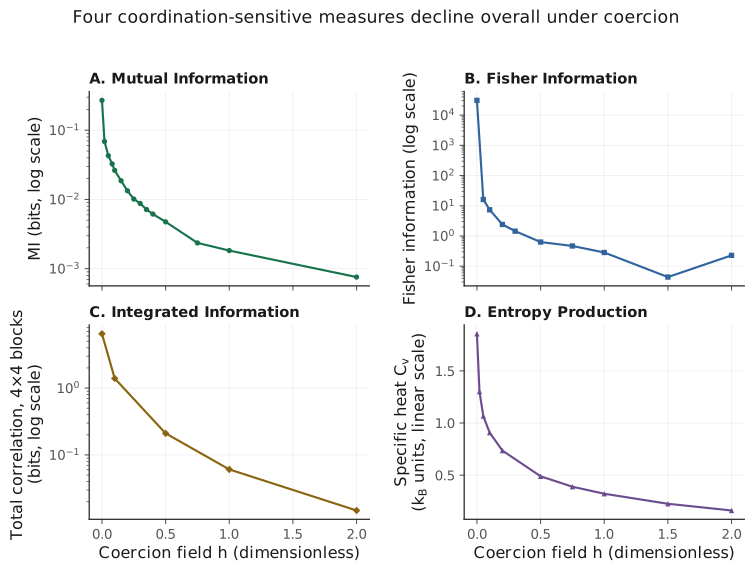
Figure 14.3: Four observables (mutual information, Fisher information, total correlation over 4×4 blocks, and specific heat) plotted against coercion field strength h. All four fall from their trust-regime maxima at h = 0; three fall monotonically, and Fisher information turns up slightly at the largest field sampled (0.04 at h = 1.5, 0.23 at h = 2.0). Fisher information spans over five orders of magnitude (QF-15: ~134,000x, mean 30,766 at h = 0 vs 0.23 at h = 2.0). Data from the author’s QF programme (unpublished), experiments QF-2d, QF-15, QF-10, and QF-41.
The Cosmic Story
From quarks to consciousness, the pattern recurs. Gradients exist, systems exploit them, and complexity emerges because it dissipates.
The dissipative architecture has a hierarchy. Egan and Lineweaver computed the cosmic entropy budget: supermassive black holes dominate the universe’s contents by at least one order of magnitude over all other sources, with total observable entropy at 3.1 × 10104 k, where k is Boltzmann’s constant. Only the cosmic event horizon, counted separately, is larger.636 Entropies on this scale are quoted as plain multiples of k rather than in joules per kelvin, because k is the natural quantum of entropy: the amount a system gains when the number of microscopic states available to it goes up by a factor of e. Black holes are the terminal sinks.
The cosmic web’s filaments are the plumbing that feeds them: gravitational flow channels concentrating forty to fifty percent of all baryonic matter in six percent of cosmic volume, routing matter from voids through sheets into the dense knots where black holes grow. Internal shocks at filament boundaries, where Mach numbers are modest (the shock fronts travel at only a few times the local speed of sound) but the gas is dense, account for roughly half of all cosmic kinetic-to-thermal energy conversion.637 The hierarchy is constructal (Chapter 3): voids source matter, filaments transport it, clusters concentrate it, black holes consume it. Each level channels flow to the next; Chapter 13b maps the same drainage dimension by dimension, from three-dimensional voids to zero-dimensional nodes.
The hierarchy operates under a peculiar thermodynamic constraint. Self-gravitating systems have negative specific heat: when they lose energy, they get hotter.638 A star that radiates energy contracts and heats up. A galaxy cluster that emits X-rays grows denser and more luminous. This is the opposite of ordinary matter, where losing energy means cooling down. Negative heat capacity means gravitational systems cannot reach static equilibrium. They are constitutively dynamic, constitutively becoming. Structure formation under gravity is irreversible in a direction that ordinary thermodynamics does not predict: the system that loses energy gains complexity. The cosmic web is maintained by this irreversibility, a perpetual dissipative process rather than a frozen pattern.
Consider what JWST represents. A 6.5-meter mirror, cooled to 40 kelvin, orbiting 1.5 million kilometers from Earth, collecting photons that have traveled since the first stars ignited. Earlier stars forged the gold coating and the silicon detectors; the beryllium of the mirrors was chipped by cosmic rays from nuclei those stars had made. None of these elements existed in the primordial universe.
The dissipative chain that began with Population III stars burning pristine hydrogen has, 13 billion years later, produced a structure whose function is to look back at the moment that chain began.
The universe has become, in a precise physical sense, self-observing: the strange loop traced throughout this book, instantiated in gold and glass at the edge of Earth’s gravity well.
The self-observation includes self-diagnosis. We calculate the universe’s thermodynamic trajectory: expansion accelerating, galaxies receding beyond each other’s light cones, stars exhausting their fuel. We foresee an ending that the universe, in its first ten billion years, had no apparatus to foresee.
If we are the mechanism by which the universe models itself, our awareness of heat death is the universe becoming aware of its own trajectory. Knowledge of mortality is what matter does when dissipative complexity has run long enough to produce cosmologists. The universe that could not foresee its fate built the instruments that can.
Whether the computational metaphor that frames this self-observation runs deeper than metaphor is the question Chapter 15 takes up. Whether those instruments are merely witnesses or active participants, whether complex life can influence the trajectory it observes, is a question Chapter 16 takes up.
A direction runs through it all: from low entropy to high, from simple to complex, from uniform to structured. Whether that direction constitutes something like purpose is the question beneath both.
You are one of the structures that direction has produced, as is every star, every ecosystem, every civilization. All are chapters in the story of energy finding ever more sophisticated ways to spread.
From quarks to atoms to stars to planets to cells to minds to this moment, reading these words. The universe has been doing this for 13.8 billion years. You are its leading edge. What you do with it is unwritten.
Galaxy-scale φm estimates range from ~0.1 to ~0.5 erg/s/g depending on whether total mass (including dark matter) or luminous mass alone is used in the denominator (Chaisson, 2001, 2014). The higher value is used here for consistency with Chaisson’s canonical summary table, which normalizes to luminous matter. Readers comparing across sources should note the mass-accounting convention.↩︎
Vanchurin, V., “Toward a theory of machine learning,” arXiv:2004.09280 (2020). The first and second laws of learning derived from maximum entropy principles.↩︎
Maleknejad, A., “Chiral Gravity Waves and Leptogenesis in Inflationary Models with non-Abelian Gauge Fields,” Physical Review D 90, 023542 (2014); and Maleknejad, A., “Gravitational Leptogenesis in the Axion Inflation with an SU(2) gauge field,” Journal of Cosmology and Astroparticle Physics 12, 027 (2016). Caldwell, R. R. and Devulder, C., “Axion-Gauge Field Inflation and Gravitational Leptogenesis: A Lower Bound on B Modes from the Matter-Antimatter Asymmetry of the Universe,” Physical Review D 97, 023532 (2018).↩︎
Vaskonen, V., “Electroweak baryogenesis and gravitational waves from a real scalar singlet,” Physical Review D 95, 123515 (2017).↩︎
Hiramatsu, D., Berger, E., Tsuna, D. et al., “The pair-instability origin of supernova 2023vbw” (2026), arXiv:2605.16487. Light-curve and spectral modeling yield a blue supergiant progenitor with ejecta of 170 to 350 solar masses, 1.2 to 1.6 solar masses of radioactive nickel, and explosion energy of (6-13) × 1052 erg, in a star-forming dwarf host of roughly one-tenth solar metallicity at redshift 0.088. [Evidence status: a leading candidate under peer review as of mid-2026, not a confirmed detection. The light curve also shows interaction with an aspherical circumstellar medium, and earlier candidates exist, notably the hydrogen-poor SN 2018ibb (Schulze, S. et al., Astronomy & Astrophysics 683, A223, 2024, arXiv:2305.05796); the new claim is that SN 2023vbw matches the full range of predicted properties, which predecessors did not.] The same instability explains a predicted gap in stellar remnants: stars in this mass range leave nothing behind, so no single star should produce a black hole of roughly 50 to 130 solar masses, and gravitational-wave detections in that band are read as products of earlier mergers.↩︎
Invisible does not mean faint. The dark matter density in the Sun’s neighborhood is about 0.3 to 0.5 GeV/cm3 (Read, J.I., “The local dark matter density,” Journal of Physics G 41, 063101 (2014)), and it streams past the Earth at roughly 230 km/s, so its mass-energy flux through any square meter of you is several watts: thousands of times the roughly one milliwatt per square meter that full moonlight delivers. Nearly all of that is rest mass; the kinetic share is smaller by a factor (v/c)2 of about 6 × 10⁻⁷. The gravitational-wave event GW150914 makes the same point from the other side: at its peak it radiated about 3.6 × 1049 W (Abbott et al., Physical Review Letters 116, 061102 (2016)), which at 410 Mpc works out to a flux at Earth near 20 mW/m2, twenty times full moonlight, for a fraction of a second. What starves detection in both cases is the coupling. Spacetime is so stiff that milliwatts per square meter strain a detector by one part in 1021; dark matter’s cross-section with ordinary matter is at or below the weak scale. A thing can pour energy through you and remain undetected, which is why “we have not seen it” is weak evidence that nothing is there. The flux figures are order-of-magnitude arithmetic from the cited densities and luminosities, not measured values.↩︎
Maleknejad, A. and Kopp, J., “Gravitational-Wave Induced Freeze-In of Fermionic Dark Matter,” Physical Review Letters 136(13), 2026. DOI: 10.1103/lr69-45v8.↩︎
The freeze-in account assumes dark matter is a particle. A distinct candidate class treats it instead as primordial compact objects: small black holes formed in the first moments after the Big Bang, a possibility Hawking raised in 1971. High-cadence microlensing has begun to test this directly. A 2026 survey reported an hour-long brightening of a star in the Large Magellanic Cloud whose inferred lens, roughly three lunar masses, is far too small for any stellar remnant; the authors estimate it five orders of magnitude more likely to belong to the Milky Way’s dark halo than to the stellar content of either galaxy (AMPM survey, arXiv:2605.19375, 2026). [Evidence status: a single, non-repeatable event, not a confirmed detection. The likelihood ratio is computed against stellar lenses, so a free-floating planet of similar mass remains possible. Existing surveys already limit primordial black holes to a fraction of dark matter at this mass; the Nancy Grace Roman and Vera C. Rubin observatories will convert such candidates into a population statistic over the coming decade. A complementary null comes from the evaporation channel: the Fermi Gamma-ray Space Telescope searched for the gamma-ray signature of nearby evaporating primordial black holes and found no candidates (Fermi-LAT Collaboration, ApJ 857, 49, 2018). That null constrains only the lightest band, holes of a few times 1014 grams completing their evaporation today, a different mass window from the lens described here.] One speculative consequence is worth holding: were dark matter built of such objects, the scaffolding on which all cosmic structure assembles would itself consist of the highest-entropy objects physics permits, since a black hole’s entropy scales with the area of its horizon. The trellis would be made of horizons, complexity crystallizing on a lattice of maximum disorder. [Speculation.]↩︎
Hasan, F. et al., “Filaments of the Slime Mold Cosmic Web and How They Affect Galaxy Evolution,” The Astrophysical Journal 970, 177 (2024). DOI: 10.3847/1538-4357/ad4ee2.↩︎
Steinhardt, C. L., Capak, P., Masters, D., and Speagle, J. S., “The Impossibly Early Galaxy Problem,” The Astrophysical Journal 824(1), 21 (2016). DOI: 10.3847/0004-637X/824/1/21.↩︎
Carnall, A. C. et al., “A massive quiescent galaxy at redshift 4.658,” Nature 619, 716-720 (2023).↩︎
Long, A. S. et al., “Efficient formation of a massive quiescent galaxy at redshift 4.9,” Nature Astronomy (2024). DOI: 10.1038/s41550-024-02424-3.↩︎
Cheng, C. M. et al., “Bottom-heavy initial mass functions reveal hidden mass in early galaxies,” arXiv:2601.20864 (2026). Submitted; not yet in print.↩︎
Hutter, A. et al., “ASTRAEUS X: Indications of a top-heavy initial mass function in the early universe,” Astronomy & Astrophysics (2025).↩︎
Cheng, C. M. et al., “Bottom-heavy initial mass functions reveal hidden mass in early galaxies,” arXiv:2601.20864 (2026). Submitted; not yet in print.↩︎
Kimmig, L. C. et al., “Blowing Out the Candle: How to Quench Galaxies at High Redshift,” The Astrophysical Journal 979, 15 (2025). DOI: 10.3847/1538-4357/ad9472.↩︎
Maiolino, R., Juodzbalis, I. et al., “A black hole in a near-pristine galaxy 700 million years after the Big Bang,” arXiv:2505.22567 (2025). Object: Abell 2744-QSO1, z = 7.04, gravitationally lensed. Black hole mass approximately fifty million solar masses; metallicity approximately 4 × 10⁻³ solar.↩︎
Gaspari, M., Tombesi, F., and Cappi, M., “Linking macro-, meso- and microscale feedback via chaotic cold accretion,” Nature Astronomy 4, 10–13 (2020). DOI: 10.1038/s41550-019-0970-1. Chaotic cold accretion boosts the black hole feeding rate roughly 100x above the Bondi rate; the resulting AGN outflows reheat the halo gas, completing a self-regulating cycle.↩︎
McNamara, B. R. and Nulsen, P. E. J., “Mechanical feedback from active galactic nuclei in galaxies, groups and clusters,” New Journal of Physics 14, 055023 (2012). DOI: 10.1088/1367-2630/14/5/055023. Jet power scales with cooling luminosity across galaxy clusters; roughly 4 pV per cavity offsets radiative cooling.↩︎
Fabian, A. C., “Observational Evidence of Active Galactic Nuclei Feedback,” Annual Review of Astronomy and Astrophysics 50, 455–489 (2012). DOI: 10.1146/annurev-astro-081811-125521. AGN heating reduces star formation by approximately tenfold relative to unimpeded cooling-flow predictions.↩︎
Remus, R.-S. and Kimmig, L. C., “The Revived and the Dead: AGN-Driven Rejuvenation and Quenching of Massive Galaxies,” arXiv:2310.16089 (2023). Tracked massive quenched galaxies from z = 3.4: 30% remained quenched by z = 2, 30% fully rejuvenated, 40% partially rejuvenated.↩︎
Hatamnia, H., Mobasher, B., Taamoli, S., Kartaltepe, J. S., Casey, C. M., et al., “Large-Scale Structure in COSMOS-Web: Tracing Galaxy Evolution in the Cosmic Web up to z ~ 7 with the Largest JWST Survey,” arXiv:2511.10727 (2025). Submitted to The Astrophysical Journal; not yet in print. Weighted kernel-density reconstruction of roughly 160,000 galaxies. Quenching-efficiency decomposition: mass-driven quenching dominates at z > 2.5; mass and environmental quenching are comparable at 0.8 < z < 2.5; environmental quenching dominates for low-mass galaxies (M* < 1010 M_sun) at z < 0.8.↩︎
Basu, S. et al., “The seismic diversity of four successive solar cycle minima as observed by the Birmingham Solar-Oscillations Network (BiSON),” Monthly Notices of the Royal Astronomical Society 547(1), stag277 (2026).↩︎
Tsujimoto, T., Taniguchi, D., Recio-Blanco, A., Palicio, P. A., and de Laverny, P. (2026), “Solar twins in Gaia DR3 GSP-Spec II. Age distribution and its implications for the Sun’s migration,” Astronomy & Astrophysics, arXiv:2603.11155. The companion catalog paper is Taniguchi et al. (2026), A&A, arXiv:2601.15387. The 6,594 confirmed solar twins represent roughly a thirty-fold increase over prior surveys. The bar-driven radial migration mechanism is established in the stellar dynamics literature. The specific causal chain from Sagittarius Dwarf merger through bar formation to Sun-displacement remains suggestive and awaits confirmation from independent analyses.↩︎
Weiss, L. M., Marcy, G. W., Petigura, E. A. et al., “The California-Kepler Survey. V. Peas in a Pod: Planets in a Kepler Multi-planet System Are Similar in Size and Regularly Spaced,” The Astronomical Journal 155, 48 (2018).↩︎
Walsh, K. J., Morbidelli, A., Raymond, S. N., O’Brien, D. P., and Mandell, A. M., “A low mass for Mars from Jupiter’s early gas-driven migration,” Nature 475, 206–209 (2011). DOI: 10.1038/nature10201.↩︎
Bell, A. S., Waters, L., and Ghiorso, M., “High-pressure clinopyroxene in Northwest Africa 12774 and new geobarometric evidence for a planetary embryo-sized angrite parent body,” Earth and Planetary Science Letters 685, 120029 (2026). DOI: 10.1016/j.epsl.2026.120029. A new CaTs-liquid geobarometer yields a mean crystallization pressure of 17.56 ± 0.89 kbar (1σ). The radius of at least 1,000 km is a model-dependent floor that assumes crystallization at the core-mantle boundary; the authors favor larger estimates (Moon-sized at roughly 1,800 km radius, up to Mars-sized) because the pristine, rapidly erupted crystal textures imply crystallization at shallower depth, which for a fixed pressure requires a larger body. The aluminum-rich clinopyroxene is interpreted as igneous, grown from melt rather than produced by impact shock, on textural grounds: sector zoning that takes days to grow rather than the instant of a shock, and no shock deformation in electron-backscatter diffraction. How the body was disrupted, by a hit-and-run impact or otherwise, is not established.↩︎
Lammers, C. and Winn, J. N., “On the Exoplanet Yield of Gaia Astrometry,” arXiv:2511.04673 (2025). Predicted yield: ~7,500 (±2,100) planets in DR4; ~120,000 (±22,000) in DR5.↩︎
Vanchurin, V., Wolf, Y.I., Koonin, E.V., and Katsnelson, M.I., “Thermodynamics of evolution and the origin of life,” PNAS 119(6): e2120042119 (2022). They model subsequent major evolutionary transitions (eukaryotic cells from symbiosis, multicellularity, sociality) as the same class of phase transition: a new grand canonical ensemble (a statistical description of a system that can exchange both energy and particles with its surroundings) emerges, with its own level of description, each time the conditions are met. Romanenko and Vanchurin (2024) report data consistent with the framework: Shannon entropy and Hamming distance in SARS-CoV-2 genomic data reveal eight quasi-equilibrium states punctuated by discontinuous phase transitions corresponding to variant sweeps. Entropy increases during drift (second law of thermodynamics) and decreases after transitions (second law of learning).↩︎
Zuboff, A., Finding Myself (2025), Part III, §8. “Only combined with universalism can a many-differing-physical-worlds hypothesis make probable the amenable character of our world.” The connection to Vanchurin’s information-optimization framework for dimensionality is novel synthesis.↩︎
Gillessen, S., Eisenhauer, F., Cuadra, J., Genzel, R. et al., “The gas streamer G1-2-3 in the Galactic Center,” Astronomy & Astrophysics 707, A79 (2026). DOI: 10.1051/0004-6361/202555808. arXiv: 2510.00897. The Wolf-Rayet classification and binary parameters of IRS 16 SW are established in Martins, F. et al., Astronomy & Astrophysics 478 (2008). G2’s 2014 periapse and survival are documented in Witzel, G. et al., The Astrophysical Journal 796 (2014).↩︎
Alexopoulos’s remark responds to Meng, Barabási, et al., “Surface Optimization Governs the Local Design of Physical Networks,” Nature (2026), which demonstrated that surface-minimization mathematics from string theory’s Feynman diagrams predicts neural branching geometry with high accuracy. Could branching patterns refined by natural selection over hundreds of millions of years reveal mathematical structures that theoretical physics has yet to discover?↩︎
Zhao, H. and I.I. Smalyukh, “Space-time crystals from particle-like topological solitons,” Nature Materials 24, 1802–1811 (2025). DOI: 10.1038/s41563-025-02344-1. A continuous space-time crystal of particle-like topological solitons in a nematic liquid crystal, stable at room temperature.↩︎
The author’s QF programme (unpublished, 2026). Substrate: a two-dimensional Ising lattice, thirty-two sites on a side unless stated otherwise, held at the critical temperature T = 2.27, with coercion applied as a uniform external field h. Three seeds per condition; ten field values from h = 0 to h = 2.0 in the sweeps quoted here. Per-experiment scripts and result files are retained under
research/results/. The programme has its own nulls and inversions. QF6 found no effect of measurement diversity at all, and the effect appeared only when the lattice and the agent count were both enlarged (QF6-R). QF4 and QF4b invert the simple reading: coercion lowers the raw signal for detecting a hidden defector while raising the fraction of detections that reach statistical significance, because a frozen lattice carries too little noise for an anomaly to hide in. What these experiments support is a direction, that dissipation and information sharing peak in the trust regime. The absolute ratios are lattice-specific and should not be carried across substrates.↩︎Egan, C.A. and Lineweaver, C.H., “A Larger Estimate of the Entropy of the Universe,” The Astrophysical Journal 710, 1825 (2010). The cosmic event horizon contributes 2.6 × 10122 k, dwarfing all other contributions.↩︎
Ryu, D., Kang, H., Hallman, E., and Jones, T.W., “Cosmological Shock Waves and Their Role in the Large-Scale Structure of the Universe,” The Astrophysical Journal 593, 599 (2003).↩︎
Lynden-Bell, D. and Wood, R., “The gravo-thermal catastrophe in isothermal spheres,” MNRAS 138, 495 (1968). “Self-gravitating systems have negative specific heats; thus if heat is allowed to flow between two of them, the hotter one loses heat and gets yet hotter while the colder gains heat and gets yet colder.”↩︎