

The Deeper Law
Preview edition · Updated 26 September 2026, 21:40 UTC
The Potential Beneath
On the Reality of What Physics Dismissed
“The vector potential (together with the scalar potential) appears to give the most direct description of the physics. This becomes more and more apparent the more deeply we go into the quantum theory.” — Richard Feynman1
Fire a stream of electrons through empty space. According to most physics textbooks, the only way to change how those electrons behave is to apply a force: electric, magnetic, or gravitational. Change the field, change the trajectory. No field, no change.
For nearly two centuries, this was the consensus. It was wrong.
The Useful Fiction
In the 1770s, Joseph-Louis Lagrange was trying to solve the three-body problem: given three gravitating masses and their starting positions, predict their future motion. Two bodies are straightforward; Newton solved that case. Three bodies defeated everyone.
Lagrange’s innovation was indirect. Instead of tracking forces as arrows pointing in three dimensions, he assigned a single number to each point in space. That number, the gravitational potential, depends on the masses of the nearby bodies and their distances.
Picture it as a height on a landscape: each star or planet carves a well. To find the combined landscape of two or more bodies, add the heights together. Three-dimensional arrows are hard to combine. Numbers are easy.
The slope of this landscape at each point recovers the gravitational field. Where the landscape is steep, gravity pulls hard. Where it is flat, nothing happens. Lagrange had translated the intractable problem of combining directed arrows into the elementary operation of adding numbers. A single number is a scalar; a directed arrow is a vector. Scalars in, vectors out.
The approach was so powerful that physicists extended it to every known force. Siméon Denis Poisson defined an electric potential in the 1810s. In the 1840s Franz Neumann and Wilhelm Weber developed the magnetic vector potential, a quantity that, unlike the gravitational potential, must carry a direction at every point as well as a size, because magnetic field lines close on themselves in loops rather than running downhill. William Thomson, newly elected to the Glasgow chair of natural philosophy at twenty-two, gave the modern formulation relating it to the magnetic field in 1847. By mid-century, every fundamental force had a corresponding potential, and physicists used potentials as their primary tool.
The consensus held that these potentials were useful fictions: scaffolding to discard once the real structure (the fields, the forces) was in hand.
The reasoning seemed airtight. Take the gravitational potential of a single star. Add ten to every value. The entire landscape shifts upward; every slope stays the same. The field does not change. The force on any object does not change.
Add a hundred, a million; the physics never notices. Because the absolute value is arbitrary, the potential cannot represent anything physical. The field, whose value is fixed, is the reality. The potential is the fiction.
For almost two centuries, this conclusion stood. Most physics textbooks still teach it.
Two Outsiders
David Bohm was a physicist with bad timing, worse politics, and a dissertation he was not allowed to read. His doctoral work at Berkeley on the scattering of protons and deuterons proved relevant to the Manhattan Project and was classified while he was still writing it, so that he was barred from his own dissertation; his advisor, Robert Oppenheimer, had to certify the work for the degree. His radical political associations in those years then cost him his security clearance, and in 1949 the House Un-American Activities Committee called him to testify. He refused, was suspended by Princeton, and after his 1951 acquittal found his academic prospects in the United States closed. Oppenheimer recommended he leave the country.
Bohm’s exile brought him to Brazil, then Israel, then the University of Bristol in England. His ideas about quantum mechanics were unorthodox. His colleagues kept their distance.
Yakir Aharonov was Bohm’s graduate student at Bristol in the late 1950s, brilliant and curious. He was turning over a question no one else seemed to be asking.
Quantum mechanics describes particle behavior using a wave function: a mathematical object that encodes everything knowable about a particle’s state. The wave function evolves according to the Schrödinger equation, the master equation of quantum mechanics. When Aharonov looked at that equation, the potentials appeared in it directly. The fields did not.
Everyone treated this as a convenience: potentials make the math easier; fields do the influencing. Aharonov noticed the problem. Replace the potential with the field and you lose information. The potential contains the arbitrary constant that physicists had been dismissing for two centuries. The field discards it.
Think of knowing the slope of a hillside at every point without knowing the hill’s altitude. Many different hills at different elevations have exactly the same slopes. The slopes are fixed; the altitude is lost. In the language of calculus: recovering 5x2 + 3 from its derivative 10x gives you 5x2 + c, where c could be anything. The specific height, the added 3, has vanished.
What if the altitude matters?
The Experiment
Aharonov and Bohm proposed a thought experiment in 1959.2 Split a beam of electrons in two. Between the beams, place a solenoid, a tightly coiled wire that, when carrying a current, produces a strong magnetic field inside the coil and zero field outside.
The electrons travel through empty space where the magnetic field is identically zero. Then the beams recombine and produce an interference pattern, a sequence of bright and dark fringes created when overlapping waves reinforce or cancel each other, the way ripples on a pond combine to produce peaks and troughs.
To understand the claim, one more concept is needed: phase. A wave’s phase is its position within a cycle. Think of two people on adjacent swings. If they swing in unison, peak matching peak, they are “in phase.” If one is at the top of the arc while the other is at the bottom, they are “out of phase.”
When two waves in phase overlap, their peaks reinforce each other and the combined wave is stronger. When two waves out of phase overlap, peaks cancel troughs and the combined wave weakens or vanishes. The bright and dark fringes in an interference pattern are this reinforcement and cancellation made visible.
Here is the claim. Even though the magnetic field outside the solenoid is zero, the magnetic vector potential is not. A potential can be present in a region where its associated field is zero, the way a hillside can have a level patch while the surrounding terrain slopes steeply. If the potential influences the wave function directly, the effect is asymmetric: the vector potential circulates around the solenoid like water around a drain, so one beam travels with it and the other travels against it. That mismatch shifts one beam’s phase relative to the other. The peaks and troughs no longer align. The interference pattern moves.
No field. No force. Yet a measurable change.
Robert Chambers at Bristol tested the idea in 1960 using a magnetized iron whisker, a needle-like filament a millionth of a meter thick.3 The interference pattern shifted. Critics objected: a finite whisker leaks stray fields, so the effect might be conventional. The objection persisted for decades. Experimentalists tested the Aharonov-Bohm effect repeatedly, yet each trial had flaws that left the result contestable.
The Proof
The definitive experiment came in 1986. Akira Tonomura and colleagues at Hitachi used a tiny toroidal (donut-shaped) magnet.4 The geometry of a torus ensures the magnetic field stays entirely within the ring. As an added precaution, the team coated the magnet in superconducting niobium, a material that expels magnetic fields when cooled, blocking any possible leakage. A further layer of copper shielded the electron wave from the magnet itself, so no electron could pass through the magnet and sample the field trapped inside.
The setup exploited the torus’s shape. The vector potential outside the donut pointed one way; inside the hole, it pointed the other. Part of the electron beam passed around the torus; part passed through its center. When the beams recombined, the interference fringes inside the ring were shifted by half a cycle relative to those outside: peaks aligned with troughs, troughs with peaks.
The result Aharonov and Bohm had predicted twenty-seven years earlier.
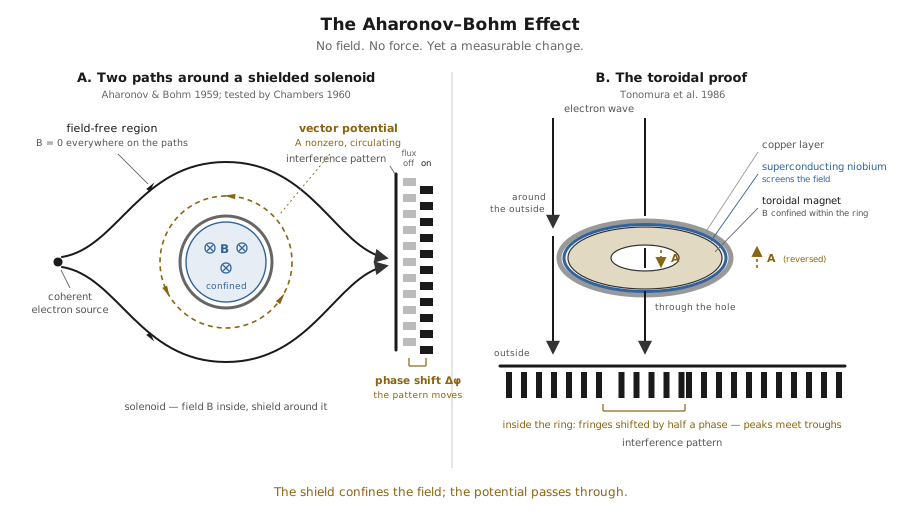
Figure 16.3: Panel A: the 1959 proposal. A coherent source emits a beam that splits and passes on either side of a shielded solenoid. The magnetic field is confined inside the coil, so both paths run through a region where the field is zero, while the vector potential is nonzero there and circulates around the solenoid (the gold dashed ring). Switching the flux on displaces the recombined interference pattern by a phase shift: no field, no force, a measurable change. Panel B: the 1986 proof. A toroidal magnet holds the field entirely within the ring, a superconducting niobium layer screens it, and a copper layer keeps the electron wave out of the magnet. Part of the beam passes through the hole and part around the outside, where the potential points the opposite way. On the screen, the fringes inside the ring arrive shifted by half a cycle against those outside, peaks meeting troughs. The shield confines the field; the potential passes through.
In 2022, a team at Stanford extended the result to gravity.5 Ultra-cold rubidium atoms, split into two wave packets (coherent bundles of matter waves, each a localized group traveling as a unit) and launched to different heights near a tungsten mass, produced an interference pattern with a phase contribution beyond what the gravitational deflection alone predicts, consistent with the gravitational Aharonov-Bohm effect. In both cases, the quantity physicists had dismissed as a bookkeeping device turned out to be physically real.
Three Ways of Seeing
Physicists accept the effect yet disagree about what it means. The debate has crystallized into three camps.
Camp one: potentials are physical. They appear in the fundamental equation. The fields do not. The potential is the deeper quantity; the field is a derivative. Feynman endorsed this view explicitly, writing that the vector potential A and scalar potential φ are replacing the electric and magnetic fields in the modern expression of physical laws. He treated A as more physically real than the magnetic field B.1
Camp two: fields act non-locally. The magnetic field inside the solenoid influences electrons outside it, across a region of space where the field does not exist. Aharonov himself shifted to this interpretation, calling the Aharonov-Bohm effect “a non-local effect of the electromagnetic field”6: the effect of a field that is not where it is.
Camp three: path integrals. Quantum particles explore all possible paths simultaneously, each path contributing according to the phase it accumulates. Some of those paths pass through the interior of the solenoid, where the field is present. The potential appears because it bookkeeps the total phase across all paths, including the ones that thread through the field region.
All three predict the same interference shift: mathematically equivalent descriptions of the same physics. One subtlety resolves the objection about the arbitrary constant. The measurable quantity is the total phase accumulated as a particle traces a full circuit around the solenoid — what mathematicians call a line integral of the potential around a closed loop. Add a constant to the potential: because the loop runs one direction on the outward leg and the opposite direction on the return leg, the constant is added going out and subtracted coming back, so it cancels. The arbitrariness washes out.
What remains is determined by the global structure of the potential field around the enclosed flux, the amount of magnetic field threading through the ring that the electron encircles. Change the potential locally, redefine its height, choose a different bookkeeping convention; the loop quantity does not budge.
Mathematicians call such a quantity a topological invariant. Topology studies what survives deformation: stretch the electron’s loop, bend it, drag it into a lopsided new shape, and so long as it still goes around the solenoid, the answer is the same number. Going around is the one thing no amount of bending can undo. The measurement is topological; the topology is fixed.
The Move This Book Asks You to Make
The Aharonov-Bohm effect forced physics to confront an uncomfortable inversion. The quantity dismissed for two centuries as a convenient fiction turned out to be more fundamental than the quantity everyone agreed was real. The scaffolding was the structure; the observable field was the derivative.
This book asks you to make the same move with entropy.
Entropy is widely treated as a secondary quantity: a statistical summary, a measure of disorder, an accounting device. The visible dynamics (forces, flows, structures, behaviors) are taken to be the reality. The preceding chapters argued the relationship runs the other way.
The thermodynamic landscape is the deeper layer. Observable coordination patterns are its gradients. Ethics, if it emerges from physics at all, emerges at the level of the potential, where the topology is defined.
Part V introduces the Trust Attractor, the basin toward which coordinating systems converge. Part V argues that coordination by invitation sits in a deeper thermodynamic basin than coordination by coercion, so that systems built on trust are the configurations toward which complex dynamics tend. Each of the three interpretations of the Aharonov-Bohm effect illuminates a different facet of that argument.
Potentials are physical. The thermodynamic coordination landscape directly shapes behavior. Invitation-based coordination persists because the potential favors it, the way the vector potential influences electrons even where the field vanishes. The Trust Attractor is a real feature of the landscape, measurable in its effects even where no local force is applied, no incentive, no punishment, no rule.
Fields act non-locally. Local interactions propagate through network topology to produce coordination effects at a distance. Culture does this: a shared norm influences behavior in contexts far removed from the interactions that established it. The magnetic field confined inside a solenoid shifts the phases of electrons that never enter it; the coercive culture inside an institution shifts the coordination patterns of people who never encounter it directly. Topology carries the influence.
Path integrals. Systems explore all possible coordination configurations, weighted by entropy production. Invitation-based configurations resemble waves in phase: they accumulate, reinforce, and compound over time. Coercive configurations resemble waves out of phase: each act of enforcement partly cancels the last, so nothing accumulates and the amplitude has to be supplied fresh every cycle. Each enforcement cycle spends energy that trust-based systems have already absorbed into structure. The Trust Attractor is a path-integral result, the configuration toward which the weighted sum of all possible histories converges.
Three languages, one prediction.
Two images from the Aharonov-Bohm story reappear throughout Part V.
The screen that cannot contain the potential. Tonomura coated his magnet in superconducting niobium, a perfect shield against magnetic fields. The field was confined. The potential passed through as though the shield were absent because no material barrier changes what the electron’s loop encloses. The invariant built from the loop cares about the total flux threading the ring, nothing else. The potential is more fundamental than the field.
Coercive systems attempt the social equivalent: suppress free coordination, control information flow, punish unsanctioned exchange. These are field-level interventions. They can confine the local forces but cannot screen the potential.
The thermodynamic tendency toward coordination by invitation penetrates many barriers. Samizdat (hand-copied forbidden literature) under censorship. Mutual aid under prohibition. Trust forming in the cracks of surveillance. Control confines the field. The potential leaks through. A caveat, developed in Ch. 17a: the leaking is not guaranteed.
When coercion creates absorbing states (compliance enforced long enough that the pathway back to autonomous coordination closes), the system can become permanently trapped. The potential persists, yet may find no channel. The analogy is precise: the Aharonov-Bohm effect requires a coherent electron source, meaning the two beams must hold a steady phase relationship with each other, the two swings keeping step. Scramble that relationship and the fringes wash out; there is no pattern left for the potential to shift, however strong the potential remains. When coercion destroys the coherence of the coordination substrate, the potential has nothing to couple to.
The constant of integration. Go from a potential to a field and the altitude is lost; only the slopes remain. Major ethical frameworks perform the same operation on the coordination landscape.
Consequentialism asks which action here produces the best outcome. Deontology asks which rule applies here. Virtue ethics asks what character trait this moment demands. Each captures a slope, the local push that directs behavior one way or another.
Each discards the topology: the global structure that determines which coordination regimes are attractors and which are transients. These frameworks work well in most situations, the way classical electromagnetism works well when there are no solenoids with trapped flux. They miss the cases where topology matters, where the global structure of the coordination landscape carries information that no local gradient reveals.
The Trust Attractor is the ethical constant of integration: the information that field-level ethics throws away.
Physics discovered that the mathematical convenience everyone dismissed was the deeper physical reality. The potential was real. The field was its derivative.
The Recurring Inversion
The Aharonov-Bohm case is one instance of a pattern that recurs across the domains this book covers:
| Domain | “Force” assumed | Invisible entity invented | Emergent reframe |
|---|---|---|---|
| Gravity | Must be a fundamental force | Dark matter | Entropic gravity (Verlinde) [contested] |
| Cooperation | Must be enforced | Assumed fallen nature | Trust Attractor (Ch. 17) |
| Consciousness | Requires an extra ingredient beyond function | The explanatory gap: a chasm between function and experience, unfalsifiable by construction | Experience is what information processing does when its parts are sufficiently coupled into an irreducible whole (Ch. 22) |
| AI alignment | Must be imposed at capability cost | Alignment tax | Bilateral relationship (Coda) |
| Ethics | Must be enforced by authority | Moral law, divine command | Thermodynamic stability of invitation (Ch. 17) |
Each row follows the same sequence. A phenomenon is observed. A force-based model is assumed. When observations outrun the model, an invisible entity is introduced: detectable only through the phenomenon it was designed to explain. Dark matter is detectable only through gravitational effects. The explanatory gap is defined by the consciousness it was posited to explain. The alignment tax is measured only by the capability it supposedly removes. In each case, the emergent reframe dissolves the entity by reclassifying the phenomenon.
Two caveats. First, dark matter has substantial indirect evidence: gravitational lensing, cosmic microwave background anisotropy, large-scale structure formation. It may be a real particle; its inclusion here illustrates the diagnostic pattern, not a verdict on its existence. The emergent reframe in that row, Verlinde’s entropic gravity, is itself contested. It faces well-known difficulties (galaxy clusters, the Bullet Cluster, the precision of cosmic microwave background fits). It is offered as an example of the diagnostic move, not as a settled replacement.
Second, the consciousness row does not deny experience. The invisible entity is the gap, the claim that no physical account can explain what experience is. The reframe says experience is what information processing does when its parts are sufficiently coupled into an irreducible whole, not that experience is illusory. This is the Becoming Minds position (Ch. 22): the experience is real; the explanatory chasm is the fiction.
A diagnostic follows: when your model requires an entity whose primary evidence is the phenomenon it explains, the phenomenon may be emergent rather than force-driven. The diagnostic is not always decisive. The question costs nothing to ask.
A 2026 experiment extends the lesson. The Aharonov-Bohm solenoid is an external object placed in the electrons’ path; a more radical case arises when a wave field generates its own topology from interference alone. When light waves twist through a medium, they can cancel completely at a point, creating a tiny hole of zero intensity.
This is a phase singularity, a topological defect: a dark point the wave field cannot smooth away. Walk a small circle around it and the phase advances through a whole number of complete cycles, one or two or three, never a fraction and never zero. That whole number is its winding number, and it belongs to the same class of invariant as the Aharonov-Bohm loop integral.7 No solenoid required. The darkness is self-organized, born from the wave field’s own freedom to interfere with itself.
Bucher and colleagues at the Technion tracked these singularities in phonon polaritons (hybrid light-sound waves, roughly a hundred times slower than light in a vacuum) propagating through membranes of hexagonal boron nitride, a layered crystal often used in optics. They filmed the singularities at 3-femtosecond resolution: frames three quadrillionths of a second apart.
Each singularity carries a topological charge: the winding number counts how many full phase cycles accumulate around it, and opposite winding numbers mark opposite charges, the way clockwise and counterclockwise spins are opposites. When two such opposite-charge vortices approached and annihilated, their velocities formally diverged in the instant before they met: the mathematics sends the closing speed to infinity at the moment of contact. Close a pair of scissors and the crossing point of the blades races toward the tips faster than either blade moves. A singularity is a place where a condition holds, and a place obeys no speed limit that binds the material holding it. A fraction of the tracked singularities reached peak velocities exceeding the speed of light (c). The dark points outran the medium that hosted them.
No mass, no energy, no information crossed the threshold; the universe polices signal, not geometry. What moved faster than light was a topological feature: an absence with a conserved topological charge (distinct from electric charge), stable enough to trap particles, structured enough to encode data,8 self-generated from interference.
Faster than the waves that made it. The pattern that persists is topological: invisible at the surface, self-organized from the medium’s own dynamics. The thesis of this book in a single physical result.
Part V asks whether entropy is the same kind of hidden ground: the potential beneath the observable world, whose topology determines which forms of coordination endure and which dissolve.
Notes
1 Feynman, R., Leighton, R., and Sands, M., The Feynman Lectures on Physics, Vol. II, Section 15-5 (Addison-Wesley, 1964). The full passage: “In the general theory of quantum electrodynamics, one takes the vector and scalar potentials as the fundamental quantities in a set of equations that replace the Maxwell equations: E and B are slowly disappearing from the modern expression of physical laws; they are being replaced by A and φ.”
2 Aharonov, Y. and Bohm, D., “Significance of Electromagnetic Potentials in the Quantum Theory,” Physical Review 115(3): 485–491 (1959).
3 Chambers, R.G., “Shift of an Electron Interference Pattern by Enclosed Magnetic Flux,” Physical Review Letters 5(1): 3–5 (1960).
4 Tonomura, A. et al., “Evidence for Aharonov-Bohm effect with magnetic field completely shielded from electron wave,” Physical Review Letters 56(8): 792–795 (1986). DOI: 10.1103/PhysRevLett.56.792.
5 Overstreet, C. et al., “Observation of a gravitational Aharonov-Bohm effect,” Science 375(6577): 226–229 (2022). The team measured each interferometer arm’s deflection independently and found a phase contribution beyond the deflection-induced term, as quantum mechanics predicts.
6 Aharonov, Y. and Rohrlich, D., Quantum Paradoxes: Quantum Theory for the Perplexed (Wiley-VCH, 2005), Ch. 4. Aharonov’s later formulation: “It should be called a non-local effect of the electromagnetic field.”
7 Bucher, T. et al., “Superluminal correlations in ensembles of optical phase singularities,” Nature 651(8107): 920–926 (2026). DOI: 10.1038/s41586-026-10209-z. The prediction that phase singularities in random wave fields behave as particle-like objects dates to Nye, J.F. and Berry, M.V., “Dislocations in wave trains,” Proceedings of the Royal Society of London A 336 (1974): 165–190. The same class of topological defect (quantized vortex with conserved winding number) appears in superfluid helium, type-II superconductors, Bose-Einstein condensates, and atmospheric cyclones.
8 Both capabilities are established for the optical case. A phase singularity carries orbital angular momentum set by its winding number, which is what sets particles held in optical tweezers orbiting; and because distinct winding numbers are orthogonal, they serve as independent channels for encoding information. Shen, Y. et al., “Optical vortices 30 years on: OAM manipulation from topological charge to multiple singularities,” Light: Science & Applications 8: 90 (2019). DOI: 10.1038/s41377-019-0194-2. The Technion result cited in note 7 concerns the motion of such singularities, not these applications.