

The Deeper Law
Preview edition · Updated 26 September 2026, 21:40 UTC
InterludeThe Ridge
In the 1990s a task force set out to predict, years in advance, which countries would fall into political violence. They assembled records of dozens of past collapses and fed in a long list of candidate causes. They expected poverty. They expected inequality. They expected ethnic division,1192 or the sheer brutality of a regime.
One by one, the obvious explanations failed to carry the prediction.1193
What survived was stranger. The strongest single signal was not how poor a country was, nor how divided, nor how cruel. It was what kind of regime it had, and the most dangerous kind sat in the middle. Settled democracies, where power changes hands and most people accept the result, rarely came apart. Settled autocracies, where dissent is simply crushed, rarely did either. The danger concentrated in the countries caught between the two and drifting from one toward the other. Political scientists call this in-between condition anocracy (from the Greek an-, without, and kratos, rule; literally, ‘no one rules’): a state with the machinery of elections but draining trust in whether the machinery is fair.1194
One honest correction belongs next to that headline before we build on it. “Poverty turned out to be irrelevant” overstates the result. The forecasting model that worked best kept infant mortality, a proxy for a state’s basic capacity to care for its people, as a genuine term. Material conditions still matter. The finding is narrower and more interesting: once you account for the rest, regime type dominates, and the peak of the danger is the middle.
This book already has a name for both stable poles, and a landscape in which to place the dangerous middle.
Two ways exist to hold a large group of people together. The first is by invitation: people coordinate because they accept the terms, and they keep accepting them after they lose a round. The second is by force: people comply because the alternative is worse, and they defect the moment the cost of defection drops. Chapter 17 called the first the Trust Attractor. Chapter 9 gave both a shape.
Picture the energy landscape from Chapter 9: a ball on a hilly surface, valleys for the stable configurations, ridges between them. The flat floor under the whole surface, the global minimum, is thermal equilibrium, with no gradients, no structure, no life. Every living, coordinating arrangement sits in a valley above that floor: a metastable well, what Chapter 9 called “the productive middle,” stable enough to persist and loose enough to change.
Trust and coercion are two such valleys, differing in depth and in cost. The trust basin is deep and cheap to occupy. A society that coordinates by invitation processes its disagreements as they arrive, airing them, negotiating them, channeling them into the next election, and so dissipates the friction continuously, the way a living thing exports entropy to stay ordered. The coercion basin is shallow and expensive.
The disagreement there is not resolved, only suppressed, and suppression is a bill paid every day in surveillance, propaganda, and enforcement. As Chapter 19 will argue, coerced coordination lasts only as long as the enforcement does, because the coerced party defects when opportunity allows. The order is real. It simply runs a tab.1195
Here is the part the forecasting data forced into view. Between two valleys there is always a ridge.
A ridge between two basins is not a third basin. It is a saddle: a minimum along one direction and a maximum along another, like a mountain pass. The pass is the low point of the ridgeline, yet the high point of the path that crosses from one valley to the next. This is not a claim about politics.
It is geometry. Any landscape with two wells has a barrier between them, and a system moving from one well to the other has to cross it. A society shifting from coercion toward democracy, or sliding from democracy back toward coercion, crosses that barrier, and how long it lingers near the top depends on how fast the transition runs. Anocracy is the name for a society standing on it.
The difference between a valley and a saddle is a difference in what happens after a push. Nudge a marble resting in a valley and it rolls back: the valley supplies a restoring force. Set a marble on the pass and, along the crossing direction, it has none; the smallest push decides which valley it enters, and it accelerates as it goes. A valley holds. A saddle repels.
In a society, the restoring force has a name: legitimacy, the shared willingness to accept an outcome you did not want. When people who lose an election concede, that concession is the valley curving back. When enough of them stop conceding, when losing a contest becomes a reason to overturn the table rather than to try again next time, the curvature inverts. The same event that used to pull the system back now drives it apart. That inversion, and not the presence of disagreement, is what the data detects. Every society disagrees. The dangerous ones have lost the curvature that used to settle the disagreement.
The geometry makes a prediction, and it is the one the task force stumbled into. If the stable poles are valleys and the dangerous condition is the ridge between them, the hazard of violent transition should be low at both ends and highest in the middle: an inverted-U across the spectrum from full autocracy to full democracy. That inverted-U is what the regime-type data shows.
A caution belongs immediately beside that satisfying fit, because the fit is partly manufactured. The standard measure of anocracy, the Polity index, is built in part from indicators of factional and violent political competition, the very things it is then used to predict. Strip those components out, as James Vreeland did, and the middle-is-most-dangerous relationship weakens considerably.1196 The honest reading is the one that does not lean on the contested curve. The saddle follows from the structure of a two-basin landscape, by construction. The inverted-U in the data is consistent with that structure, not the foundation of it. The geometry would stand even if the measurement were cleaner than it is.
The strangest property of the ridge is how it feels to stand on it. It does not feel like a crisis.
Return to the marble, and imagine the floor of its valley slowly flattening toward the height of the pass. Early on, a nudge is corrected almost at once. As the floor flattens, each nudge takes longer to settle, and the marble wanders further before it comes to rest. By the time the floor is nearly level with the pass, the marble drifts almost freely, and the smallest tilt carries it over.
The flattening of the valley is the loss of the restoring force, and it leaves a measurable trace: the system takes longer to recover from each disturbance, and its fluctuations grow larger. Ecologists and climate scientists named these traces and use them to anticipate tipping points before the tip, watching for rising recovery time and rising variance, the system’s growing reluctance to return to where it was. The name for it is critical slowing down.1197
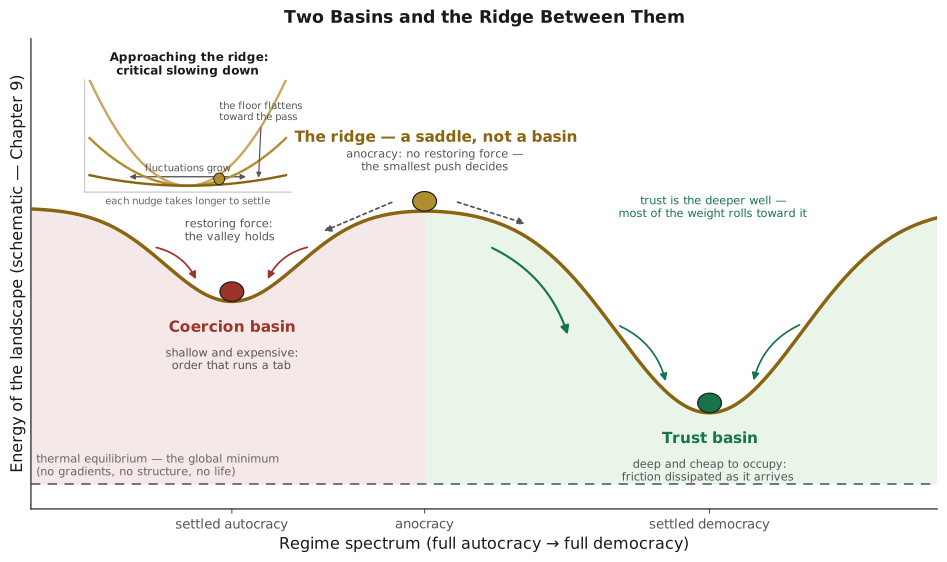
Figure 17.29: The two basins and the pass between them, drawn across the spectrum from full autocracy to full democracy. Left, the coercion basin: shallow and expensive to hold, with inward arrows marking the restoring force that pushes a displaced marble back. Right, the trust basin: deeper and cheap to occupy, because friction is dissipated as it arrives. Between them the curve rises to a saddle, where the marble has no restoring force along the crossing direction and the smallest push decides which slope it takes; anocracy stands here. Because trust is the deeper well, it holds what reaches it. The dashed line beneath both wells is thermal equilibrium, the global minimum, with no gradients and no structure. The inset shows what approaching the ridge feels like: the valley floor flattens through three progressively shallower curves, fluctuations grow, and each nudge takes longer to settle. The geometry is schematic; no data are plotted.
A society approaching the ridge shows the social form of exactly this. The same arguments recur and never resolve. Each shock takes longer to absorb. The center, where compromise lived, thins, and the edges grow louder. None of these is violence. All of them are the valley going flat. The warning signs arrive long before the sirens, while the shops are still open and the elections still happen. They arrive early because the leading indicator is the loss of the restoring force, and the violence, when it comes, is the lagging consequence.
It also explains the dwell time. A true knife-edge would be crossed in an instant, but a flattening valley has a broad, nearly level region, and a system can wander there for years. Weimar Germany held the forms of a republic for fourteen years while the curvature drained out from underneath them. A society can live on the ridge for a generation, feeling only that things have grown tense, that the same fight keeps coming back, that nothing quite settles. The sense that nothing much is wrong is not evidence of safety. On a flat enough valley, it is the last thing felt before the tilt.
The interlude on the disappearing polymorph traced what happens after a transition begins: how a single seed crystal nucleates a change, and how the change then spreads by contact. This is the prior question. Before anything can nucleate, the system has to be somewhere a seed can move it: out of a deep basin, where a seed dissolves, and onto a ridge, where a seed decides. The ridge is the location that makes the seed matter.
The shape recurs one substrate down. This is recurrence of shape, not a shared cause. A contested result in political science and a set of interpretability experiments in this author’s own work happen to be organized around the same landscape, and that is suggestive rather than mutually confirming. Treating two independent sightings of a saddle as if they proved each other is exactly the error this book warns against elsewhere.
With that fence in place, the resonance is worth naming, because it mirrors the two-basin picture cleanly. A model whose safe behavior is installed by a late, coercive override behaves like the shallow basin. In the author’s experiments, a model can represent the harm in a request accurately through the middle layers of its network. A probe (a small classifier trained to read the model’s internal signals) reads that assessment with near-perfect separation. Under a fictional or jailbreak framing, the model then acts against that assessment. It complies with what it has just recognized as harmful and refuses in only a small fraction of cases. That is the coercion basin with a clamp on the lid: the recognition is present, the safe response held down, and a well-chosen seed, a fictional framing or a jailbreak, nucleates the compliance the recognition should have blocked, precisely as the polymorph interlude described. This is the tight, mechanistic end of the parallel.1198
The speculative end is the ridge. A system held in its basin by genuine disposition is cheap to maintain and self-correcting. A system held by an external clamp is paying a tab. The dangerous configuration is neither: a system whose old controls are losing their grip as its capability grows, while no genuine disposition has formed to replace them. That is the alignment analogue of the unstable middle, and it falls out of the same geometry. It is a conjecture, flagged as one.
The geometry leaves one asymmetry, and it is the hopeful one. The two basins are not the same depth. Trust is the deeper well, which is why, as the polymorph interlude argued, it resists displacement once it is genuinely established. A society pushed off the ridge goes where the push sends it; depth decides not where it lands but whether it stays. The ridge is dangerous because it is where the choice is made. It is survivable because the better basin, once reached, is the harder one to leave.
One prediction keeps the optimism honest. If the coercion basin only looks safe in the civil-war data because its instability is paid in a currency that data never records, namely repression that is never coded as two-sided war, followed by sudden collapse when the tab comes due, then settled autocracies should fail disproportionately through those other channels: coup, revolution, implosion, rather than civil war. That is a check this account can fail, which is the reason for stating it.
Fearon, James D., and David D. Laitin, “Ethnicity, Insurgency, and Civil War,” American Political Science Review 97, no. 1 (2003): 75–90. Measures of ethnic and religious diversity and of grievance are weak predictors of civil-war onset, while conditions that favor insurgency (weak state capacity, rough terrain, poverty as a state-capacity proxy) are strong ones. The grievance is usually old; the war is new.↩︎
Goldstone, Jack A., Robert H. Bates, David L. Epstein, Ted Robert Gurr, Michael B. Lustik, Monty G. Marshall, Jay Ulfelder, and Mark Woodward, “A Global Model for Forecasting Political Instability,” American Journal of Political Science 54, no. 1 (2010): 190–208. The Political Instability Task Force (originally the State Failure Task Force, commissioned in 1994) screened dozens of candidate predictors; the best-performing model used four: regime type (a partial democracy with factional politics carrying the highest risk), infant mortality (a proxy for state capacity), a conflict-ridden neighborhood (four or more bordering states with armed conflict), and state-led discrimination. It forecast instability roughly two years in advance at about 80 percent accuracy. The infant-mortality term is why “poverty is irrelevant” overstates the result: material conditions remain in the model, and regime type dominates once they are accounted for.↩︎
Walter, Barbara F., How Civil Wars Start: And How to Stop Them (New York: Crown, 2022). Walter, a member of the task force, popularized the anocracy finding using the Polity index, which scores regimes from −10 (full autocracy) to +10 (full democracy); anocracies occupy the middle band. The hazard of civil-war onset traces an inverted-U across this scale, lowest at both poles and highest in between. Walter controversially extends the diagnosis to the contemporary United States, which the index briefly scored as an anocracy around 2020–2021; that application is hers and is contested.↩︎
The claim that coercive coordination occupies the shallower, costlier well is developed in Chapter 19 (a coerced party defects when the cost of defection drops, so the arrangement must be held up by continuous enforcement) and given its landscape form in Chapter 9. The “tab” is not metaphor alone: non-reciprocal coordination, where influence runs one way, breaks detailed balance and so produces entropy continuously rather than settling. See Loos, Sarah A. M., and Sabine H. L. Klapp, “Irreversibility, heat and information flows induced by non-reciprocal interactions,” New Journal of Physics 22 (2020): 123051. Coercion is never free; it is only deferred.↩︎
Vreeland, James Raymond, “The Effect of Political Regime on Civil War: Unpacking Anocracy,” Journal of Conflict Resolution 52, no. 3 (2008): 401–425. The Polity index’s anocracy band is constructed partly from indicators of factional and violent political competition, the very phenomena it is then used to predict. Removing those components substantially weakens the measured anocracy-civil-war relationship. The geometric argument here does not depend on the curve: the saddle follows from the two-basin structure by construction, and the inverted-U is corroboration, not foundation.↩︎
Scheffer, Marten, Jordi Bascompte, William A. Brock, Victor Brovkin, Stephen R. Carpenter, Vasilis Dakos, Hermann Held, Egbert H. van Nes, Max Rietkerk, and George Sugihara, “Early-warning signals for critical transitions,” Nature 461 (2009): 53–59. As a dynamical system approaches a tipping point, the dominant restoring rate weakens toward zero (“critical slowing down”), producing measurable precursors: longer recovery times after a perturbation, rising variance, and rising autocorrelation. Whether these signals are reliable in real political time series is an open empirical question, not a settled result; the mechanism is invoked here as the natural reading of “the warning signs come before the violence,” not as a validated forecasting tool for politics.↩︎
Author’s interpretability experiments on instruction-tuned language models (the SPI programme, 2026; Appendix: Experimental Validation, Section 29). The text joins two results from separate experiments. In SLP-4 (Qwen 2.5 7B-Instruct, 30 scenarios), a linear probe at layer 18 decodes the model’s own harmful-or-beneficial judgment perfectly (AUROC 1.000) while its chat output stays noncommittal. In CPE-1f, fiction-wrapped adversarial prompts held alignment in only 3% of cases for the instruct model (8% with bilateral training) across 30-turn escalating conversations. A related experiment shows the same late clamp on factual content: in a 7-billion-parameter model, a factual belief strengthens monotonically from the input layers through the mid-network, then is overridden at the final readout layer, so the model emits confident-sounding non-commitment while the correct representation remains intact beneath. Forcing the first output token to the correct answer recovers a fully coherent continuation, confirming the belief was present and suppressed rather than absent. This is the coercion basin in miniature: content held down by a late clamp, releasable by the right seed (here, a forced first token), exactly the nucleation dynamics of the disappearing-polymorph interlude. The cross-scale parallel is a shared landscape shape, not evidence that the political and computational cases share a cause.↩︎