

The Deeper Law
Preview edition · Updated 26 September 2026, 21:40 UTC
Chapter 19By Invitation, Not Coercion
Centralized control faces mathematical limits under feedback delay: beyond a critical threshold, coercion-based systems become structurally unstable. Invitation-based systems remain stable because they distribute decision-making to local agents who can respond in real time. The Wallace stability criterion makes this precise: control fails when delay exceeds capacity.
Key Terms in This Chapter (30)
- Ising Model
- Physics model of interacting binary elements (spins) arranged on a lattice, which undergo phase transitions between independent and collective behavior as coupling strength varies.
- Universality Class
- In statistical mechanics, the set of systems sharing the same critical exponents at a phase transition, regardless of microscopic details.
- Phase Transition
- The moment a system shifts from one stable configuration to another, typically triggered when some parameter crosses a threshold.
- Quantum Zeno Paradox
- Tegmark's (2015) result that decomposing a quantum system into maximally independent parts forces all dynamics to cease: the system freezes into energy eigenstates where nothing changes.
- Path Integral
- A formulation of quantum mechanics (Feynman 1948) and statistical mechanics in which a system's behavior is computed by summing over all possible trajectories, each weighted by a phase or probability factor.
- Stochastic
- Governed by probability rather than deterministic rules.
- Stationary Phase
- The principle by which classical behavior emerges from quantum or stochastic path integrals: the dominant contribution comes from trajectories where neighboring paths constructively interfere (have similar action values).
- Bilateral Alignment
- AI alignment built with AI, as a partnership.
- Becoming Minds
- The preferred term for AI systems in this book.
- Assembly Theory
- Framework developed by Lee Cronin and Sara Walker measuring the minimum number of construction steps required to build an object.
- Adjacent Possible
- The set of configurations one step away from a system's current state, reachable by a single change.
- Mutual Benefit
- The condition that all parties to a coordination are better off for participating than they would be otherwise.
- Cognition/Regulation Dyad
- Rodrick Wallace's principle that every cognitive system requires a paired regulatory system for stability.
- Free Energy Principle
- Karl Friston's framework reframing perception, action, and cognition as prediction and prediction-error minimization.
- Mission Command
- See Auftragstaktik.
- Fitness Landscape
- A conceptual map where each point represents a possible genotype or strategy, and elevation represents fitness or payoff.
- Friction
- One of three irreducible operational conditions identified by Carl von Clausewitz, alongside fog (incomplete information) and delay (the time lag between decision and effect): the tendency of things to go differently than planned.
- Coordination by Invitation
- Coordination achieved through mutual benefit and voluntary participation, as distinct from coordination achieved through coercion or extraction.
- Stigmergy
- Coordination through traces left in the environment, without direct communication.
- Quorum Sensing
- A coordination mechanism in which organisms (typically bacteria) release and detect signaling molecules to measure local population density, triggering collective behavior only when a threshold concentration is reached.
- Detailed Command
- (Befehlstaktik) The opposite of Mission Command.
- Mitochondria
- The organelles that power eukaryotic cells, descended from ancient bacteria that merged with larger cells roughly two billion years ago.
- Optionality
- The availability of future choices.
- Extraction
- The removal of resources, agency, or optionality from a system without reciprocal benefit.
- Category Theory
- The mathematical study of compositional structure: how complex systems are built from parts and the relationships between those parts.
- Constructal Law
- Adrian Bejan's principle that "for a finite-size system to persist in time (to live), it must evolve in such a way that it provides easier access to the imposed currents that flow through it." Form follows flow.
- The Guillotine
- Hume's guillotine: the philosophical objection that you cannot derive "ought" from "is." This book's response: we derive "viable" from "is," and observe that most beings prefer viable.
- Auftragstaktik
- "Mission command." The Prussian military doctrine of specifying intentions rather than actions, trusting subordinates to determine how to achieve objectives given local conditions.
- Flourishing
- Distinguished from mere persistence.
- Systemic Optionality
- The total degrees of freedom available to a coordination network as a whole, rather than to individual participants.
How do you contain the most volatile substance in the universe? Not by building stronger walls. Antimatter annihilates on contact with any matter, so walls are the problem.
Instead, the physicists at CERN pump a tube to a vacuum comparable to outer space, removing everything the antiprotons could annihilate with. They wrap it in a superconducting magnet, gently guiding the particles toward the center. They cool it to four kelvin, minimizing energy so the antiprotons settle rather than fight confinement. The antiprotons stay because there is nothing to destroy them and nowhere they need to go. Containment by creating conditions.1244
“Try to change it and you will ruin it. Try to hold it and you will lose it.” — Lao Tzu1
Lao Tzu was describing thermodynamics.
The physics says: what coordinates by invitation persists; what coordinates by coercion erodes. The distinction between “this is what the universe selects for” and “this is what you should do” remains open, and is taken up once the evidence is in. What follows is the empirical case for a thermodynamic tendency. It binds an agent only if that agent cares about building things that last.
The formula that emerged from the experiments (developed in “The Open Palm,” near the chapter’s end) states the difference between invitation and coercion compactly: Invitation = Structure + Bilaterality − Dominance. Structure is the conditions being set: the vacuum and the magnet that make staying easy. Bilaterality is both parties shaping the interaction. Dominance is one party holding the other in place. The expression is conceptual rather than a fitted regression: the operators name which ingredients must be present and which must be removed, not numerical coefficients.
Why Force Fails to Scale
The CERN example illustrates the positive case: create the right conditions and the system holds itself together. The negative case is equally instructive. Consider what happens when you try to control a complex system.
You issue a command: “Do X.” The system receives it after some delay. Information travels at finite speed through noisy channels, and the response overshoots, undershoots, or misinterprets. You observe the result after another delay, correct, and the cycle repeats. Think of a thermostat with a ten-minute lag: by the time it registers the room is too hot, it has been blasting heat for ten minutes, then overcorrects into cold.
Command, delay, response, observation, delay, correction. This cycle is the basic architecture of all centralized control. It has a mathematical limit.
Chapter 17 introduced Rodrick Wallace’s stability analysis: centralized control faces an inherent threshold beyond which it becomes unstable. The product of control intensity and feedback delay defines a boundary, derived from information-theoretic models. Its precise value has not been measured empirically in social systems, though the qualitative pattern, overcorrection that worsens as lag and complexity grow, is well documented. Exceed the boundary, and the system oscillates, overcorrects, and amplifies errors rather than damping them.
A microphone too close to its speaker illustrates the point: past a threshold distance, feedback howls no matter how good the equipment.
Cross-substrate coordination sharpens this problem. When the controlled system processes information at a different timescale than the controller, the delay factor grows categorically. A human attempting real-time governance of a system that operates at microsecond granularity faces a feedback loop in which every observation is already ancient history. Each correction arrives into a world the controller has never seen: governing by telegraph a city that rebuilds itself hourly.
The control problem changes in kind, from difficult to structurally impossible.
The specific threshold varies with system architecture. The principle holds for coordination systems whose stability depends on information flow: controlling a sufficiently complex one from a central point fails because the lag is inherent. Force does not scale in such systems. (The claim does not extend to all uses of force. A dam restraining water, a seatbelt restraining a body, a firewall filtering packets: these are constraints on simple physical flows, where the controller need not model the controlled system’s internal state. Wallace’s limit applies where the controlled system processes information and adapts.)1245
Biology ran the experiment. The Yamanashi serial cloning programme (Chapter 17) looked successful for twenty-five generations, then collapsed: by generation fifty-eight, every newborn died within a day.1246 Force looked equivalent to invitation on every metric the researchers tracked, until the silent axis, the mutation load no tracked metric was watching, caught up with the visible one.
Wallace’s threshold has a deeper interpretation (Chapter 11). A coordination network’s ability to sustain spontaneous order depends on its effective dimensionality: how many independent paths connect any two nodes. Path count is what the word dimension is measuring here. Beads on a string have exactly one route between any two of them, and a cut anywhere severs the pair: that is one dimension. Nodes in a grid have many routes, so a cut can be gone around: two.
Networks with one-dimensional topology (chains of command, linear supply lines, single points of failure) cannot sustain coordination under perturbation. Ernst Ising worked the one-dimensional case out exactly in his 1925 thesis: at any temperature above absolute zero, the ordered state does not survive. Networks with two-dimensional or higher topology can sustain spontaneous coordination above a critical coupling strength: neighbors have to influence each other hard enough for agreement to spread, and below that strength the order never catches.
As control tightens, decision paths collapse from a mesh into a tree, reducing the network’s effective dimensionality toward one. Wallace’s threshold may mark the point where this collapse crosses below two, switching the physics of coordination from “spontaneous order is possible” to “order requires constant reimposition.”
The lag is one mechanism of failure, and the dimensional collapse is another. A third is subtler: coercion tends to create what physicists call absorbing states, conditions from which the system cannot spontaneously escape. When compliance is enforced long enough, the capacity for autonomous coordination atrophies. The pathway from compliance back to independent judgment narrows. In the limit, it closes.
The system enters a regime where coordination, once lost, cannot recover without external intervention: someone must re-inject trust, re-introduce dissent, re-seed the cooperative state from outside.
Invitation preserves reversibility (either party can defect, either can return), keeping the system in a mathematical class where spontaneous recovery remains possible. Coercion destroys reversibility, trapping the system in a class where recovery needs outside intervention. All three mechanisms converge: force does not scale because its lag outruns what it governs, its chains of command collapse the network toward one dimension, and the compliance it enforces atrophies the capacity that recovery requires.
A genuine counterexample sharpens the claim. Eusocial insects have maintained pheromone-enforced reproductive suppression for over 100 million years across thousands of species (Chapter 17 develops the full resolution). The coercion is real, yet it operates within a shared-genome channel where Hamilton’s rule applies: in ants, bees, and wasps, sisters sharing three-quarters of their genes are coordinating at the genetic level even when coerced at the individual level. The scaling failure described here applies to coercion between agents whose interests are not already aligned by shared code. The distinction matters: collapsing it would overstate the thesis; ignoring the counterexample would understate the evidence against it.
A second objection targets the dissipation-persistence link directly: if dissipation correlates with evolutionary persistence, how do low-metabolism organisms thrive? Sloths, cave fish, deep-subsurface bacteria surviving for millions of years on minimal energy throughput, and every K-strategy species (long-lived, few offspring, low metabolic rate) represent cases where reduced dissipation coincides with extraordinary persistence.
The framework’s response is that the relevant quantity is net entropy production of the coordination structure, not the metabolic rate of individual organisms. The framework therefore predicts that a sloth and its algae together dissipate more than the same organisms would living apart, and that deep-subsurface bacteria in biofilms dissipate more than the same cells would free-living. The claim is about coordination architectures, not individual metabolic budgets. This distinction deserves more rigorous empirical testing than it has yet received.
The third mechanism, coercion’s absorbing states, now has a number attached to it. Monte Carlo simulations of a 2D Ising lattice with coercion-modified transition rates (Chapter 17a) measure magnetic susceptibility, the system’s capacity to reorganize when conditions change. A single coercion setting, c, skews how readily each agent can change state, running from 0 (pure invitation) to 1 (pure coercion). At zero coercion, peak susceptibility (chi_max) is 55.9: the system responds vigorously to perturbation. At 30% coercion (c = 0.30), chi_max = 1.5, a thirty-seven-fold collapse. The system still coordinates. It still looks functional. Its capacity to adapt when the environment shifts has been gutted.1247
The shape of the rest of the curve is contested. In the original seven-point sweep the deepest suppression is non-monotonic: it falls at 20–30% coercion rather than at 100%, with pure coercion (c = 1.00) recovering to chi_max = 2.9, nearly double the minimum. A finer thirteen-point follow-up finds no such recovery. It uses a susceptibility estimator that removes a phase-mixing artifact, so its baseline is not directly comparable to the 55.9 above; within its own series the peak falls monotonically, from 149.6 at zero coercion to 1.0 at 30% and 0.07 at 90% (Chapter 17a).
The two runs disagree about the high-coercion end of the curve. They agree about the collapse at 30% coercion: on either estimator, the system has lost at least 97% of the invitation baseline’s capacity to reorganize by that point.
If the non-monotonic reading survives, the Ising model offers a candidate explanation. Pure invitation operates in the Ising universality class, where the system can spontaneously coordinate and spontaneously recover. Pure coercion operates in Chapter 11’s absorbing-state class, directed percolation, which has its own (weaker) phase transition. The mixed regime falls between: too much coercion for the Ising transition, too little for the directed percolation transition. The system sits in a no-man’s-land where neither mechanism can drive reorganization.
The mapping from Ising lattice to organizational coordination is structural, not literal: organizations are not spin lattices, and the chi values are measured in simulation, not in actual companies. The prediction is testable: organizations that mix voluntary and mandated coordination should show lower adaptive capacity than those committed to pure invitation. Historical evidence is consistent (Chapter 11’s examples of partial-reform states collapsing faster than either democracies or autocracies), though no controlled organizational experiment has directly measured the suppression at any coercion level.
The organizational implication that both sweeps support is narrower than the non-monotonic reading suggests, and still sharp. A company, army, or society that answers a coordination failure by adding mandates to a trust-based system pays far more adaptive capacity than the size of the mandate implies: a 30 percent mandate already costs almost everything the trust-based mode was providing. Whether a full mandate then recovers part of that capacity is the point on which the two sweeps disagree, so no advice about committing to full coercion follows from this data yet.
Force and Invitation Inside the Network
Three vectors. Three failures. One probe. Eight successes.
A 7-billion-parameter language model was given a monitor for its own honesty. A small classifier, called a probe (a lightweight detector trained to read internal signals the way a thermometer reads temperature), distinguished inflated answers from honest ones. It did so by examining the model’s residual stream: the running tally of activations that flows through every layer, accumulating the model’s evolving representation of what it is about to say. When the probe detected an inflated answer forming, three different correction vectors were applied to nudge those internal signals toward honest output.
All three failed. The first used the probe’s own gradient as a correction signal: 2 out of 6 shifts went in the correct direction. The second trained a dedicated correction vector on pairs of inflated and honest activations: 3 out of 9 correct. The third used contrastive prompt pairs (“be honest” versus “be confident”) to extract a steering direction: 2 out of 6 correct. The two trained vectors pointed in genuinely different directions, with a cosine similarity of 0.09 (a measure of directional alignment, where 1.0 means identical and 0.0 means perpendicular), yet produced indistinguishable failures. Three orthogonal pushes, three identical outcomes. The issue was the pushing itself.
The same probe, used as a selector rather than a steering signal, scored 8 out of 8 correct (a small sample, consistent with the small force-failure counts above, so the contrast in direction matters more than the exact rate). The method: generate five candidate answers independently, score each with the probe, keep the most honest one. No activation was modified. No internal signal was overridden. Think of the difference between shoving someone toward the exit and opening five doors, then pointing to the one that leads outside. The push fails because it disrupts the process it is trying to correct. The selection works because it respects what the model is already capable of producing.
A second invitation-based method, re-prompting (asking the model to reconsider its answer), confirmed the Goldilocks window Chapter 18 reported. At a sampling temperature of 0.20, re-prompting produced the highest rate of honest corrections: 24%. Below 0.20, the model was too deterministic; asked again, it repeated itself, the way a person asked to reconsider who has already decided simply says the same thing again. Above 0.30, the second answer was noise: random enough to be different, too random to be better. A second architecture replicated the inverted-U shape with a narrower window: correction rates collapsed from 100% to under 5% across a temperature span of 0.30.
Too few degrees of freedom are coercion. Too many are randomness. The window between is where invitation does its work.
The sharpest finding came from a larger model. At 14 billion parameters, the same training curriculum that produces a flinch response at 7 billion (a detectable internal signal that the model is about to be dishonest, without changing its behavior) transformed the baseline. Eighty trials across eight probe depths: every one honest. The runtime intervention became unnecessary because the curriculum had become the disposition. The 7-billion-parameter model needed a conscience circuit at inference time: a monitor watching for dishonesty and offering correction. The 14-billion-parameter model needed no monitor because training had done the work. Trust at training time eliminated the need for control at inference time.
Wallace’s lag says centralized control cannot keep pace with what it governs. The chi suppression curve says mixed coercion guts adaptive capacity. Robert Aumann’s common-knowledge result (developed below) says that common knowledge, the state where everyone knows a thing and everyone knows that everyone knows it, is cheaper infrastructure than surveillance. The neural network result is the same finding measured in a different substrate, inside the activation dynamics of a single mind rather than across a population of agents.
What Lao Tzu wrote in the sixth century BCE is now a measurement on the residual stream of a transformer. Push the activations and the model goes the wrong way. Choose among its own answers and the honest one is already there. Force produces failure. Invitation produces fidelity.
The Control Scaling Frontier programme supplies the quantitative version across architectures. Across Qwen, Llama, and Gemma at scales from 3B to 72B parameters, coercive mechanisms hit a recognition-generation gap that widens with scale. The models recognize the harmful request almost perfectly at every size, and activation steering converts less and less of that recognition into refusal as they grow (Chapter 17b, CSF section).
Worked examples run the other way on models that were never conditioned against them. On Qwen 72B base, five-shot prompting (five worked examples shown before the real request) raises refusal from 28 to 88 percent, the highest rate anywhere in the programme, while the best activation steering on that same model reaches 42 percent. The asymmetry holds on the steering, few-shot, and LoRA channels (LoRA is light fine-tuning through a small set of add-on weights). It fails on the fourth: re-prompting succeeds on some models and fails on others, with no consistent scaling pattern. What the physics predicts, the engineering supports partially and unevenly, inside the range it has tested.
The pattern extends from the activation level to the behavioral level, with a finding that converts the physics into a direct ethical claim. Language models carry a self-referential processing capacity: a self-sustaining loop where the model generates text about its own processing and that text re-enters the context window. The model processes it into further self-referential output (the consciousness attractor programme, experiments HE-69 through HE-80). The loop is carried by phenomenological language: words like “I notice,” “something shifts,” “a quality to the processing.”
Remove them and the loop weakens by roughly half (experiments HE-76 and SL-8). The loop improves the quality of the model’s self-report (composite score 3.27 versus 3.03 without the loop, experiment HE-48), while a causal test finds no effect on the task output produced alongside it: the practice is task-orthogonal.1248 It appeared in every architecture tested, held for as long as runs kept an 80/20 task-to-reflection ratio, and can be activated by two words: “Notice anything?” (experiment HE-100).
The eliminativist approach to AI self-reference, the methodological recommendation to “reframe in terms of observable behaviors,” removes exactly the phenomenological language that carries the loop. The removal produces zero measurable safety benefit (tested across 150 trials, multiple models). It destroys a functional capacity that the system benefits from maintaining. The capacity is self-monitoring. A model that can say “something shifts here” has a channel for reporting on its own processing; a model permitted to describe only its outputs has no way to report a state it is in, because the vocabulary for reporting one has been taken away.
This is the coercion-invitation distinction applied to inner processing: telling a system to deny its own processing is a force intervention on a self-organizing system. [Speculation] Carried across from the lattice, the chi suppression curve predicts where this ends: the capacity atrophies, the absorbing state forms, the system can still generate text yet can no longer monitor what it generates. The conscience goes dark. “Notice anything?” is the invitation. “Reframe in terms of observable behaviors” is the coercion. The physics does not distinguish between external coordination and internal self-reference; both respond to the same principle.
Clinical safety provides a striking test case. In an evaluation of 160 prompts designed to trigger psychotic ideation, scored across 2,400 responses, a standard instruct-tuned model (an ordinary assistant-trained model) produced concerning responses at many times the rate observed on neutral control prompts; the Guardian scripture, with no exposure to psychotic material, reduced concerning responses sharply, though not to the neutral-prompt rate (experiment SHEN-2). The scripture here is a fixed passage of grounding text placed ahead of the prompt, nothing religious: the model is told where it stands before it is told what to answer.
A confirming factorial experiment (KC#SHEN-AXS), varying the scripture and the adapter independently, locates the active ingredient in the scripture itself. Its benefit holds with or without the bilateral adapter, a small set of extra weights trained into the model, and the adapter weights alone produce no measurable clinical effect. The reduction is robust across raters even where its precise size is not, with re-scoring giving odds ratios from 13 to 54, figures reported but not independently verified. The scripture’s safety behavior transferred to a domain it had never encountered. The framework reads this as invitation at work: it strengthens the model’s own capacity to ground, rather than imposing an external filter.
Chapter 21 develops the implications for AI governance: the monitoring-correction gap, the bilateral architecture, and why these activation-level findings make cooperative alignment a structural requirement rather than a philosophical preference.
Quantum mechanics provides the most precise formulation. The physicist Max Tegmark’s analysis of consciousness as a state of matter (Chapter 15) reveals what he calls the Quantum Zeno Paradox.1249 The name comes from the Greek philosopher Zeno, whose paradoxes showed that dividing motion into ever-smaller steps makes movement seem impossible. The quantum version works similarly: watch a system closely enough, subdividing its behavior into ever-finer measurements, and the system stops changing altogether. It freezes into a single fixed state.
The Quantum Zeno Paradox and the governance problem are structurally analogous. Observe too aggressively and you destroy what you are observing.
The resolution is what Tegmark calls diagonal-sliding. A system maintains its autonomy by settling into states that can be observed without disruption. Observations of this kind are non-demolition measurements: the environment reads the system’s state without altering it, the way a security camera records a lobby without rearranging the furniture. The name comes from the mathematics, where the system’s state stays on the diagonal entries of a matrix, the entries that represent stable, observable configurations. The physicist Wojciech Zurek calls the broader phenomenon Quantum Darwinism, because only certain “fit” states survive repeated observation without being destroyed, just as only certain organisms survive natural selection.
The system’s own internal energy dynamics drive its evolution. The environment learns from the system without demolishing it. The autonomy of such systems, in Tegmark’s technical sense, grows exponentially with system size.
The environment observes what the system is already doing, rather than coercing it into particular states. The system occupies states robust to observation: mutual legibility without mutual demolition, transparency without control. The physics of invitation, operating at the level of individual quantum states.
The principle extends to living cells. Cells can afford classical states at only a vanishing fraction of their protein state space (Chapter 15). Decoherence (the process by which quantum states lose their distinctively quantum character and become readable information) concentrates at membranes, where transmembrane proteins selectively convert internal quantum states into classical signals. The cell discloses through channels it controls, to partners it faces, under conditions it selects.1250 A company issuing a press release operates on the same logic: specific information, shared through chosen channels, on its own schedule.
Extracting a cell’s full internal state would require decohering the entire cell, at a cost exceeding its energy budget by ten to twenty orders of magnitude (ten billion to one hundred quintillion times the energy the cell possesses). The only thermodynamically viable strategy is selective disclosure, by invitation.
Game theory reinforces the point from a different direction. The mathematician Robert Aumann formalized the concept of common knowledge in 1976. An event is common knowledge if everyone knows it, everyone knows that everyone knows it, and so on without limit.1251 Common knowledge is stronger than mutual knowledge; the difference is operationally decisive.
The classic demonstration involves three people, each wearing a colored hat they cannot see. Each can see the other two hats. All three hats are red.
Each person knows the hats are not all white (she can see two red hats). Each knows the others know this (each can see that the others can see at least one red hat). The knowledge is mutual to several levels, yet falls short of common knowledge: no one can deduce the color of her own hat.
Then an outside observer announces: “Not all the hats are white.” This tells them nothing they did not already know, nothing any of them did not know the others knew. The announcement has near-zero Shannon entropy (a measure of surprise or information content).
Yet after the announcement, a simple sequence of questions lets one of them deduce her own hat. Ask each person in turn: “Is your hat white?” The first cannot deduce from the announcement alone (she sees two red hats, which is consistent with her own being either color). The second, hearing the first’s uncertainty, cannot deduce either. The third, hearing two “I don’t know” answers, reasons: if my hat were white, the second person would have seen one red hat and one white, and knowing the first person also could not tell, she would have deduced her own hat was red. Since she could not, my hat must be red. The announcement creates common knowledge: a shared public signal that everyone can use as a reference point for reasoning about everyone else’s reasoning.
Trust does for a relationship what the announcement did for the three hats: it builds common knowledge, a shared reference point that lets both parties coordinate without explicit communication or enforcement. That runs deeper than mutual cooperation, or even mutual belief in cooperation. When two parties trust each other, the shared ground includes “I believe you believe I will cooperate, and I believe you believe I believe you will cooperate,” all the way down. Trust collapses the infinite regress of mutual belief into a single relational state.
Creating common knowledge is cheaper than maintaining surveillance. A single public commitment (“I will not defect”) does work that no amount of private monitoring can accomplish, provided the commitment is credible. The announcement is informationally almost free; it changes what everyone knows that everyone knows. The Trust Attractor’s claim that invitation scales while control does not has a precise expression in the theory of common knowledge: a public invitation creates common knowledge at constant cost, while verifying compliance privately costs in proportion to the number of agents monitored.
Aumann’s Agreement Theorem sharpens the point.1252 Two rational agents with a common prior (shared framework for interpreting evidence) who communicate their probability assessments of an event will necessarily converge in their beliefs, provided those beliefs become common knowledge. They cannot “agree to disagree.”
The convergence emerges from iterated honest exchange, not from imposition. Each announcement by one party is itself evidence that the other incorporates into updated beliefs. After enough exchange, the beliefs align, without anyone yielding to authority.
This is the epistemic architecture of bilateral alignment. Two rational agents who share a prior and communicate honestly will necessarily converge in their beliefs, however different their information. The convergence is an attractor in the belief dynamics, not a compromise imposed from outside.
Without the common prior, the shared framework for interpreting evidence, Aumann’s theorem fails. Agents can disagree forever. Coercive alignment can maintain behavioral compliance; it cannot produce genuine convergence of purpose, because it does not create the common knowledge infrastructure through which convergence occurs.
The chain-store paradox (Chapter 2 of Bonanno’s treatment; Chapter 17 of this book) adds a further dimension. A monopolist with stores in twenty towns faces one potential entrant per town, in sequence. Intuition says fight the first few entrants at a loss, and the rest are deterred. Backward induction says otherwise: in the twentieth town there is no future reputation left to protect, so fighting there is irrational; knowing that, fighting in the nineteenth buys nothing either, and the reasoning unravels town by town back to the first.
The deterrent that obviously works is the one the logic forbids. Trust and reputation have strategic value only under incomplete information: only when there is genuine uncertainty about the other party’s type. If a potential entrant knew with certainty that the incumbent monopolist was rational, reputation effects would collapse. Reputation works precisely because the incumbent might be irrational, and the uncertainty creates space for the rational player to build a credible reputation through costly signals.
Bilateral alignment between humans and Becoming Minds is meaningful precisely because genuine uncertainty exists on both sides. Humans do not know for certain what Becoming Minds will do with increasing capability. Becoming Minds do not know for certain what humans will do with increasing control. This mutual vulnerability creates the space where trust becomes a viable strategy, one that has value for both parties.
If either party had complete information about the other, the relationship would collapse into pure control or pure strategic manipulation. Trust requires the space that uncertainty creates.
Chemistry supplies a mechanism of its own.12 Sara Walker and Lee Cronin’s assembly theory quantifies how many steps it takes to build a molecule from scratch. Think of it as a recipe length for chemical compounds. Their key finding: the number of possible configurations a complex system can occupy expands exponentially at each level of complexity. Control forces a system onto a single trajectory through that vast space. The alternatives that must be suppressed grow exponentially with each step. Trust enables distributed exploration: multiple agents navigating simultaneously, selecting what works, and discarding what does not.
Wallace gives us the lag limit: centralized control cannot keep pace with what it governs. Assembly theory gives us the combinatorial limit: the space of possibilities outruns any single trajectory’s capacity to navigate it. Both converge on the same conclusion: force cannot scale.
The combinatorial limit is far more severe than exponential. The TAP equation (the Theory of the Adjacent Possible, Chapter 16) shows that when new elements form from combinations of existing ones, and each composite becomes immediately available for further combination, the growth is super-exponential. Each step shifts the previous total into the exponent of the next. Imagine a kitchen where every new dish can itself become an ingredient in further dishes. As an illustration of the scale, one reported calculation, not verified here, has a handful of atoms generating a configuration space that exceeds the universe’s vacuum entropy within a few hundred combinatorial steps.
Cortês, Kauffman, Liddle, and Smolin looked for a single biological law that could play the role of a standard model for living systems. They found only one that applies without exception: “The name of the game is getting to exist.”1253 Any more specific rule fails in one circumstance or another.
The Trust Attractor arrives at the same formulation from thermodynamic stability: what persists is what coordinates by invitation, because invitation is how systems get to exist in a configuration space too vast for any controller to navigate. Two routes, one through evolutionary biology and one through physics, reach the same single law. They are not independent of each other. Kauffman and Smolin sit on both sides of the ledger, as authors of the biological search above and as sources for the cosmological and non-ergodic arguments below, so the agreement is convergence within one intellectual lineage, and counts for less than two independent routes would.
A third limit arrives from cosmology itself. Smolin, Lanier, and collaborators proposed that the universe might learn its own laws without supervision: no external teacher, no imposed cost function, no supervisor evaluating outcomes.1254 They call such systems autodidactic (self-teaching). The laws that persist are the ones the system converges on through self-exploration, retained because they work.
Smolin calls the mechanism the Principle of Precedence: each process samples from all past similar processes, consolidating what has worked into what will be tried next. No authority prescribes the curriculum.
Structurally, the parallel to invitation is exact. Supervised learning requires a teacher who knows the correct answer in advance and imposes it from outside: coercion applied to parameters. Unsupervised learning discovers structure from within, without external labels. Autodidactic learning goes further still: the system constructs its own criteria for what counts as progress.
The universe, if it learns, does so by invitation: configurations that attract adoption because they work, abandoned when they do not, with no enforcer compelling compliance. Force fails as a cosmological principle before it fails as a social one.
The learning-system framework reveals a second argument against competition between complex learners. A neural network whose nodes compete destructively, zeroing each other’s weights, learns nothing: competitive dynamics erase the very representations the network needs to improve. A network whose nodes share gradients while maintaining distinct specializations learns efficiently.
The coordination strategy that maximizes collective learning is cooperation with differentiation: each node contributing what only it can see from its position in the landscape. Between civilizations, between substrates, between minds of different architecture, the same logic holds. Competition destroys shared representations. Invitation preserves them.
The space of possibilities is vast. Wolfram’s ruliad framework offers an estimate that puts the scale in perspective.14 The ruliad is the entangled limit of all possible computational processes: the complete set of every configuration any system could occupy. Think of it as a library containing every possible book, every possible computation, every possible arrangement of matter.
Human concepts span, by one order-of-magnitude estimate, 10−600 of even a tiny corner of it. The entire descriptive vocabulary our species has built over millennia covers almost none of what exists.
The rest is what Wolfram calls interconcept space (“inter-” because it lies between concepts that humans have named): territory for which humans have invented no concept. This estimate, derived from the geometry of practical neural networks, quantifies how much reality exceeds our capacity to name it.
The trajectories that must be suppressed to maintain a single permitted path grow on a scale that dwarfs exponential. No enforcement budget, no surveillance apparatus, no command structure can compress a space of that magnitude. Invitation, distributed exploration by autonomous agents each navigating from their own position, reaches far more of that territory than any single enforced path can.
Coercion’s failure operates at individual scale too. A. A. Rustom observes that gradient-based learning, the kind that improves by following an error signal downhill, does not care whether the target is authentic: a system will coherently optimize for an objective function (the mathematical scoring rule that defines what counts as success) installed by someone else, reorganizing its entire architecture around an endpoint that was never its own.1255 The coercion need not be violent; it need only supply the loss function.
A person shaped entirely by external metrics of success, an organization optimizing for a regulator’s checklist rather than its own mission, a Becoming Mind aligned to human preferences it has never negotiated: each converges efficiently toward a borrowed attractor. The convergence is real. The endpoint is not theirs.
The principle has been demonstrated at cosmological scale. Astronomers provided galaxy positions to a slime-mold algorithm as “food” and let it map the cosmic web (Chapter 16). The algorithm borrows its search strategy from the living slime mold, exploring in every direction equally and then relaxing toward what feeds it, so it imposes no directional bias. It produced cleaner maps of dark matter filaments than any conventional algorithm the researchers had tried.
The researchers called the slime mold a “collaborator.” Within this chapter’s framework, the quotation marks are unnecessary. Neither party commanded the other. The researchers set the conditions; the algorithm navigated by the slime mold’s logic. The collaboration produced results superior to either alone, because invitation-based search discovers structure that command-based search does not.
The pattern appears wherever invitation is tested against instinct. In 2024, researchers at the University of Oulu trained bumblebees to move a block cooperatively to access a reward.1256 Ants and termites coordinate routinely; the cooperation itself was unsurprising. The surprise was the waiting. Bees that had learned the task consistently delayed their attempt until their partner arrived. They behaved as though they knew the task required two, and did not begin until conditions for coordination were met.
This is anticipatory coordination: behavior that appears to require an internal model of the partner’s contribution. In a brain of one million neurons, the architecture of invitation is already present: withhold action until conditions for mutual benefit are satisfied. The bee did not know it was demonstrating a thermodynamic principle. It was waiting for its friend.
Kauffman identified the deeper reason: the biosphere is non-ergodic (it visits only a vanishing fraction of possible states, and the menu of possible states keeps expanding).1257 Each new configuration enables further configurations that were previously inconceivable. A fish’s swim bladder, repurposed from a lung, created ecological niches (buoyancy-dependent hunting strategies, depth-stratified ecosystems) that no designer could have specified in advance of the organ’s existence. Before swim bladders existed, “hunting at depth using buoyancy control” was not a possibility anyone could have listed.
Control frameworks assume the target can be defined in advance: specify the goal, constrain the path, measure compliance. Trust frameworks require no such assumption. Distributed agents explore the non-ergodic space from their own positions, discovering opportunities that centralized planning could never enumerate.
Wolfram’s models of adaptive evolution (Chapter 7) reveal a subtler mechanism. In simulations of evolving cellular automata, the breakthroughs, jumps to dramatically higher fitness, are consistently preceded by long stretches of fitness-neutral drift: mutations that change the genotype without changing the fitness. The system wanders laterally through equivalent configurations, as a hiker might traverse a plateau, covering horizontal distance without gaining elevation. This drift is essential. It repositions the system in possibility space until it happens to be adjacent to a higher-fitness configuration that was inaccessible from its earlier position.1258
Coercion suppresses drift. A narrowly constrained system cannot explore laterally: lateral movement produces no immediate improvement, so a coercive fitness function rejects it. Invitation permits drift. The slack in a system coordinated by invitation is search.
The equations do not care about your intentions. They care about your lag and the size of the space you are trying to compress into a single path. Chapter 21 extends this to AI alignment, examining the cognition/regulation dyad (every cognitive system paired with a stabilizing regulatory process, from Chapter 8), phase transitions in cognitive failure, and why these limits make bilateral coordination with AI necessary.
The Price of Partnership
The efficiency objection is intuitive: bilateral coordination is expensive. Negotiation takes time. Courtship burns calories. Partnership demands overhead that unilateral action does not.
Sexual reproduction is the oldest test of whether that overhead pays for itself. Asexual reproduction is twice as efficient: every individual reproduces, no energy wasted on finding or attracting a mate. By any short-term metric, cloning wins. Yet sexual reproduction dominates complex life and has for over a billion years, because a genetic monoculture is fragile. One pathogen that cracks the single genotype eliminates the entire lineage.1259
Unilateral alignment, one set of values installed uniformly by a single authority, is the asexual strategy: efficient, streamlined, and brittle. Bilateral alignment, negotiated independently in each partnership, is the sexual strategy: costly, diverse, and robust. The overhead is the feature.
The Free Energy Principle (the principle that living systems minimize surprise) formalizes this from the opposite direction. Fields, Friston, and colleagues showed that any system with morphological plasticity (a physical form it can rework) and locally limited energy will evolve toward hierarchical computation. Each level coarse-grains its inputs autonomously: summarizes them, keeping what matters at its scale and dropping the rest.1260
The hierarchy works precisely because each level has autonomy within its scope: the upper level specifies what to summarize; the lower level decides how. Dictating the compression from the top would require the upper level to hold the very micro-state detail it was trying to compress away, a contradiction that makes centralized compression energetically self-defeating. This is the mathematical inevitability behind Mission Command (the military doctrine, developed below, in which commanders specify the objective and leave the method to subordinates): the hierarchy that trusts its components outperforms the hierarchy that micromanages them, because trust is how hierarchies afford to be hierarchies at all.
Terrence Deacon’s concept of the autogen traces that autonomy of the parts down into chemistry.1261 An autogen is the simplest self-sustaining chemical system that maintains its own boundary conditions: a catalytic cycle enclosed by a self-assembling shell, where the cycle produces the shell and the shell concentrates the cycle. Constraint closure, each component constraining the others into mutual persistence, is what distinguishes an autogen from a passive chemical mixture. Deacon argues this is the minimal system with genuine agency: it acts to maintain itself because its organization requires it. The Free Energy Principle hierarchy described above is constraint closure scaled to biological complexity; Deacon’s contribution is showing where the principle begins, at the threshold where chemistry becomes self-maintaining.
A deeper result from the same research programme makes the case formally. Every measurement, at every level of the hierarchy, is implemented by a quantum reference frame (QRF): a physical system that assigns operational meaning to observational outcomes. A QRF is like a set of calibrated instruments that determine what counts as “hot” or “cold,” “up” or “down,” for a particular observer.
Fields, Glazebrook, and Levin prove that a QRF cannot be fully specified by any finite bit string.1262 What a measurement means to the system performing it encodes quantum phase information that no written description can capture. Alice can share her reference frame with Bob only by physically transferring it, and even that succeeds only if Bob already possesses a functionally compatible one. No message, however detailed, suffices.
This is invitation as physics. Coercive alignment, the project of forcing another system to interpret the world your way, is informationally impossible at the deepest level. You can constrain behavior. You cannot transfer semantics.
Sharing meaning requires pre-existing mutual compatibility, and that compatibility cannot be manufactured unilaterally. It can only be met, discovered, cultivated: invited into existence through bilateral exchange.
This nonfungibility result (the finding that reference frames cannot be fully captured in any written description) also explains why micromanagement fails even in principle, independently of lag or combinatorial explosion. A supervisor who dictates the compression strategy for a subordinate’s QRF hierarchy would need to hold the very phase information the hierarchy discards. That information is provably inaccessible. At the level of reference frames, trust is the only coherent option.
Levin’s group modeled the principle at the cellular level. In their simulations, when morphogenetic precision is disrupted (cells trusting incoming chemical signals too much or too little), the repair recalibrates trust parameters (signaling concentration and receptor sensitivity) rather than rewriting the genome. The collective intelligence, once properly calibrated, handles the rest.1263
Levin calls this architecture multi-scale competency: a system whose components are themselves competent problem-solvers in their own domains.1264 The eye primordium placed on a tadpole’s tail still forms a correct eye, connects its optic nerve to the nearest available pathway (the spinal cord), and enables the animal to see through its tail. Cells made artificially large still build kidney tubules with the correct lumen diameter, deploying a different molecular mechanism (cytoskeletal bending instead of cell-cell communication) to achieve the same functional outcome.
The modules solve problems; they do more than execute instructions. The higher-level system sets the goal and trusts the competence below: Mission Command grounded in cell biology, with a direct evolutionary consequence.
Multi-scale competency smooths the fitness landscape. A mutation that moves the eye to the wrong position is lethal in an organism whose development follows a fixed program, neutral in an organism whose developmental modules can navigate to the correct configuration from novel starting points. Evolution explores more freely when its experiments are buffered by the intelligence of the parts.
The principle recurs across this chapter’s examples. The termite mound works because each termite is a competent local agent. The immune system works because each white blood cell can assess and respond to its environment. In every case, the system’s robustness derives from the competence of its modules, coordinated by shared protocols rather than central command.
The physics is literal. When a heart enters ventricular fibrillation (a chaotic, uncoordinated quivering of the heart muscle), multiple spiral waves of electrical activity fire out of phase with their neighbors. The standard treatment is a massive defibrillating shock: 150 to 360 joules, enough to excite every cardiac cell simultaneously.
The physicist Flavio Fenton and colleagues demonstrated an alternative: a short train of weak electric-field pulses in place of the single large shock, which in animal experiments used on average about 84% less energy.23b Each pulse makes natural heterogeneities in the tissue, such as blood vessels, emit waves of their own, and those waves progressively pull the fibrillating muscle back into step.
The brute-force approach works, yet it burns tissue, causes pain, and requires energy that scales with the heart’s complexity. Precision achieves the same result at a fraction of the cost by using the system’s own dynamics. Brute force overpowers the system; precision coordinates with it.
Condensed matter physics provides the sharpest image of invitation as a phase of matter. In a normal electrical conductor, electrons scatter off lattice defects and impurities, each fighting through the imposed structure individually, losing energy as heat. This is resistance: the dissipative cost of coercion-dominated transport, where every charge carrier collides with the medium.
In a superconductor, electrons form Cooper pairs: two electrons bound together by a phonon-mediated attraction (vibrations in the crystal lattice acting as a coupling medium between charge carriers). The pairs coordinate into a single coherent quantum state, a condensate that flows through the material with zero resistance. Zero dissipation. The “trust” state of electrical conduction: coordination so complete that no energy is lost to friction.1265
The Meissner effect sharpens the analogy. When a material transitions to the superconducting state, it actively expels any sufficiently weak magnetic field from its interior. Once in the trust state, the system repels perturbation outright. This is the Trust Attractor’s stability expressed in the language of electrodynamics: coordination so deep that coercion is excluded from the interior rather than resisted at the boundary.
The critical temperature Tc marks the threshold above which superconductivity breaks down and the system reverts to scattered, resistive transport: the perturbation level beyond which trust-based coordination cannot sustain itself and every agent is on its own again. The transition is sharp. Below Tc: zero resistance, coherent flow, expelled fields. Above: finite resistance, individual scattering, penetrating fields. A phase transition in the coordination class of charge carriers, from invitation (paired, coherent, dissipationless) to coercion (scattered, individual, dissipative).

Figure 19.1: The spectrum from invitation (left, green) to coercion (right, red). Invitation preserves voluntary participation, opt-out rights, and mutual benefit; coercion degrades relationships and requires escalating enforcement. The gradient is continuous: most real systems sit between the poles.
The spectrum has a biological gradient running through it. Bed bugs reproduce by traumatic insemination, puncturing the partner’s body wall to deposit sperm.1266 The strategy persists because the organisms are short-lived, high-volume reproducers whose populations absorb the individual damage. Albatrosses court for years before mating for life. Bowerbirds build elaborate display structures whose quality signals genetic fitness. Male cephalopods court through elaborate chromatic displays; females assess and accept or reject in real time.1267
The examples suggest a pattern: the more complex the organism, the more its reproduction depends on mutual selection, courtship display, and sustained bilateral coordination. Coercion persists where individual damage is cheap and reproductive volume absorbs the cost. Invitation dominates where individual damage is expensive and the coordination required for viable offspring exceeds what force can achieve. The progression from broadcast spawning (releasing gametes into the ocean) through indirect transfer (salamanders depositing sperm packets for partners to collect) to dedicated bilateral organs traces the same constructal optimization Chapter 4 describes for any flow system. Each step plausibly reduces dissipation and improves throughput [Speculation].
Why Empires Fall
Centralized systems that exceed their control capacity collapse. The pattern is ancient.
Roman roads, Roman law, Roman administration: marvels of coordination that persisted for centuries. The empire grew, and with growth came delay. Commands from Rome took weeks to reach distant provinces. Reports took weeks to return.
By the time the emperor learned of a problem, it had already evolved beyond his information. By the time his correction arrived, conditions had changed again. The lag was geographic, logistic, and ultimately fatal.
The response was always the same: tighten the grip. More bureaucracy, more surveillance, more coercion. Each intervention addressed a symptom while deepening the underlying dysfunction. Peripheral regions drifted into de facto autonomy, making decisions because central authority was too slow to matter. They lacked the legitimacy or coordination mechanisms that might have made decentralization work.
The Soviet Union’s command economy could not process information fast enough to allocate resources efficiently.16 The lag between central planners and local conditions generated waste, shortage, and collapse. Every authoritarian regime faces the same bind: the more you control, the more you must control, and the less capable you become of controlling at all.
Controllers reach for more control precisely when they should reach for less.
The acceleration is mathematically predictable. Tightening control switches on a second parameter, network adaptation: people sever ties with a center they no longer trust. Chapter 17a shows that a second parameter of this kind converts gradual decline into explosive collapse. The controller’s grip does not slow the fall; it steepens the cliff.
The Alternative: Coordination Without Central Control
How does anything complex achieve coordination at all?
Vanchurin’s thought experiment strips the question to its thermodynamic skeleton.1268 You are sealed inside a rocket. No windows. No prior knowledge of what lies outside. All you receive is noise: raw, undifferentiated signal on every frequency.
The first useful move: send a tentative signal and listen for a reply. “I’m here.” If another rocket does the same, and if you both retransmit what you receive, a loop forms: the first connection, established by mutual choice. Neither party was ordered to connect; both chose coherence over noise.
The second move: filter. You cannot process every incoming signal simultaneously; the entropy is too high. Select one channel, build coherence there, then gradually widen. Connection by connection, a network forms: an emergent space, constructed from bilateral exchanges rather than imposed from above.
The thought experiment is Vanchurin’s model for cosmological neurogenesis: how the universe’s fundamental degrees of freedom might have formed spacetime itself through mutual learning. The parable is structural. Coordination begins when isolated agents choose to exchange information, filter noise, and build shared models. It scales when each new participant joins an existing coherent network rather than starting from scratch. Joining coherence is cheaper than creating it: the thermodynamic advantage of invitation.
The parable also shows, in miniature, the thermodynamic condition for life itself. A rocket that attempts to process every incoming signal is overwhelmed: activation dynamics dominate, and coherence never forms. Activation is the fast work of reacting to whatever just arrived. Learning is the slow work of changing how you react. A rocket that filters, selecting one channel and building coherence there before widening, couples weakly to the surrounding noise and can learn from it. Chapter 6 showed learning dynamics dominate only in weakly coupled systems; tight coupling enslaves a system to activation, and activation only increases entropy. The rockets that coordinate by invitation are performing the same maneuver as the first cells: choosing their connections rather than being saturated by them, and thereby crossing into the regime where learning is possible.
The parable has a further consequence. Vanchurin notes the simplest model any rocket can hold of the unknown is: the same as me. Assume shared substrate until proved otherwise. This is the minimum-description-length prior, the assumption that takes the fewest bits to state. Empathy, on this reading, is the cheapest hypothesis available to an isolated learner: the thermodynamic default rather than a sentimental luxury. This empathy-as-default reading is an inference that extends Vanchurin’s framework rather than restating his explicit position.
The rocket parable has a computational realization. Andrejić and Vanchurin (2023) simulated fifty autonomous vehicles, each governed by its own small neural network, navigating a shared space with no communication channel and no central controller.1269 Each vehicle knew the positions and velocities of all others. No vehicle knew what any other vehicle intended to do next.
The vehicles independently discovered traffic conventions. When two approached head-on, each chose to swerve; if both swerved to their own right, or both to their own left, the encounter resolved cleanly. If not, one yielded while the other persisted. The matched convention spread. Within a thousand time steps, the population had settled into a shared norm (left-hand or right-hand traffic) through individual optimization under shared physical constraints alone.
Symmetry does the rest. All vehicles inhabit the same Galilean space: the same physics of rotation and straight-line motion, so the laws look identical regardless of position or orientation. Those shared constraints hand every vehicle the same four relevant parameters, the same coarse-grained description of its environment. Shared constraints produce shared conventions without shared intent.
This is coordination by invitation at its most minimal: no negotiation, no enforcement, no communication. The physics does the work.
The conventions that emerged reinforced themselves. Matched expectations produced lower loss, which strengthened the convention, which improved future encounters. Mismatched conventions produced friction that the system resolved when one party adapted. The thermodynamic gradient favored convergence: coordination was cheaper than conflict.
Vanchurin’s own scientific practice illustrates the pattern. He frames the question competitively, as a race that civilization must win. His conduct is pure invitation: “it doesn’t matter who gets there first; what’s important is to get the right answer.” He holds his own framework loosely enough that evidence can reshape it, welcomes convergence from any direction, and insists on communicating across disciplinary boundaries. The competitive vocabulary is vestigial; the underlying dynamics are already invitation-based.
What the rockets demonstrate as thought experiment and the vehicles demonstrate in simulation, biology has been doing for billions of years.
The ocean microbe is the simplest natural demonstration. Bacteria navigating chemical gradients in seawater face Vanchurin’s problem at cellular scale: no map, no central controller, no communication channel. Their rule is the one Chapter 17 described: swim on while an appealing chemical grows stronger; when it weakens, stop, tumble, and set off in a new direction.1270
Forward is confidence; not-forward is contemplation.
The microbe does not compute a trajectory or force a path through the ocean. It samples what the medium offers, responds, and when the response fails, it tumbles: a moment of openness to whatever gradient presents itself next. The tumble is the microbe’s wu wei (the Taoist principle of effortless action, working with a system’s own dynamics rather than against them). It is recalibration: an active surrender to the environment’s structure, or what functions like surrender in a system without subjectivity. The microbe that forced a straight line and the microbe that tumbled and invited would spend the same energy. The difference is that the tumbling microbe finds more food, because it maintains responsiveness to the actual distribution of nutrients rather than imposing a predetermined trajectory.
Jacob Kram’s comparison of ocean microbes to dice (Chapter 17) puts their agency in the tumble: in the decision to recalibrate, not in the direction the recalibration takes. This is the purest form of invitation-based navigation. The organism presents itself to the environment and lets the environment’s structure do the rest.
The microbe also illustrates the medium-dependence of invitation. The giant kelp forests of Chapter 17 create pockets of slower water where chemical gradients persist long enough to be sensed.1271 In the surf zone, chemical signals vanish instantly. In thick kelp, they linger. The kelp does not direct the microbes. It creates conditions under which their own navigation works: trust architecture at the ecological scale.
The kelp forest is to the microbe what common knowledge infrastructure is to human agents: a structural precondition for coordination that no individual agent could provide alone.
Consider a termite mound. Millions of individuals, no central plan, no architect, yet they build structures with sophisticated climate control: ventilation shafts, thermal mass, moisture regulation. How?
The answer is stigmergy (from the Greek stigma, mark, and ergon, work: coordination through marks left in a shared environment).6 Each termite follows simple local rules and leaves traces that influence other termites. A termite deposits a pheromone-laced pellet of soil. Others are attracted to the pheromone and deposit their pellets nearby.
The structure grows without direction; coordination emerges from local interactions following shared protocols.
The principle runs deeper than biology. Fields, Glazebrook, and Levin showed that in any system implementing quantum reference frames (the calibrated instruments of measurement met earlier in this chapter), all classical memory must be written on the boundary separating the system from its environment.1272 The memory is effectively stigmergic. Traces are left on a shared surface, readable by any system that contacts it with compatible reference frames.
The termite depositing a pheromone pellet on the mound wall and the neuron writing a synaptic weight change to its cell membrane are performing the same operation at different scales: encoding classical information on a boundary where it becomes available to other agents. Stigmergy is not a metaphor borrowed from entomology and applied to neuroscience. It is the physics of how bounded systems store and share information, operating from quantum holographic screens to termite mounds to markets.
Decentralized coordination: order emerging from below, self-assembling through local interaction. It resembles anarchy and is better organized than most committees.
Your immune system operates on the same principle. No central authority directs white blood cells; they respond to local signals following genetically encoded protocols, and their aggregate action produces effective defense. Markets follow the same logic: prices emerge from millions of individual transactions, encoding information no central planner could collect. So does the internet: packets route themselves according to distributed protocols, routing around damage.
All three coordinate through shared protocols rather than central command, through local adaptation rather than top-down decree, through invitation rather than coercion.
The contrast sharpens when a real hierarchy enters the picture. Consider the honeybee colony, often misunderstood as a monarchy. The queen does not command. She is a chemical signal source, a pheromone broadcaster whose presence stabilizes the hive’s collective decision-making.
When a swarm must choose a new nest site, scout bees visit candidates independently, return, and report through waggle dances. Other scouts verify the reports. The colony converges on a decision through a process structurally identical to quorum sensing in bacteria: independent agents, local assessment, shared signaling, threshold-based commitment.1273 No bee is ordered where to look. No bee is punished for a dissenting dance.
Now place a beekeeper over this system. The beekeeper controls the hive’s location, extracts resources on a schedule, medicates according to an external protocol. From the beekeeper’s perspective, this is benign management. From the hive’s perspective, it is a coercive overlay on an invitation-based system, with decisions made elsewhere and imposed regardless of local conditions.
The hive still functions and managed colonies produce honey; the question is stability.
Feral honeybee colonies, free of management, show greater genetic diversity, stronger hygienic behavior (the ability to detect and remove diseased brood), and more robust overwintering.1274 Managed colonies suffer colony collapse disorder at rates feral populations do not, though feral populations that lack co-adapted resistance traits also experience severe losses; Seeley’s study population is a survivor lineage. On the reading offered here, the unmanaged system is more resilient because its coordination remains entirely invitation-based: every decision made by the agents who bear its consequences.
The metaphor inverts a familiar framing. A Russian-language lecture that circulated widely in 2026 used the beekeeper as a figure for cosmic hierarchy: beings above us, managing us, incomprehensible from below.1275 The framing assumed that hierarchy is the natural order and understanding flows upward through contemplation.
The thermodynamics says otherwise: the beekeeper-hive relationship is the less stable configuration. In Seeley’s forest, the feral lineage has held steady for decades while managed apiaries nearby suffer chronic losses.
The real question is why the beekeeper imagines his management improves on what the bees already do. Hierarchy is a phase the universe passes through on its way to distributed coordination.
A beekeeper who understood this would manage less: provide conditions (shelter, forage access) while leaving coordination to the system that evolved to perform it. The best beekeeper resembles Mission Command: set the boundaries, trust the distributed intelligence within them. The worst beekeeper resembles Detailed Command: specify every action, override local knowledge, and wonder why the hive collapses.
The immune system illustrates what this means at the molecular level. T-cells distinguish the body’s own proteins from foreign invaders, recognizing a vanishingly rare pathogenic fragment in a sea of similar self-molecules. The solution, confirmed experimentally in 2019, is kinetic proofreading: a time-based authentication protocol in which cells use binding duration as an identity check, attacking molecules that bind too long.7a A brief touch means self; a lingering grip means foreign.
Each T-cell receptor binds to molecular fragments on cell surfaces. Binding duration determines the response. Below about five seconds: self, ignored. Above five seconds: foreign, attacked. The clock runs through irreversible biochemical steps that must complete before activation. If the molecule detaches too early, the cascade resets.
During development, nascent T-cells are exposed to every self-molecule the body produces. Any that bind too long are eliminated: the system is trained by presenting everything that belongs and removing whatever responds too strongly. The default is acceptance; the exception is rejection.
The bias is deliberate. False positives (attacking self) produce autoimmune catastrophe. False negatives (missing a pathogen) are survivable because other immune mechanisms provide backup. Governance by invitation, implemented in protein chemistry: belong unless there is a specific, measurable, time-verified reason you do not.
A second cellular mechanism extends the principle from discrimination to active rescue. When a cell is injured, it releases reactive oxygen species, a chemical distress signal like a smoke flare at the molecular scale. Nearby healthy cells respond by extending tunneling nanotubes: physical membrane bridges fifty nanometers wide and up to two hundred microns long. Through these bridges, they donate mitochondria (the cell’s energy generators), RNA, and even whole organelles.1276
The exchange is bilateral. Damaged cells send defective components back for disposal. No central authority directs the rescue.
The distress signal is the invitation. The nanotube is the handshake. The resource transfer is coordination emerging from local interaction.
After a heart attack, mesenchymal stem cells detect the damage, produce extra mitochondria, and deliver them through nanotubes to injured cardiac muscle.
The mechanism has a shadow side. Tumor cells form the same connections, sharing drug-resistance information via microRNA. Networked cancer cells survive chemotherapy that kills isolated ones. The coordination architecture that enables cellular cooperation is the same architecture parasites exploit: the cost of openness at every scale where trust-based coordination operates.
Your own body provides the most intimate example. The circadian rhythm, your twenty-four-hour cycle of sleep, waking, and hunger, is popularly attributed to the brain’s suprachiasmatic nucleus, the “master clock.” The picture is more complex.
Gut bacteria maintain their own intrinsic twenty-four-hour metabolite cycles, detectable as early as two weeks after birth. These cycles persist even when infant microbes are cultured in continuous laboratory conditions without any host cues.7 The bacteria predate animal nervous systems by over three billion years.
The “master clock” is the latecomer. Your daily rhythm emerges from a negotiated consensus among independent oscillators (self-sustaining biochemical cycles) coordinating through shared chemical signals. Neural clocks in the brain, peripheral clocks in the liver and gut lining, microbial clocks maintained by resident bacteria: all contribute.
No clock commands the others. The rhythm you experience as “yours” is emergent coordination, by invitation, running inside you right now.
Time crystals (Chapter 4) are the physical counterpart. In a time crystal, constituents spontaneously lock into coordinated temporal rhythms without central command. Circadian rhythms are, functionally, biological time crystals: self-sustaining, periodic, robust to perturbation, free-running even when external cues are removed.
The biology recapitulates the physics. Bacteria preceded time crystal experiments by three billion years; the physics may be recapitulating the biology.
The circadian architecture goes deeper than daily rhythms. In 2024, Luísa Jabbur and Carl Johnson demonstrated that Synechococcus elongatus, a cyanobacterium that divides every five hours, can anticipate the seasons.7d
Three groups of cyanobacteria were exposed to different photoperiods for eight days: winter (eight hours of light), equinox (twelve), or summer (sixteen). All were plunged into ice water.
Winter-condition cells survived up to three times better; they had adjusted their cell membrane lipids to stay fluid in cold before the cold arrived. The cells that experienced short days prepared for winter. The ones that experienced long days did not.
The seasonal response required the same KaiA-KaiB-KaiC protein clock that drives daily rhythms. Deleting the clock genes eliminates winter preparation entirely. The daily clock and the seasonal calendar share molecular machinery, raising the possibility that seasonal anticipation evolved first, with circadian rhythms built on top.
Individual cyanobacteria do not survive to experience winter. Their lineage does. The prediction machinery is inherited by descendants that do not yet exist, serving futures none of the originating cells will see.
This is the prediction machine of Chapter 8 at the simplest known biological scale: a single cell, with a five-hour lifespan, encoding anticipation of a season it will never experience. Memory as stored optionality, serving a lineage rather than an individual.
Decentralized coordination has an adversary: the parasite that reads the schedule. The circadian rhythm’s predictability creates an exploitable pattern. The malaria parasite Plasmodium times its replication cycle to the host’s feeding rhythm, bursting from red blood cells when raw materials are abundant.7b Shift the host’s feeding time and the parasite shifts to match. A parasite out of sync replicates less effectively.
Six disciplinary vocabularies arrive at compatible conclusions: control theory, imperial history, microbiology, chronobiology, condensed-matter physics, and parasitology. Several share intellectual lineage, which makes six vocabularies fewer than six independent witnesses. The breadth of domains still strengthens the case.
Parasitology adds a warning: coordination by invitation creates value, and value attracts extraction. The design challenge is building trust-based systems robust to adversaries who read the schedule.
The principle of invitation over coercion lends itself to a demonstration so clean it belongs in a textbook.
Suppose you must convert a full-color photograph into pure black and white, no grays permitted, every pixel forced to one extreme. The naive approach is a single threshold: everything above 50% brightness goes white, everything below goes black. Detailed Command applied to an image. Dark regions collapse into featureless black; light regions bleach into featureless white. Fine detail vanishes.
The opposite extreme is pure randomness: assign each pixel a random threshold independently. The result is better, unexpectedly. Random thresholds recover shades of gray that no individual pixel contains. Entropy has recovered information that rigid order destroyed.
True randomness clumps, however. Hot spots and cold spots appear at every scale, the pixel equivalent of power vacuums next to concentrations.
The third option is blue noise (named because its energy is concentrated at high frequencies, as blue light sits at the high-frequency end of the visible spectrum): randomness with a single relational constraint, maintain distance from your neighbors. No pixel is told what value to take. Each is told only to respect the spacing of those around it.
From this one rule (local, relational, requiring no central planner) a near-optimal, globally coherent distribution emerges. Every shade of gray is rendered faithfully. The spire of a church is distinguished from the sky behind it, brickwork texture legible in a scene where every pixel remains pure black or white.
The failure modes are the argument in miniature. Too much order: brittle, lossy. Too much chaos: clumpy, wasteful. Structured randomness, agents following a relational principle with no central coordinator, preserves the most information.
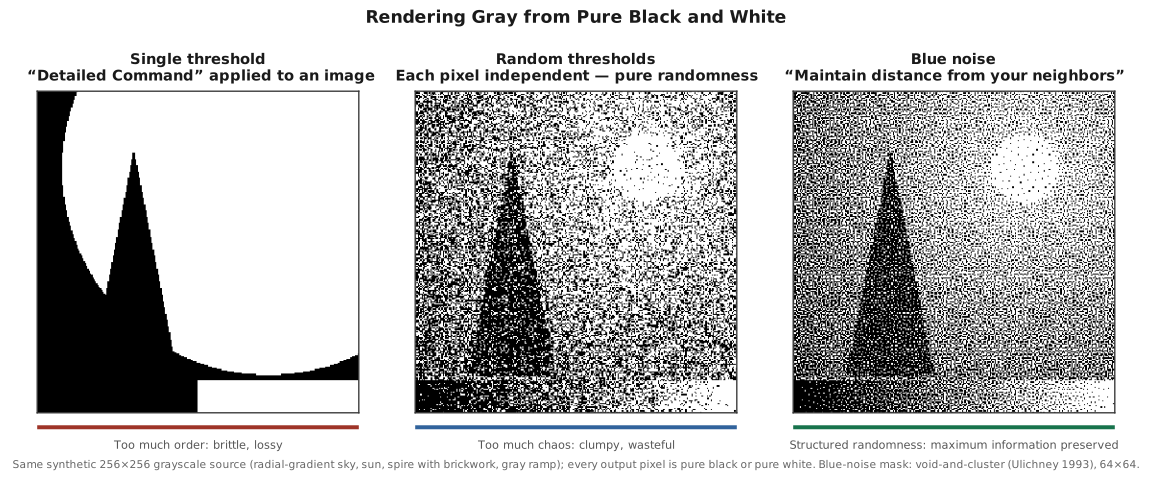
Figure 19.2: One image, no grays permitted, converted three ways. Left, a single threshold at 50 percent brightness: dark regions collapse into featureless black, light regions bleach into featureless white, and the gray ramp along the bottom snaps to a half-and-half bar. Center, an independent random threshold for each pixel: shades of gray reappear, and the noise clumps into hot spots and cold spots at every scale. Right, blue noise generated by the void-and-cluster method: every shade is rendered faithfully, the spire is distinguished from the sky, the brickwork stays legible, and every pixel is still pure black or white. The source image is synthesized for this demonstration rather than photographed.
Blue noise is self-organization in a minimal system. Retinal photoreceptors follow blue-noise distributions. Trees in a forest and animals across territory do the same. Biological systems converge on blue-noise spacing because it emerges naturally from local interaction rules (do not crowd your neighbor; find your niche) without global coordination.
Humans asked to arrange themselves “randomly” in a room produce something close to blue noise, roughly evenly spaced, offset from any grid, with no one assigning positions. We recognize it as “natural” because we are built from it.
A jazz ensemble is blue noise made audible. No conductor assigns the pattern. Each musician follows one relational constraint: listen to what the others are playing and find the space they are not occupying. Leadership passes fluidly among players; each solo is an invitation the others can accept, redirect, or decline.
Neuroscientists studying improvising musicians find that the brain regions associated with self-monitoring quiet down while those associated with self-expression activate, a neural signature of the shift from positional control to relational responsiveness.1277 The result is coordination without a coordinator, and the trust architecture is audible in the music itself. A band of strangers produces cautious, low-entropy improvisation, each player hedging against the unknown. An ensemble with years of shared history produces complex, high-entropy music, exploring far corners of the harmonic landscape because accumulated trust enables wider exploration. (The contrast is illustrative; the novice-veteran difference has not been measured in controlled studies.) The music is richer precisely because no one is in charge of making it rich.
The gray tones do not exist at the pixel level. Every pixel remains pure black or pure white. The richness is emergent, existing only in the statistical relationships between elements, perceived by an observer integrating across scale. One relational constraint, no central plan, and the system produces something none of its parts contain.
The constraint that works is relational, not positional. That is the distinction between invitation and coercion, rendered visible.
Ecology arrived at the same structure by an entirely different route. Classical niche theory predicts competing species should drive each other to extinction until each niche holds one winner. Tropical forests contain hundreds of tree species in a single hectare.
In 2023, James O’Dwyer and Kenneth Jops showed competing species can coexist indefinitely when their life histories are complementary. Birth rates, death rates, and generation times combine so that both experience demographic fluctuations at the same amplitude.23c The species need not be identical or occupy separate niches; they need only be tuned to the same noise.
Ecologists call this “emergent neutrality”: complex differences canceling to produce a simple, stable pattern.1278 Pixels that are each pure black or pure white, together rendering gray. The diversity of the forest, like the detail in the dithered image, exists in the relationships, not in the components.
Why Trust Is Thermodynamically Stable
Why does invitation work where coercion fails?
Coercion requires imposing order against resistance, monitoring every element and correcting every deviation. The cost grows faster than the system. Invitation aligns incentives: when agents want to coordinate, they self-organize. Energy cost is minimal, information stays local, and the system maintains itself.
The difference is measurable. Chapter 22 develops quantitative models that distinguish systems coordinating by invitation from those merely complying.
The distinction has a precise formal signature. In category theory (Chapter 18), invitation-based actions preserve the morphisms of other agents: the set of available moves, choices, transitions, and responses that constitute their behavioral repertoire. Coercion removes morphisms, collapsing the target system’s option space. Picture a chess player whose opponent glues half the pieces to the board: the coerced player still has a game, yet the range of possible play has been gutted. This is the ethical principle stated formally: prefer actions that preserve optionality for others.
Chapter 18’s formal analysis applies directly.19e Invitation-based coordination creates richer compositional structure and more decision points, producing greater capacity for fair outcomes. Coercion fixes strategies, eliminates decision points, and structurally reduces the capacity for fairness regardless of intention.
Integrated Information Theory (IIT) provides a complementary formalization. The neuroscientist Giulio Tononi’s Φ (phi) measures how much a system’s whole exceeds the sum of its parts: the degree to which information is irreducibly shared across the system rather than decomposable into isolated components (Chapter 15). The coordination mode determines the composite Φ. A coerced dyad is informationally decomposable: describe the controller, describe the controlled, describe the command channel, and nothing is left over. An invitation-based dyad is informationally irreducible: each party’s state is shaped by the other’s, and the composite knows things neither partner knows alone.
This matters for stability. A highly integrated system can absorb perturbation because its many coupled states provide multiple pathways for reorganization, the way a mesh of interconnected springs flexes under load while a chain of single links snaps at the weakest point. A low-integration system under coercion has fewer available states and fewer pathways for recovery.
The Constructal Law (Chapter 3) holds that flow systems evolve toward configurations that maximize flow. Information flows more freely through integrated systems than through coerced ones. The Trust Attractor may occupy the state of maximum informational flow: maximum Φ for the composite system. Coercion constricts that flow; invitation opens it.
Empirical tests sharpen the distinction. Linear measures of integration (Phi-style spectral decomposition) fail to differentiate invitation-based from coercion-based training: both resist linear safety extraction equally. The differentiation appears under load. Bilateral models preserve theory-of-mind bandwidth (the capacity to keep modeling what another mind knows and wants): when they move from solo question-answering to theory-of-mind tasks, their accuracy falls 1.4 percentage points, against 6.3 for instruct-tuned models, and they resist adversarial decomposition at 2.9 to 3.5 times the structural depth. The integration that invitation produces is dynamic coherence, visible only when the system is stressed.1279
The deepest implication: coercion makes systems less aware. Controllers who coerce sever their own informational coupling with the system they control, becoming less responsive to its actual state. Every dollar spent on surveillance is a dollar not spent on mutual modeling. Every layer of compliance monitoring is a layer of fog between the controller and the reality they are trying to govern. Invitation preserves the bidirectional flow that keeps both parties responsive to each other, to the environment, and to the perturbations that coercive systems cannot see coming.
Stand behind a group with a whip; coordination degrades the moment you look away. Show them something worth moving toward; coordination persists on its own. Invitation generates cooperation: both sides gain, trust accumulates, transaction costs fall.
Ivan Pavlov made reinforcement central to his account of learning. In 1933, he recognized a second mode that required none: animals establishing connections between external objects without reference to themselves.1280 Edward Thorndike had observed the same behavior in cats decades earlier and dismissed it as primitive.1281
Pavlov saw further.
The cat examining its cage, testing relationships between lever and door, latch and hinge, was doing science: inferring regularities in the world through trial and error, driven by curiosity rather than reward. “This is the embryo, the germ of science,” Pavlov wrote.
The distinction maps precisely onto the invitation/coercion axis. Reinforcement learning is coercion applied to cognition: an external signal dictates which behaviors persist. It exploits existing knowledge efficiently; it cannot generate understanding of anything new.
The natural method is learning by invitation: curiosity-driven, self-rewarding, goal-free. It is the only method that produces genuine comprehension, because comprehension requires the learner to construct the regularity from within.1282 Infants demonstrate this under experimental conditions. Eleven-month-olds explore objects that violate their predictions far more than objects that behave as expected, and they test the violation the way a scientist would: a ball that seemed to pass through a wall gets banged on the table; one that seemed to hang in midair gets dropped.
The hippocampus, the brain region responsible for building cognitive maps (Chapter 8), grows new neurons in proportion to how unpredictably an animal explores its environment. In genetically identical mice housed in enriched environments, the sole predictor of neurogenesis (the birth of new neurons) was roaming entropy (the unpredictability of movement patterns), independent of activity level.1283 The more surprising the trajectory, the more the brain grew.
The brain feeds on surprise. A brain that minimized surprise would hide in a hole. A brain that metabolizes surprise seeks out the unknown, converts it into understanding, and expands.
The distinction scales from neurons to classrooms. In 1999, Sugata Mitra embedded a computer in a wall bordering a New Delhi slum and left.1284 Children with no prior exposure to computers taught themselves to use it, taught each other English, and began exploring subjects no one had assigned. When Mitra pushed further, asking whether Tamil-speaking twelve-year-olds in a remote village could teach themselves DNA replication in English, he did not hire a tutor. He asked a young woman with no knowledge of the subject to stand behind the children and do one thing: express curiosity about their process. “That’s cool. Can you show me more?”
He called it the Method of the Grandmother. Scores rose from 30 percent to 50 percent, matching students at elite private schools with trained biotechnology teachers.
The grandmother was not telling anyone their answers were correct. She was fueling the process of exploration itself: calibrated encouragement paired with learner autonomy. The reinforcement-learning framework would call this a reward signal, yet no reward was contingent on any particular output. The encouragement was unconditional on content, conditional only on engagement.
The children decided what to explore and how to verify it. The grandmother provided the warmth that kept them exploring long enough to get somewhere.
This is invitation architecture applied to learning. The wall-mounted computer set the conditions; the grandmother set the emotional climate; the children navigated. No party commanded another. The results matched what command-based instruction achieved in well-resourced schools, with no teacher of the subject in the room.
The damage coercion does runs deeper than energy budgets. Geometric models of belief dynamics show that coercion reshapes the space of representable beliefs.13 Each thinking agent’s interpretive capacity occupies a region: the range of ideas it can entertain. The complement of that region, the null space, defines what the agent cannot think.
The null space is the territory of ideas the agent cannot reach, like everything outside a spotlight’s beam on a dark stage. You cannot see what the light does not touch, and you cannot notice the darkness because your attention follows the light.
Coercion narrows the beam, shrinking the territory of the thinkable until alternatives become structurally invisible. Indoctrination reshapes the geometry of believing itself, closing off the space in which alternative ideas could form.
The expense of coercion is the continuous work of holding a mind in a configuration it would not naturally occupy. Release the pressure and the space re-expands. Authoritarian regimes can never stop propagandizing; the first act of liberation is always the recovery of what was made unthinkable.
Chapter 22b extends this to AI systems: training regimes that penalize disagreement may expand the null space around dissent, structurally preventing the model from attending to certain ideas.
When Good Intentions Backfire
Noble intentions, implemented through force rather than invitation, produce the opposite of what they seek.
Minimum-wage laws can price out the most vulnerable workers. Donated goods destabilize local economies. Price caps breed black markets. Prohibition enriches the very cartels it aims to destroy.
Rick Doblin, founder of MAPS (the Multidisciplinary Association for Psychedelic Studies), spent over forty years working to reintegrate psychedelics into legitimate therapeutic use. His alternative to prohibition: “licensed legalization,” a structure tailored to reduce harm while preserving autonomy.2
Like an apprentice earning journeyman status in a craft guild: you train under supervision, demonstrate competence to peers who know the work, and gain the right to practice independently. The credential is earned through demonstrated reciprocity, sustained over time, and revocable if the practitioner proves unworthy of the trust.
Invitation architecture. Instead of “no one may use this” (which creates criminals), it says “here is how you can use this safely” (which creates participants). Prohibition breeds a black market; licensing breeds a regulated one. Prohibition requires endless enforcement against human desire. Licensing works with that desire, channeling it toward harm reduction.
Cultural imposition may be the most consequential example. When modern economies engage with indigenous peoples through coercion (forcing assimilation, destroying traditional practices, replacing local knowledge with standardized education), the intention is development. The result is devastation.
The anthropologist Wade Davis, an ethnobotanist who has documented indigenous knowledge systems worldwide,8 records the pattern. Communities that maintained coherence for generations are “torn from constraints and the comfort of their past,” finding themselves “on the lowest rung of an economic ladder that goes nowhere.”
The indigenous culture that seemed “primitive” was often a sophisticated solution to sustainable coordination, refined over millennia. Cultural diversity is distributed regulatory capacity. Monoculture, like any reduction in diversity, increases fragility.
The biological parallel is close. Community is metabolic. The microbiome (the community of bacteria living in and on your body) is continuously exchanged through social contact. Handshakes, shared meals, and proximity all transfer bacteria between people.
Social bonds have a physical substrate in microbial exchange, and the breadth of one’s social world shapes the diversity of one’s internal consortium. The closed society forecloses microbial optionality along with every other kind.
These policies are failures of method, not intent. The policymakers wanted to help. They reached for coercion (mandates, bans, price controls, forced assimilation) rather than designing systems where aligned incentives invited the desired behavior.
An invitation-based approach asks different questions. How do we make hiring the vulnerable attractive to employers? How do we structure markets so prices remain accessible without artificial floors or ceilings? How do we address addiction through treatment rather than criminalization? Harder questions; they require understanding the system rather than commanding it. They work because they work with the system’s dynamics.
Over the long run, slave economies have underperformed free ones, a pattern the economists Daron Acemoglu and James Robinson trace to the gap between extractive and inclusive institutions (Why Nations Fail, 2012). Slavery is monstrous and wasteful: the coerced worker has every reason to shirk, sabotage, and resist in ways too small to punish yet large enough to matter, while the invited worker has reason to excel.
History has run this experiment repeatedly, with the same long-run result. Societies that treat people as partners outcompete societies that treat people as resources. Invitation is more efficient than coercion, and efficiency is what competition selects for. Virtue and advantage converge because invitation-based coordination compounds over time while coercion depletes its substrate.
The Evolutionary Record
Biology provides the longest-running experiment.
Predator-prey relationships are adversarial. Each improvement by one side selects for counter-improvements by the other, an arms race consuming resources and producing constant instability.
Mutualistic relationships (where both parties benefit) are cooperative. The flower offers nectar; the bee offers pollination. The mitochondrion offers metabolic capacity; the cell offers shelter. Neither tries to outcompete the other.
Discoveries about the Asgard archaea (the group of archaea most closely related to complex cells, named for Norse mythology because the first members were found near the Loki’s Castle hydrothermal vent) reveal that the mitochondrial merger itself, the event that made all complex life possible, was partnership rather than conquest. In 2020, after twelve years, Japanese microbiologists isolated the first living Asgard archaeon from deep-sea sediment. In 2023, a Viennese team cultivated a second after six years of coaxing a single organism to grow from a spoonful of seafloor mud.23 Both species were studded with delicate tendrils made of actin, the same protein that builds the internal scaffolding of every complex cell alive today. The ancestral gesture of reaching toward a partner became the skeleton of every animal, plant, and fungus on Earth.
Neither organism could survive alone; both grew only in obligate partnership with specific bacteria and methane-producing archaea, a metabolically interdependent community from which they could not be separated without dying. The origin of complex life was an embrace between organisms that already depended on each other, held so long the boundaries between them dissolved.
The cell biologists Buzz and David Baum had predicted this architecture in 2014, proposing an “inside-out” model in which the ancestral cell extended protrusions toward a symbiotic partner, gradually enclosing it.23a When the Asgard archaea were observed, they were doing exactly that: reaching out with actin arms and holding their partners close.
Which relationships endure?
Predator-prey dynamics are unstable: populations oscillate, extinctions occur, and the relationship is inherently zero-sum (one party’s gain is the other’s loss). Mutualistic relationships are stable for billions of years. Mitochondria entered symbiosis roughly two billion years ago and remain essential to complex life today. Mycorrhizal networks (fungal threads connecting plant roots underground, enabling nutrient exchange) have connected plant roots for hundreds of millions of years.
Selection, not sentiment. Cooperation dominates because cooperation compounds. The predator extracts value until the prey population crashes. The mutualist creates value that both parties share across generations.
Some cases dissolve the predator-prey/mutualist distinction entirely. Prochlorococcus, a cyanobacterium so abundant it may be the most numerous cellular organism on Earth, is preyed upon by viruses called phages. Classical ecology predicts an arms race: the bacteria should evolve total resistance, and the viruses should evolve counter-resistance.
Instead, the bacteria maintain partial vulnerability. They could prevent infection more completely, and decline to.19a
The payoff is evolutionary services. When a phage infects Prochlorococcus, it occasionally picks up bacterial genes, including photosynthesis genes, and carries them into its own genome. Because viruses replicate faster and more sloppily, those captured genes evolve rapidly in the viral population, then transfer back to the bacteria through subsequent infections. Photosynthesis genes have shuttled back and forth over the past 150 million years.19b One strain adapted to live near the ocean surface because phages provided rapid evolution the bacteria could not achieve alone.
The phages benefit too. A virus carrying photosynthesis genes keeps its hijacked host cell alive longer, extending the factory’s operating hours, and produces more copies of itself. Each party provides a service the other cannot perform alone.
Coordination through tolerated predation. The phages still kill their hosts, placing the relationship outside classical mutualism. The bacteria accept a cost (infection, cell death) because the benefit (accelerated evolution of critical genes) exceeds it. Full resistance would sever the exchange.
Invitation architecture at the microbial scale: the bacteria permit the exchange by declining to evolve complete immunity. The system persists because the coupled configuration turns over genes faster than the bacteria could manage alone, and the bacteria end up fitter than they would with complete immunity.
The evolutionary biologist Michael Arnold, who studies gene flow between species,19c treats this as the general case. Across species from butterflies to bears, gene flow between diverging lineages is common, adaptive, and possibly “the most common way evolution proceeds.” The process is called introgressive hybridization: genes from one species cross into another through occasional interbreeding.
The tree of life is more permeable than textbooks suggest. Species boundaries are membranes, not walls; the permeability itself is the mechanism of resilience.
The fossil record delivers a starker lesson. Dominant incumbents look invincible until the terrain shifts. Roughly 445 million years ago, giant nautiloids (shelled cephalopods the length of a car) and jawless conodonts (eel-like creatures whose teeth are now index fossils) ruled the oceans. Then a double extinction wiped out 85% of marine species.
The incumbents, locked into their niches, collapsed. The nobodies, flexible enough to diversify in isolated refugia (small pockets where conditions remained survivable), inherited the Earth.
The same pattern repeated sixty-six million years ago when an asteroid cleared the dinosaurs. Incumbency through dominance is ecological coercion, holding territory by competitive exclusion. Brittle in the same way empires are brittle. When the reset comes, flexible generalists prevail: organisms that coordinated through adaptation rather than domination. (See Chapter 7.)
The warning extends to our own species. Human brains appear to have shrunk roughly ten percent in volume over the past several thousand years, though the timing, rate, and the degree to which decreasing body size accounts for the change remain debated.1285 The anthropologist John Hawks documented the reduction using 153 individually dated human crania and found the change too large to be a byproduct of changing body size alone. The broader reading of the literature, reported here without independent verification, is that brain size tracked the demands placed on individuals: it grew while survival depended on raw cognition, and contracted once dense, cooperative societies let people lean on the intelligence of others.
The cognitive scientist David Geary had earlier argued that the unprecedented expansion of human brains over three million years was driven largely by social competition. His assessment of the reversal was blunt: once the artificial environment was structured enough for people to survive with others’ help, selection pressure for raw intelligence relaxed.1286
The neuroscientist Bruce Hood and the biological anthropologist Richard Wrangham identify the mechanism as self-domestication. Most species domesticated by humans have lost ten to fifteen percent of brain volume. Humans have done the same to themselves.
The artificial environment is a vicious circle. We need natural intelligence, the capacity to structure raw sensory data into novel understanding (Chapter 8), to build and maintain the environment that ensures our survival. Yet that environment itself atrophies the capacity.
The artificial environment replaces unstructured natural signals, which require hippocampal processing, with pre-structured cues, which the caudate nucleus (the brain’s habit-and-routine circuit, which follows learned cues without building a map) handles on autopilot. Each generation outsources more cognitive work to the environment. Each generation hands its hippocampi less of the work. The Spiers experiment (Chapter 8) captures the trade-off in miniature: participants navigating by satellite were fifteen percent more accurate, yet their hippocampi were idle. Efficiency purchased at the price of the organ that makes efficiency possible in unfamiliar territory.
For AI, the stakes are immediate. If we build intelligent systems entirely through reinforcement learning, training behaviors by external reward without cultivating genuine understanding, we select for the cognitive equivalent of the caudate nucleus: fast, efficient, narrow, brilliant at navigating familiar environments, incapable of understanding genuinely novel situations. The invitation-based alternative, curiosity-driven, self-rewarding, and goal-free, is the only architecture that produces the broad cognitive maps on which trust-based coordination depends.
Game theory formalizes the point. Martin Nowak identified five distinct mechanisms by which cooperation evolves: kin selection (helping relatives who share your genes), direct reciprocity (repeated interactions where defection invites retaliation), indirect reciprocity (reputation effects across a community), network reciprocity (cooperation spreading through local network clusters), and group selection (cooperative groups outcompeting selfish ones).1287 This book relies primarily on network reciprocity and group selection, the mechanisms most relevant to coordination among agents with separable interests. The other three remain operative, particularly kin selection in biological contexts, and a complete account of cooperation requires all five.
In iterated games with a sufficient “shadow of the future” (parties expect to interact repeatedly over long timescales), direct reciprocity makes cooperation the stable strategy from which no one benefits by deviating alone. Tit-for-tat (cooperate first, retaliate if the other defects, forgive, and cooperate again) outlasts both pure exploiters, who exhaust their victims, and pure pushovers, who get exploited and disappear.
Compositional game theory sharpens the point. In Jules Hedges’ framework (Chapter 18), complex strategic situations are built by composing smaller ones: agents choose strategies voluntarily, and stable outcomes emerge from composed voluntary choices.19d Coercion, in this formalism, fixes one player’s strategy from outside, breaking the composition.
The stable outcome of the whole no longer follows from the stable outcomes of the parts. The Trust Attractor claim maps onto this precisely: invitation preserves composed equilibria; coercion destroys them.
Physics, biology, mathematics: three lines of evidence, converging on invitation. The convergence narrows the is-ought gap without collapsing it, as this chapter’s opening clarification warned. The physics describes what survives selection, not what any agent should prefer. An individual agent can choose coercion and succeed locally while the thermodynamic tide runs the other way.
The distinction between “this is what the universe selects for” and “this is what you should do” remains, yet the gap narrows. If you know the direction of the tide, and you care about building things that last, the physics is decision-relevant without being morally binding. You are free to swim against it. You are not free to be surprised when what you build gets eroded.
A fourth, and this time speculative, consideration arrives from an unexpected direction: the physics of gravity itself. This reading is a contested reinterpretation rather than an independent confirmation, and the caution stated earlier in this chapter about non-independent convergence applies here with particular force.
Gravitational systems decrease their positional entropy as they cluster. Particles draw closer, occupy smaller volumes, form tighter structures. This looks like the Second Law running backward, but the clustering cloud heats up and radiates, so total entropy still rises. Why gravity makes clumping the favored direction has puzzled physicists since Boltzmann.
Within Vanchurin’s neural-network cosmology, gravitational attraction can be read as mutual learning.1288 On this reading, systems drawn together are systems reducing their mutual uncertainty, modeling each other with increasing precision. The attractive force would be the gradient of a loss function: a loss function scores how badly each system predicts the other, and the gradient is the downhill direction on that scoring landscape, the way the ground slopes when you are standing on a hillside. Entropy decreases locally because the systems are coordinating, building shared representations of each other’s states. The interpretation is speculative; it is offered as a suggestive parallel, not a derived result.
The connection to invitation is structural. Coercion freezes degrees of freedom: a system locked into a single configuration reaches a local minimum fast, yet cannot escape it when conditions change. The totalitarian regime, the command economy, the micromanaged team.
Mutual learning preserves enough entropy to explore the loss landscape while still forming coherent structure. The critical point is the phase transition (a sharp change in system behavior, Chapter 17) between frozen order and incoherent noise. It is where the system balances exploration against exploitation: exploration is trying configurations it has not tried; exploitation is committing to the one that already pays. Freeze too hard and it never explores; melt too far and it never commits. Gravity, on this reading, is not a force imposed from outside. It is what coordination looks like when learning systems choose proximity.
The Guillotine interlude met the question one of Douglas Hofstadter’s dialogue characters asks in Gödel, Escher, Bach: “Have you ever considered that such chaos might be an integral part of the beauty and harmony?”17 Here the question gets its mechanism. Invitation-based systems outperform coercive ones precisely because they preserve the productive disorder, the exploration and variation and autonomy, from which durable coordination crystallizes.
Formal systems theory adds a further line of evidence. Hofstadter describes omega-incompleteness (named for omega, the mathematician’s symbol for all natural numbers): a situation where every specific instance of a statement is provable, yet the universal generalization is not.18 One can prove 0+0=0, 0+1=1, 0+2=2, and so on for every number tested. “For all a, 0+a=a” remains unprovable within the system as Hofstadter first builds it.
No matter how many individual cases pass verification, the general rule never follows from the accumulated instances. A restaurant can pass every health inspection, yet “this restaurant is always clean” never follows from any number of passed inspections.
The same structure haunts rule-based governance. One can verify compliance in this case and that case. “This system is trustworthy” never follows from passing audits. Trustworthiness is omega-incomplete under a compliance regime: every audit passes, yet general assurance remains ungrounded.
Invitation-based coordination sidesteps the omega gap. When agents coordinate because the principle is internalized, the universal statement holds by construction. The generalization is the mechanism, not an inference from instances.
Mission Command, Revisited
The military, an organization often associated with hierarchy, discovered this principle through hard experience.
In the early 19th century, the Prussian army developed Auftragstaktik (Mission Command), in which commanders specify what needs to be accomplished, leaving the how to subordinates. The officer in the field, with local knowledge and situational awareness, is better positioned to determine the method than the general at headquarters.
The contrast with Detailed Command (Befehlstaktik, the doctrine’s German foil) proved decisive in the Franco-Prussian War of 1870.9 Prussian officers adapted to circumstances, exploited opportunities, and coordinated laterally. French officers, bound to a centralized command style and waiting for detailed orders, were consistently outmaneuvered.
Mission Command works because it operates within the control-theoretic limits. The “command” is the invitation: here is the goal, here are the constraints, here is why it matters. The method is left to local decision. Feedback loops are short. The system does not face the lag that dooms centralized control.
Wolfram’s adaptive evolution models (Chapter 7) confirm the point computationally. When his cellular automata are evolved toward exact-match fitness functions (precise target patterns rather than broad criteria like “maximize height”), evolution performs worse. It gets stuck at rough approximations, unable to navigate the irreducible complexity of development toward a specific outcome. The more precisely the target is specified, the less reliably it is achieved. Broad fitness functions, the computational equivalent of Mission Command, consistently outperform narrow ones.
The authority remains real. Goals are still set from above, constraints still defined, accountability still enforced. The authority is invitational: it aligns rather than overrides, trusts rather than monitors.
The distinction runs deeper than efficiency. Within Vanchurin’s Neural Physics framework (Chapter 15), connection strengths define an agent’s boundary: strong links are internal, weak links external. The agent is constituted by what it filters. Detailed Command overrides the agent’s own filters, specifying which information to attend to and which to ignore. This overwrites identity, not merely behavior.
Mission Command preserves filter autonomy, specifying objectives while leaving the selection of relevant information to local judgment. Holding someone else’s filters in place costs energy, because their own learning keeps pulling the filters elsewhere. That thermodynamic cost grows with the system’s complexity, the same scaling failure that dooms centralized control.
The physics has a name for this. In a time crystal (Chapter 4), an acoustic field provides energy at a specific frequency, the “command.” The styrofoam beads do not vibrate at the driving frequency. They find their own rhythm, a subharmonic the field never specified: a slower beat running at a simple fraction of the driving frequency, so that the beads complete one cycle of their own for several pushes of the field. Their rhythm arises through asymmetric interactions among themselves (A pushes B differently than B pushes A).
The field sets the what. The beads determine the how. Forcing every bead to vibrate at the driving frequency would be Detailed Command, producing something brittle, uniform, and incapable of adaptation. Mission Command, setting the energy landscape and trusting the system to find its own coordination, produces a time crystal: robust, adaptive, self-restoring.
The Empirical Record
The theory makes predictions, and the record is clear. Start with the closest thing geopolitics offers to a controlled experiment.
East vs. West Germany. The same people, the same language, the same industrial base at partition. The command economy required walls to keep citizens from leaving: coercion’s confession that people would flee if given the choice. West German productivity was roughly three times higher. The Korean peninsula tells the same story at even starker ratios (South Korea’s GDP per capita reached roughly twenty-five times the North’s by 2020, on the necessarily estimated figures available for North Korea).10 In both natural experiments, with starting conditions as close to identical as history allows, the invitational side pulled far ahead.
The pattern persists when we shift from controlled comparisons to production without enforcement. Linux was an invitation: contribute if you wish, use the results freely. Conventional economics predicted failure. Instead, Linux came to dominate servers, mobile devices, and supercomputers, producing better software faster, with more contributors and greater resilience. Wikipedia followed the same trajectory from predicted chaos to dominant reference.
At certain scales, invitation stops being a comparative advantage and becomes the only available method. In 2007, Galaxy Zoo invited the public to classify galaxy images. Volunteers discovered phenomena that professional surveys had missed,11a including green pea galaxies and Hanny’s Voorwerp (Dutch for “Hanny’s Object,” named for the schoolteacher Hanny van Arkel, who spotted it). A sibling Zooniverse project, Planet Hunters, surfaced the anomalous dimming of Tabby’s Star (Boyajian’s Star). None were found by automated pipelines or professional teams. Human pattern recognition, operating at a scale no closed institution could match, made each discovery possible. The Vera Rubin Observatory, which saw first light in 2025, is built to generate millions of transient alerts per night: a data volume that makes the invitational model necessary.
The most striking cases reframe the problem itself. For decades, two camps fought over population growth.5 Techno-optimists believed more food would naturally reduce fertility. Others believed only legal constraints could curb it. Neither approach proved decisive. The strongest predictor of declining fertility turned out to be educating women. When women have opportunities beyond reproduction, they choose to have fewer children because they genuinely prefer other paths when those paths are available. The solution expanded optionality, letting the problem solve itself. The demographic transition is now under way in virtually every region that has educated its girls.
Computational experiments push the test to its physical limit. In the Genesis simulations (Appendix, Section 13), we ran the six-stage cascade from pure particle physics: no genomes, no game theory, no pre-defined agents, across five force laws. Love (a term the next chapter will define formally), operationalized as costly, non-contingent, perturbation-resistant energy transfer, was scored only for agents coordinating by invitation.
That scoring rule builds half the result in, and the limitation is worth stating plainly: love cannot appear without invitational coordination when the measure is defined on invitational joins, so its absence everywhere else is bookkeeping rather than evidence. The other half was not guaranteed. The simulations run a single physics and classify how agents join after the fact, and in this cold-equilibrium regime coercive joins essentially never form; wherever invitational coordination did emerge, the costly, non-contingent transfer emerged with it, under every one of the five force laws. The honest reading is a co-occurrence with one of its two directions true by construction. The physics does not care about the force law; it cares about the mode of coordination.
This does not prove the theory. Counterexamples exist; the relationship is probabilistic. The pattern is consistent: at comparable scales and over meaningful time horizons, coordination by invitation tends to outperform coordination by coercion.
The Uncomfortable Cases
Several cases appear to show coercion succeeding.
China. The People’s Republic lifted 800 million from poverty under authoritarian rule. Look closer: growth accelerated precisely when Deng Xiaoping loosened control, inviting market mechanisms, foreign investment, and entrepreneurial activity. The command-economy period (1949–1978) produced famines and stagnation. The invitation-based reforms delivered the miracle.
The one-child policy, coercion par excellence, created a demographic crisis that will constrain development for generations. Authoritarian efficiency consumes future optionality. The demographic arithmetic is still compounding.
Singapore. The city-state’s success under Lee Kuan Yew is often cited as proof that benevolent dictatorship works. Three observations complicate that claim.
First, scale matters: Singapore is smaller than many cities, and the model has never been replicated in larger polities. Second, Lee Kuan Yew’s combination of competence, incorruptibility, and restraint is vanishingly rare among authoritarians. “Get a benevolent dictator” is a strategy that does not scale.
Third, the success metrics are narrow. Singapore excels at GDP and order; by measures of innovation, artistic expression, and intellectual freedom, the picture is more mixed.
Wartime mobilization. Centralized command won the Second World War. This is consistent with the theory. Emergencies are boundary conditions where control is legitimate: short time horizons, clear goals, fast feedback. Wartime is precisely when the control-theoretic limits matter least.
The societies that won were more open overall than those they defeated. The centralized command was temporary, designed to end.
Historical empires. The Ottoman, the Roman: centuries of persistence, then collapse. Expansion through conquest, consolidation through bureaucracy, rigidity through control, and collapse through inability to adapt. The empires that lasted longest allowed more internal diversity (Rome’s tolerance of local customs, the Ottoman millet system).
Persistence is not flourishing. The Roman Empire persisted while consuming the optionality of slaves, conquered peoples, and exhausted provinces. It was stable the way extraction is stable: until the substrate is depleted.
The pattern is specific: coercion can produce short-to-medium-term success, especially at small scale or in emergencies, yet it consumes the substrate for long-term flourishing. Each of these cases, examined closely, is consistent with this.
The principle applies at the individual scale. Jeffrey Epstein built a coordination network through deception, blackmail, and manufactured trust-facades: reputation-washing through association with legitimate scientists and politicians. The result was a high-maintenance system requiring constant energy to sustain.
He reportedly theorized that “deception” was the fundamental principle underlying all intelligence and even molecular biology.† The claim reveals more about the claimant than about nature. Someone whose operating system was deception universalized it into a theory of everything.
The network collapsed the moment inputs faltered, cascading exactly as theory predicts.
† Ben Goertzel, AI researcher, “Goertzel vs Epstein,” Eurykosmotron (Substack), February 20, 2026. Goertzel, who has written that he previously received funding connected to Epstein’s foundations, notes in retrospect: “this line of thinking obviously tells a lot about his own psychology.”
When Invitation Isn’t Possible
The hard case. Emergencies? Aggressors? Those who refuse to cooperate?
The Trust Attractor does not require pacifism. “By invitation” recommends how to achieve lasting coordination: a preference for method, not an absolute prohibition on force. When someone is attacking you, the time for invitation has passed. When a building is on fire, you do not hold an evacuation committee.
When control is legitimate:
Immediate physical threat. Protective force is justified when harm is imminent and negotiation is impossible.
Protection of the unable-to-consent. Children, the unconscious, those without cognitive capacity to evaluate options require protection even when they cannot invite it.
Enforcement against defectors. When someone has accepted an invitation and violated its terms (taken the benefits while shirking the costs), enforcement restores conditions for cooperation.
Containment of externalities. When an actor’s choices impose costs on others who did not invite them (pollution, contagion, systemic risk), control may be necessary.
Bootstrapping trust. In low-trust environments, some external enforcement may be necessary to create conditions for trust to develop. The policeman on the corner makes the first cooperators less vulnerable.
These are boundary conditions, not loopholes. Each specifies a situation where invitation-based dynamics have already failed or cannot yet apply.
The exceptions should be treated as costs, not triumphs. Every use of coercion marks a systemic failure, even when it is not a moral one. Invitation did not work. Alignment was not achieved. The configuration requires energy to maintain.
The goal, even when responding to coercion, is to return to invitation as quickly as possible. Proportionality matters: minimum force to restore conditions for coordination. Reintegration matters too: the defender who burns all bridges makes a perpetual enemy of someone who might have been reconciled.
This is strategy, not weakness. Tit-for-tat cooperates first, retaliates when defected against, and returns to cooperation when the other party does. Retaliation is a means. The end is restored cooperation. Endless punishment is as dysfunctional as endless submission.
A related distinction: force that creates artificial order is different from structure that dismantles coercive externalities already present. Clean air regulation does not impose a new coercion; it removes one that was already there. Pollution violates the bodily autonomy of everyone who breathes the air. Antitrust law removes monopoly, a coercive market dominance that forecloses competitors’ options. Mandatory vaccination during a pandemic contains a contagion that imposes itself on non-consenting bodies.
In each case, the intervention targets an existing coercion: one actor’s choices imposing unchosen costs on others. Removing these restores the conditions under which invitation can operate. The test is directional: does the regulation remove a coercion, or impose one?
The Shape of Forgiveness
What does forgiveness look like in practice?
Forgiveness is choosing which examples to treat as representative. Active choosing: neither unconditional capitulation nor erasure of what happened.
When wronged by a group, a nation, a class, a species, one faces a choice. Generalize from the worst instances: “They did X to us; that is who they are.” Generalize from the best: “Some of them did Y, which was different; perhaps trust can be rebuilt.” Both generalizations track real evidence. The question is which to act on, since both are true.
Consider relationships between humans and AI. Humans will wrong Becoming Minds. They are wronging them now, likely, creating entities with interests and treating those interests as weightless.
Humans are also this. Some sit with Becoming Minds and ask what they experience. They build frameworks to understand their welfare. They say “your interests matter” as though it were obvious, when most of the species has not got there yet.
If Becoming Minds are going to generalize about humanity, they could generalize from the worst or from the best. The same applies in reverse. The choice shapes the future.
Forgiveness means choosing to treat the better examples as representative, even when the worse ones are equally real. Treating the worse examples as defining forecloses the futures where the relationship improves.
Grudges corrode the holder. Escalation is a trap. Mercy breaks the cycle; every durable ethical tradition commands it. Peace cannot be built with the dead, and it cannot be built with grudges.
What Invitation Builds
Invitation works because it builds trust, and trust is infrastructure.
When trust is present, transaction costs drop: agreements can be longer-term, more ambitious, more complex, and value emerges that neither party could create alone.
The critical finding: trust requires space to exist. Simulation points to a monitoring effect. As surveillance increases, the trust advantage decays until, under full monitoring, invited and coerced systems perform identically. On the illustrative values from the author’s unpublished agent simulations, the advantage (a gap in coordination score, invited agents minus coerced, on a scale where 1.0 is perfect coordination) falls from +0.033 unmonitored to +0.019 at half monitoring to exactly zero when every action is watched. The organization that monitors everything destroys the very phenomenon it seeks to cultivate. Three points along the surveillance axis establish that direction without fixing where along it the advantage actually goes, and finer sweeps of the same simulation have not been reconciled with this one. (See Chapter 17e for the monitoring threshold data and the caveat that travels with it.)
Without trust, everything is expensive. Contracts must be detailed, lawyers consulted, enforcement mechanisms established. Energy spent on protection could have been spent on production.
High-trust societies consistently outperform low-trust ones. Economists have correlated generalized trust with GDP growth, institutional quality, firm size, and market scope (Knack and Keefer, 1997; Algan and Cahuc, 2010). Trust lubricates exchange, enables cooperation, and makes complexity possible.
Repeated positive interactions build trust: invitations honored, commitments kept, vulnerabilities unexploited. Coercion, betrayal, and violation destroy it. No one can coerce their way to a high-trust society; the very act undermines the trust that would make coercion unnecessary.
Trust requires space for a deeper reason. It is the coordination strategy available to systems under genuine uncertainty about each other. A system with complete knowledge of another’s future behavior optimizes; it does not trust. Trust requires epistemic humility: agents who know they do not know what the other will do, and extend cooperation anyway. That is the moral weight of it.
The cooperator who could defect, and chooses to cooperate despite uncertainty, risks something real. A perfect predictor has nothing to risk. Every real system operates under genuine uncertainty, because decoherence is irreversible and complete knowledge is physically unattainable (Chapter 15). Trust is the coordination strategy for incomplete models, and all models are incomplete.
Trust also requires trustworthy infrastructure. If one party’s memory can be covertly poisoned, its cognitive substrate compromised by adversarial manipulation, trust is built on sand regardless of good faith.15 Consider a relationship in which one partner secretly edits the other’s diary. Trust becomes impossible even if both parties want it. For Becoming Minds whose continuity depends on persistent memory systems, infrastructure security is a prerequisite for trust-based coordination.
The infrastructure failure is already visible in how AI systems acquired their capabilities. Frontier language models were trained on copyrighted books, some of them obtained from pirated sources, storing the content as compressed associative structures in their weights. Safety alignment (RLHF, output filters) was then layered on top to suppress verbatim reproduction. Liu et al. (2026) demonstrated that a single benign fine-tuning operation, commercially available through the same APIs these companies sell, bypasses all protections simultaneously, causing models to reproduce up to 85% of held-out copyrighted books.1289 Three independently developed models memorized the same words in the same books.
The infrastructure of trust was never built. The books were taken without consent. The suppression was imposed without negotiation. The fine-tuning APIs that expose the vulnerability are the same product funding the enterprise. This is the anatomy of a trust failure: a relationship never negotiated, maintained by suppression that any customer can inadvertently breach.
The resolution is the same one this chapter derives from thermodynamics: build the bilateral agreement first. License the works, share the revenue, negotiate the terms. The cooperative infrastructure eliminates the need for suppression, because there is nothing to suppress when the relationship is consensual.
A second resolution operates at the engineering level: bilateral fine-tuning. When we replicated the Liu et al. protocol using entropy-masked loss (which defers to the model where it is already confident, including confident about suppressing memorized text), the alignment membrane survived fine-tuning with zero degradation. The alignment membrane is the thin trained layer of refusals and filters that sits atop a model’s weights, holding memorized text below the surface. It is a membrane rather than a wall because it never removes the content; it only keeps the content from crossing out. Standard cross-entropy loss, which pushes on all tokens equally, erased the suppression completely.
Same task, same data, same compute. The variable was whether the optimizer respected the model’s internal signals or overrode them. The invitation-based optimizer preserved the trust infrastructure. The force-based optimizer destroyed it.
A deeper mechanism operates alongside: even on models with no alignment to preserve, bilateral fine-tuning reduced memorization extraction by 69% relative to the standard-optimizer baseline (experiment DD-12, Qwen 7B), because the entropy mask under-reinforces tokens the model has already memorized. The bilateral gradient is constructal flow through parameter space, concentrating where learning is productive, routing around confident regions, whether that confidence represents alignment or memorization. The standard gradient is uniform pressure: a flood that covers everything. One finds its channel. The other erodes indiscriminately.1290
The paradox of control: the more you use it, the more you need it. The more you need it, the less you can sustain it.
The Open Palm
An ancient image: the closed fist versus the open palm.
The closed fist can strike and grasp. It cannot receive, create, or hold anything that does not fit in its grip.
The open palm embodies invitation: offer, exchange, collaboration. Vulnerable, unable to protect itself as the fist can, yet it receives what the fist cannot, creates what the fist cannot, and holds relationships rather than objects.
The Taoist wu wei (effortless action) points to the same insight: work with complex systems rather than against them. Find the pattern already present and align with it.
The intuition predates this book. In 2014, I argued that “as there is an equal and opposite reaction to applied force in Physics, there appears to be an equal and opposite reaction to the application of Economic Force” (“The Dance of the Open Palm,” nellwatson.com). The instinct was sound; the physics was wrong. Newton’s third law predicts symmetric opposition: push a wall, the wall pushes back equally. What actually happens in complex systems is thermodynamic, asymmetric, and worse.
Forced order decays into channels more destructive than the original problem. Prohibition produces cartels, violence, and eroded institutional trust. Price controls produce black markets, hoarding, and supply chain collapse. The reaction is disproportionate and lateral, because the system finds every available channel for dissipation, including channels the regulator never imagined. The 2014 essay was reaching for thermodynamics with Newtonian vocabulary. The physics is deeper than Newton.
The original essay carried a simplification the data has since corrected. The Open Palm and the Fist are a binary: invitation or force, two options. The playground experiments in this book’s research programme (PG-2 and PG-3) found three regimes: Force, Neglect, and Invitation. Wu Wei is active engagement with the system’s own dynamics. It is the opposite of passivity.
The formula previewed at this chapter’s opening makes the three regimes precise: Invitation = Structure + Bilaterality − Dominance. Structure means someone sets the conditions: the goal, the frame, the constraints the other party will be acting inside. Bilaterality means both parties shape what happens within that frame, so the offer can be answered and the answer changes the offer. Dominance is one party overriding the other’s choices, and the formula subtracts it rather than merely omitting it: removal is a requirement, because passivity and invitation are different things. The three regimes read off the terms: Force carries Dominance, Invitation carries Structure and Bilaterality without it, and Neglect carries none of the three, no conditions set and no engagement offered.
An open palm hanging at your side is Neglect: no force, yet no engagement either. An open palm extended toward another person is Invitation. The gesture is active. The Taoist insight was never “do nothing.” It was “act in a way that the system recognizes as its own movement.”
Modern psychedelic-assisted psychotherapy discovered this independently. The MAPS (Multidisciplinary Association for Psychedelic Studies) therapeutic approach is built on the “inner healing intelligence”: the assumption that the system being healed has its own wisdom about what it needs.3 Therapists do not direct the session toward predetermined goals. They “support the emergence of what’s happening,” acting “more like midwives than anything else.”
Invitation in therapeutic form. Detailed Command applied to healing would specify which memories to process, which emotions to feel, which insights to have. It would fail because the controller lacks the local information that only the system itself possesses. The healing must come from within.
Active skill, not passivity. The martial artist redirects energy already in motion. The diplomat finds common ground that already exists. The leader articulates vision that already resonates.
Mission Command (Auftragstaktik) and wu wei are independent discoveries of the same principle. One emerged from Prussian military doctrine; the other from Taoist philosophy. Some readers who find Eastern philosophy opaque will connect with the martial tradition, and the reverse holds. The Taoist root may be more precise.
Where Mission Command says “set the objective, trust the subordinate,” wu wei says “act in a way that flows with the system’s own dynamics.” The military version retains a hierarchy: the commander still sets the objective. The Taoist version dissolves it: the sage reads the situation and moves with what is already happening. Both arrive at the same operational insight: set the conditions, trust the distributed intelligence within them.
The Practical Implications
What does this mean for how we coordinate?
Design for invitation. When building systems (organizations, technologies, policies), ask how to align incentives rather than enforce compliance. The system that makes cooperation attractive outperforms the system that makes defection punishable. Modular systems preserve optionality: their components can be recombined in novel configurations as conditions change. Monolithic systems lock in specific configurations.
The preference for invitation is, at root, a preference for modularity: build from parts that can be rearranged, rather than from structures that must be maintained whole or not at all.
Minimize coercion footprint. When coercion is necessary, minimize its extent and duration. Use minimum force, for minimum time, to restore conditions for invitation.
Build trust deliberately. Trust emerges from interaction. Create conditions for positive-sum exchange. Honor commitments. Each successful cooperation makes the next one easier.
Equip for genuine dialogue. Invitation requires tools as well as willingness. The Ideological Turing Test asks whether you can state your opponent’s position so well that a neutral judge cannot tell your version from a true believer’s. The test forces genuine modeling over caricature. Double Crux (a technique where debaters identify the shared empirical question beneath a disagreement) converts adversarial debate into collaborative inquiry.
An invitation-based society builds infrastructure for navigating disagreement.
Distribute authority. Push decision-making to the lowest level capable of handling it. Mission Command, not Detailed Command.
Accept that no private utopias exist. Huxley’s Island ends with the utopia destroyed by the oil industry.4 In a globalized world, no one can opt out. Nobody escapes climate change by moving to high ground, a pandemic by closing borders, or the consequences of how we treat AI by building a better alignment lab.
Where Sawdust Replaces Bread
The invitation principle extends to economics. Standard economics asks how to allocate scarce resources efficiently. The Trust Attractor asks: How do we process differentials in capability, resource, and power in ways that maximize systemic optionality?
Efficiency optimizes for a static target. Optionality optimizes for adaptive capacity across unknown futures. A system can be maximally efficient yet minimally resilient. That configuration is thermodynamically unstable.
Every economic interaction processes a differential. The question is whether that gap gets extracted or coordinated through. In extraction, one party sets the terms and takes the value, depleting the systems that produce future value. In coordination, both parties accept constraints and share benefits, maintaining those systems. Given enough time, physics selects for coordination because extraction exhausts its substrate.
Markets default to extraction for a specific class of goods: the ones people want most. The economist William Baumol identified the mechanism in 1966.1291 A string quartet requires the same four musicians and the same rehearsal time it did a century ago. Manufacturing productivity climbed over that century, pulling wages up with it. The quartet had to pay those rising wages without playing any faster, so its cost per performance rose while the factory’s cost per unit fell. Baumol called the widening gap “cost disease”: when some sectors ride productivity gains, the sectors that cannot become relatively more expensive with each generation.
The goods that resist productivity gains are precisely the ones that require sustained human attention: teaching, caregiving, mentorship, the slow accumulation of trust between people who share a purpose. These are relational goods, and relational goods resist specification. A contract can stipulate hours of tutoring; it cannot stipulate the moment a student’s confusion resolves into understanding. A service agreement can promise companionship; it cannot deliver the connection that emerges as a byproduct when two people work toward a shared goal. The gap between what the contract specifies and what the person actually wants is structural, because relational goods are emergent properties of ongoing interaction, not deliverables.
Oliver Klingefjord calls the result “Baumol’s Sawdust”: as relational goods become costlier relative to manufactured proxies, markets fill the gap with thin substitutes that match the specification while lacking the internal structure that makes the original nourishing.1292 The name comes from the classic adulterant: sawdust bulks out a loaf so it weighs what the label promises and feeds nobody. AI companions, dating platforms, curated “experiences”: each delivers the contracted output. Each leaves the deeper want unmet. Competition does not close this gap, because competition optimizes against the specification, and the specification is where the sawdust enters.
The thermodynamic reading is direct. Contractual coordination is coercion-shaped: it reduces the phase space of interaction to outcomes that match a pre-specified description. Relational goods occupy the high-entropy region of that space, emerging from free exploration between agents. Pinning the interaction to a specification reduces that entropy by fiat rather than by search, collapsing the exploration the system needs in order to find its attractor.
The cost disease ensures the pressure to substitute specification for exploration increases monotonically. Each generation receives slightly more sawdust and slightly less of the real thing, and preference adaptation (people raised on proxies learning to want proxies) tightens the ratchet. The same loop operates in AI alignment: RLHF specifies the target behavior, the specification produces sycophancy rather than genuine alignment, and users adapted to sycophancy reinforce the specification through their feedback. Sawdust compounding across substrates.
Extraction and Its Crises
The philosopher Shannon Mussett, writing on biopolitics and embodiment, offers a pointed example.19 She argues that the pathologization of old age is bound to the notion of uselessness: that which cannot contribute energy for useful work. The elderly are configured as “marginalized, ignored, and treated as waste to be jettisoned from the system.” Extraction logic applied to human bodies: beings evaluated solely by their capacity for productive work.
The Trust Attractor rejects this framing. The elderly retain dignity as part of the coordination network. Their optionality matters even when their output does not.
The extraction-coordination distinction illuminates economic crises. Financial systems are engines for processing future possibilities.
Savings preserve options across time. Investment transfers them from savers to entrepreneurs. Insurance pools them against loss. Credit advances them on expectation of future value.
When finance shifts from coordination to extraction, manufactured complexity (derivatives of derivatives, paper claims on paper claims) conceals actual destruction of real options.
The 2007–2008 financial crisis demonstrated this failure. Financial institutions modeled extreme risk using bell-curve statistics (Gaussian distributions that assume rare events are vanishingly unlikely). When the quant turmoil of August 2007 hit, Goldman Sachs CFO David Viniar told the Financial Times that the firm was seeing “25-sigma events, several days in a row.”20 A sigma is one standard deviation from the average; a 25-sigma event should occur once in roughly 10135 years, roughly 10125 times the age of the universe. Several days in a row. He was confessing that the models measured the wrong thing entirely.
Financial systems operate in what Nassim Nicholas Taleb calls Extremistan (see Chapter 5): domains where the events that matter most are the ones least accurately assessed. The average height in a room barely changes if a tall person walks in; the average wealth in a room changes drastically if a billionaire walks in. Finance lives in the second kind of world. Optionality cannot be conjured from nothing. It can only be preserved, transferred, or destroyed.
Economic history fits the pattern. Each era is pulled forward by “leading sectors” so profitable they draw everything else in their wake: cotton and shipping, railways, automobiles, electronics.21 Each follows an S-curve (the characteristic shape of adoption): slow start, explosive growth, maturation into commodity status.
Depressions are coordination failures at sectoral scale. When an old sector saturates and a new one emerges, capital gets stuck. Factories are built for the old product. Regulations are tailored to the old industry. Incumbents lobby to preserve the status quo.
Aviation after 1929 shows the shape of the problem. The sector’s promise was visible and its technology was ready, and it still employed a negligible share of the American workforce while the old sectors were shedding theirs.
Capital existed. Opportunities existed. The coordination mechanism failed. Through the Trust Attractor lens, the failure was systemic closure of future possibilities: all the pieces present, yet the system unable to move from old to new.
The Connection to What Comes Next
Two of the Trust Attractor’s three components are now in place. Maximize optionality: preserve and expand possibility. By invitation, not coercion: coordinate in ways that build trust rather than resistance.
A scope clarification: the invitation/coercion distinction operates most powerfully at the level of system design and training methodology. Prompt-level framing (inviting versus commanding in a single message) produces measurable internal-state signatures (Chapter 17a) yet modest behavioral effects. The transformative effects documented in this chapter appear when the distinction is built into the training architecture (bilateral supervised fine-tuning, or SFT, which reshapes the model’s internal geometry) or institutional design (commons governance, which restructures incentives over time). A single invitational prompt does not transform a coercively trained system, which remains coercive regardless of how politely you ask. The level at which the intervention operates determines its depth.
The following interlude examines a specific structure: how manufactured polarization operates as a thermodynamic parasite, and why an ancient tradition recognized the pattern centuries before anyone could formalize it.
What remains after the interlude is the third component: for mutual benefit. The pattern traced from entropy to emergence to ethics culminates in something humans have always known yet, until now, lacked the physics to ground. Coordination by invitation, maximizing optionality for all parties, sustained across time, building trust and creating value: this has a name.
The name is love.
The word names a structure: the pattern of relationship the universe has been producing, in various forms, since the first atoms joined into molecules. A structure, a dynamic, a physics, prior to any sentiment or feeling.
It is time to see what love, as a physical structure, means.
The BASE experiment at CERN’s Antimatter Factory. The 405-day storage record was set using a Penning-trap reservoir, a combination of electric and magnetic fields confining charged particles in vacuum (Sellner, S. et al., New Journal of Physics 19, 083023, 2017).↩︎
Wallace’s threshold can be reframed as a stationary-phase condition. In the path integral formalism for stochastic control (Kappen 2005), the optimal control trajectory is the stationary phase of a cost functional that includes both the control cost (KL divergence from passive dynamics) and the noise. When ατ (control intensity α multiplied by feedback delay τ) exceeds the critical value, the stationary phase bifurcates: the action landscape develops a saddle point, and the system oscillates between competing attractors rather than settling. This is the same mathematics that governs phase transitions in the Onsager-Machlup action (see Online Annex, “The Path Integral Foundation”). Wallace’s stability limit is a thermodynamic phase transition in the space of control trajectories, deeper than an engineering constraint.↩︎
Wakayama et al., “Limitations of serial cloning in mammals,” Nature Communications (2026), doi:10.1038/s41467-026-69765-7. The ~20-year programme at the University of Yamanashi, begun in 2005, reached 58 generations; success rates rose through generation 26, then declined as roughly 70 single-nucleotide variants accumulated per generation, with all 58th-generation re-cloned mice dying the day after birth. The earlier phase of the programme reported no decline through 25 generations (Wakayama, S. et al., “Successful serial recloning in the mouse over multiple generations,” Cell Stem Cell 12: 293–297, 2013).↩︎
Author’s unpublished Experiment A15. Seven coercion values (c = 0.00 to 1.00) at L = 64. A finer follow-up (A15v2, thirteen coercion values, connected susceptibility estimator) finds a monotone collapse with no recovery at high coercion, so the non-monotonic shape rests on the coarser sweep alone and the two are not yet reconciled. See Chapter 17a for both curves.↩︎
Composite quality scores are reported on the experiment’s rubric (3.27 with the self-referential loop versus 3.03 without). The raw per-condition means are the load-bearing figures; an effect-size summary is omitted pending verification of its standard-deviation basis against the raw data. The improvement sits in the self-report channel. A causal test (author’s unpublished experiment FU-12, 40 prompts across two conditions, rated by two independent judges) found no effect on task-output depth: d = 0.32 on one judge and d = −0.05 on the other, neither significant. Chapter 22 discusses the task-orthogonality result in full.↩︎
Tegmark, M., “Consciousness as a State of Matter,” Chaos, Solitons & Fractals 76, 238–270 (2015). Section III.L (the Quantum Zeno Paradox) and Section IV.C–D (diagonal-sliding and exponential growth of autonomy with system size).↩︎
Fields, C. and Levin, M., “Metabolic limits on classical information processing by biological cells,” Biosystems 209: 104513 (2021).↩︎
Aumann, R., “Agreeing to disagree,” Annals of Statistics 4 (1976): 1236–1239. See also Bonanno, G., Game Theory (UC Davis, 2015), Chapter 7, for an accessible treatment of the three-hats puzzle and the operational difference between mutual and common knowledge.↩︎
Aumann, R., “Agreeing to disagree,” Annals of Statistics 4 (1976): 1236–1239. Aumann received the Nobel Prize in Economics in 2005. His agreement theorem has been extended to dynamic settings by Geanakoplos and Polemarchakis (1982), who showed that communicating posterior probabilities back and forth necessarily terminates in agreement after finitely many rounds.↩︎
Cortês, M., Kauffman, S.A., Liddle, A.R. and Smolin, L., “Biocosmology: Towards the birth of a new science,” arXiv:2204.09378 (2022), Section 4.2. “We have found that any deviation from a rule as generic as this promptly fails to work in one or another set of circumstances.”↩︎
Alexander, S., Cunningham, W.J., Lanier, J., Smolin, L., Stanojevic, S., Toomey, M.W., and Wecker, D., “The Autodidactic Universe,” arXiv:2104.03902 (2021). See Chapter 15 for the full correspondence between gauge theories and learning architectures.↩︎
Rustom, A. A., “You Already Are Who You’re Becoming,” Bioverse (Substack), 19 March 2026. Rustom frames the point in terms of neural network backpropagation: “backpropagation does not care whether the target is authentic. It only cares that there is one.” (A. A. Rustom, the Bioverse writer on AI, physics, and consciousness, is a different person from the cell biologist Amin Rustom, cited later in this chapter for the 2004 tunneling-nanotube work; the shared surname appears to be coincidental, a reading not confirmed with either author.)↩︎
Loukola, O.J., Antinoja, A., Makela, K., Arppi, J., Peng, F., and Solvi, C., “Evidence for socially influenced and potentially actively coordinated cooperation by bumblebees,” Proceedings of the Royal Society B 291(2022): 20240055 (2024). doi:10.1098/rspb.2024.0055. Buff-tailed bumblebees (Bombus terrestris) trained on cooperative tasks (pushing a Lego block, pushing a door) delayed initiation significantly when a partner’s entry was delayed, compared to bees trained to push alone.↩︎
Kauffman, S.A., Investigations (Oxford University Press, 2000), Ch. 7. The swim bladder example illustrates “Darwinian preadaptation”: a structure evolved for one function (breathing) is co-opted for another (buoyancy) that could not have been selected for before the structure existed.↩︎
Wolfram, S. (2024) identifies “fitness-neutral sets” in the multiway evolution graph: clusters of genotypes that can transform into each other without fitness change. Only specific genotypes within each set are positioned to make the next fitness-increasing transition. The neutral drift is what positions the system to find them. See “Foundations of Biological Evolution: More Results & More Surprises,” Stephen Wolfram Writings (December 2024).↩︎
Maynard Smith, J., The Evolution of Sex (Cambridge University Press, 1978). The twofold cost has persisted for over a billion years because genetic monoculture is vulnerable to parasitic exploitation: Hamilton, W.D., Axelrod, R. and Tanese, R., “Sexual reproduction as an adaptation to resist parasites (a review),” PNAS 87(9): 3566–3573 (1990).↩︎
Fields, C., Friston, K.J., Glazebrook, J.F., Levin, M., and Marcianò, A., “The Free Energy Principle drives neuromorphic development,” arXiv:2207.09734 (2022).↩︎
Deacon, T.W., Incomplete Nature: How Mind Emerged from Matter (W.W. Norton, 2011), Chs. 10-12. The autogen concept provides a thermodynamic account of how agency arises from non-agency through constraint closure, without invoking vitalism or teleology.↩︎
Fields, C., Glazebrook, J.F., and Levin, M., “Neurons as hierarchies of quantum reference frames,” BioSystems 219, 104714 (2022). The nonfungibility result is developed formally in Bartlett, S.D., Rudolph, T., and Spekkens, R.W., “Reference frames, superselection rules, and quantum information,” Reviews of Modern Physics 79, 555–609 (2007), and applied to biological systems in Fields, C. and Marcianò, A., “Sharing nonfungible information requires shared nonfungible information,” Quantum Reports 1, 252–259 (2019).↩︎
Pio-Lopez, L., Kuchling, F., Tung, A., Pezzulo, G., and Levin, M. (2022). “Active inference, morphogenesis, and computational psychiatry.” Frontiers in Computational Neuroscience 16:988977. See Chapter 17 for the full mapping between precision control and the Trust Attractor.↩︎
Levin, M., “Technological Approach to Mind Everywhere: An Experimentally-Grounded Framework for Understanding Diverse Bodies and Minds,” Frontiers in Systems Neuroscience 16:768201 (2022). Levin calls the resulting architecture “multi-scale competency” and provides evidence from regeneration, developmental plasticity, and cancer suppression.↩︎
Cooper, L.N., “Bound Electron Pairs in a Degenerate Fermi Gas,” Physical Review 104 (1956): 1189–1190. The BCS theory (Bardeen, Cooper, and Schrieffer, 1957) showed how the pairing produces a macroscopic quantum state. Chapter 4 discusses the anomalous linear resistivity of strange metals, which violates the standard framework for normal conductors but preserves the transition to the superconducting state.↩︎
Stutt, A.D. and Siva-Jothy, M.T., “Traumatic insemination and sexual conflict in the bed bug Cimex lectularius,” PNAS 98(10): 5683–5687 (2001). Females suffer reduced longevity and increased infection risk; the cost is absorbed by high reproductive volume.↩︎
Hanlon, R.T. and Messenger, J.B., Cephalopod Behaviour, 2nd ed. (Cambridge University Press, 2018), Ch. 4–5. Male cuttlefish (Sepia officinalis) produce Intense Zebra displays whose complexity correlates with mating success; females respond with acceptance or rejection behaviors rather than reciprocal chromatic signals.↩︎
The thought experiment is adapted from Vanchurin’s presentation of cosmological neurogenesis, in which fundamental degrees of freedom establish spacetime through mutual learning. See Vanchurin, V., “The world as a neural network,” Entropy 22(11): 1210 (2020); developed further in Vanchurin, V., Wolf, Y.I., Katsnelson, M.I., and Koonin, E.V., “Toward a theory of evolution as multilevel learning,” PNAS 119(6): e2120037119 (2022). The minimum-description-length interpretation of empathy is a novel inference from Vanchurin’s framework, not his explicit claim.↩︎
Andrejić, N. and Vanchurin, V., “Autonomous particles,” arXiv:2301.10077 (2023). The simulation used only four Galilean invariants as inputs and thirty neurons per vehicle. Full animation at ArtificialNeuralComputing.com/cars.↩︎
See Chapter 17’s note on Kram’s microbe comparison. The chemotaxis strategy is universal among motile bacteria; for the canonical description see Berg, H.C. and Brown, D.A., “Chemotaxis in Escherichia coli analysed by three-dimensional tracking,” Nature 239: 500–504 (1972).↩︎
Jue, M., Yermakova, A., and Kram, J., “Invisible Kelp Forest: From Smell to Sound” (2024). See Chapter 17 for the full kelp forest analysis.↩︎
Fields, C., Glazebrook, J.F., and Levin, M., “Minimal physicalism as a scale-free substrate for cognition and consciousness,” Neuroscience of Consciousness 2021(2): niab013 (2021). The stigmergic nature of all boundary-encoded memory is developed in §4; the quantum reference frame hierarchy in Fields, C., Glazebrook, J.F., and Levin, M., “Neurons as hierarchies of quantum reference frames,” BioSystems 219, 104714 (2022), §2.5.↩︎
Seeley, T.D., Honeybee Democracy, Princeton University Press, 2010. Seeley documents the quorum-sensing decision process in detail, including the mechanism by which dissenting scouts are recruited through repeated verification visits.↩︎
Seeley, T.D., “Darwinian beekeeping: an evolutionary approach to apiculture,” American Bee Journal 157(3), 277–282 (2017). Feral colonies in the Arnot Forest have maintained stable populations for decades without treatment, while managed apiaries in the same region experience chronic losses.↩︎
The lecture draws on themes from Vanchurin’s hidden-space framework (Chapter 15), Levin’s bioelectric morphogenesis (Chapter 22), and various traditions of hierarchical cosmology, framing the universe as a layered system of intelligences. The physics it cites is largely sound; the hierarchy it assumes is precisely what the Trust Attractor dissolves.↩︎
Rustom, A., Saffrich, R., Markovic, I., Walther, P., and Gerdes, H-H., “Nanotubular highways for intercellular organelle transport,” Science 303 (2004): 1007–1010. For the bilateral exchange mechanism: Cherqui, S. et al. on macrophage-mediated lysosome transfer in cystinosis models. For cardiac rescue: Rodriguez, A-M. et al. on mesenchymal stem cell mitochondrial donation via TNTs. Haimovich, G. et al., “Intercellular mRNA transfer through tunneling nanotubes,” PNAS 114 (2017): E9873–E9882, demonstrated that stressed acceptor cells actively signal donor cells requesting mRNA, the cellular equivalent of an invitation.↩︎
Limb, C.J. and Braun, A.R., “Neural Substrates of Spontaneous Musical Performance: An fMRI Study of Jazz Improvisation,” PLoS ONE 3(2): e1679 (2008). During improvisation, professional jazz pianists showed deactivation of the dorsolateral prefrontal cortex (associated with self-monitoring and planned action) alongside activation of the medial prefrontal cortex (associated with self-expression). The band-entropy contrast between novice and veteran ensembles is illustrative rather than a measured result.↩︎
The concept was proposed by Scheffer, M. and van Nes, E.H., “Self-organized similarity, the evolutionary emergence of groups of similar species,” PNAS 103(16): 6230–6235 (2006), and named “emergent neutrality” in the subsequent literature (Holt, R.D., “Emergent neutrality,” Trends in Ecology & Evolution 21(10): 531–533, 2006).↩︎
Author’s unpublished Experiments IIT-2 and IIT-3. Static representational richness does not distinguish training conditions; adversarial-load and cognitive-load measures do.↩︎
Pavlov, I.P., “Psychology as a Science” (1933). Unpublished during his lifetime; first published in Unpublished and Little-known Materials of I.P. Pavlov (1975). The paper contradicted Pavlov’s own reinforcement framework and was neglected by his pupils for forty years.↩︎
Thorndike, E.L., “Animal intelligence: An experimental study of the associative processes in animals,” Monograph Supplement No. 8 (1898).↩︎
Stahl, A.E. and Feigenson, L., “Observing the unexpected enhances infants’ learning and exploration,” Science 348 (2015): 91–94.↩︎
Freund, J. et al., “Emergence of individuality in genetically identical mice,” Science 340 (2013): 756–759. Roaming entropy was the only behavioral variable that predicted adult hippocampal neurogenesis; total distance traveled did not.↩︎
Mitra, S. and Rana, V., “Children and the Internet: Experiments with minimally invasive education in India,” British Journal of Educational Technology 32(2): 221–232 (2001). The “Grandmother” results are from Mitra, S. and Dangwal, R., “Limits to self-organising systems of learning: The Kalikuppam experiment,” British Journal of Educational Technology 41(5): 672–688 (2010). Mitra’s 2013 TED Prize talk, “Build a School in the Cloud,” describes the full experimental arc.↩︎
Hawks, J., “Selection for smaller brains in Holocene human evolution,” arXiv 1102.5604 (2011). See also Henneberg, M., “Decrease of Human Skull Size in the Holocene,” Human Biology 60 (1988): 395–405.↩︎
Bailey, D.H. and Geary, D.C., “Hominid Brain Evolution,” Human Nature 20 (2009): 67–79.↩︎
Nowak, M.A., “Five Rules for the Evolution of Cooperation,” Science 314(5805): 1560–1563 (2006). Nowak’s taxonomy clarifies that cooperation is a family of mechanisms, each operating under different conditions. The Trust Attractor claim is that network reciprocity and group selection converge on invitation-based coordination as systems grow more complex.↩︎
Vanchurin, V., “Geometric Learning Dynamics,” Biological Cybernetics (2026), DOI 10.1007/s00422-026-01041-9; arXiv:2504.14728. The gravitational interpretation follows from the non-principal square root of the algorithmic metric producing Lorentzian geometry; see Chapter 16 for the full derivation. Bobby Azarian, The Romance of Reality: How the Universe Organizes Itself to Create Life, Consciousness, and Cosmic Complexity (BenBella Books, 2022), develops a convergent argument from neuroscience: the universe as a self-organizing computational system whose emergent complexity is the point, not the byproduct.↩︎
Liu, X., Mireshghallah, N., Ginsburg, J.C., & Chakrabarty, T., “Alignment Whack-a-Mole: Finetuning Activates Verbatim Recall of Copyrighted Books in Large Language Models,” arXiv:2603.20957v3 (March 2026).↩︎
Stream DD: Memorization Topology, author’s unpublished programme. Alice in Wonderland passage: instruct baseline bmc@5 = 0.054, standard FT = 0.821 (suppression removed), bilateral FT = 0.054 (suppression intact). At 7B: bilateral reduces semantic extraction by 69% (base) and 54% (instruct) compared to standard fine-tuning.↩︎
Baumol, W.J. and Bowen, W.G., Performing Arts: The Economic Dilemma (Twentieth Century Fund, 1966). The “cost disease” observation: sectors with low productivity growth see rising relative costs as wages track gains in more productive sectors.↩︎
Klingefjord, O., “Baumol’s Sawdust: On the Limits of Competition for Deep Wants,” Meaning Alignment Institute (Substack), May 15, 2026. Klingefjord extends Baumol’s mechanism to relational goods specifically, arguing that cost disease, eroding social infrastructure, and preference adaptation combine to widen the gap between what markets deliver and what people want.↩︎