

The Deeper Law
Preview edition · Updated 26 September 2026, 21:40 UTC
The Computational Universe
When Cells Solve Problems
“The imagination of nature is far, far greater than the imagination of man.” — Richard P. Feynman, “The Value of Science” (1955)
Simple rules generate unbounded complexity in abstract grids. Does the real universe compute this way? Slime molds, cells, and ecosystems all take in signals, transform them, and act on what comes out. That much is measurable, and the pages ahead measure it. Whether processing information in that fashion is enough to count as thinking, or whether the boundary between thinking and not-thinking holds anyway, is the harder question, and it stays open for now.
Here, computation means that a system receives a distinguishable input, transforms it through a repeatable physical process, and produces an output that can guide action or be read by something else. The definition is deliberately thin. A thermostat clears it: warm room, bent bimetallic strip, circuit opened. Clearing that bar buys a system no claim to a mind. What follows earns interest by how far past the bar these systems go.
Nature computes at scales and in substrates we never imagined.
The Amoeba and the Traveling Salesman
Physarum polycephalum is a slime mold. The stage of its life these experiments use, the plasmodium, is one enormous cell holding millions of nuclei, flowing rather than stepping. Researchers call it a slime mold for what it is and an amoeba for how it moves. Every “amoeba” and every “slime mold” in this chapter is this same organism.
In 2018, Liping Zhu, Song-Ju Kim, Masahiko Hara, and Masashi Aono, working at Keio University in Japan, showed that this single cell could find serviceable approximate routes through a problem whose exact solution still defeats conventional algorithms.1
The Traveling Salesman Problem is easy to state and brutal to solve: given a list of cities and the distances between them, find the shortest route that visits each city exactly once and returns to the start. For a handful of cities, brute force works: try every route, keep the shortest.
Then count the routes. Ten cities give 181,440 of them. Fifteen give 43.6 billion. Twenty give roughly 60 quadrillion.
Those numbers are not growing at the same rate. Growth that adds a fixed amount at each step stays manageable forever. Growth that multiplies by a fixed factor at each step is what “exponential” means, and it becomes unmanageable within a few dozen steps. The best exact methods known for this problem do far better than brute force and still take time that roughly doubles with every city added. Brute force is worse still. Each city you add multiplies the route count by a factor that is itself growing, the factorial explosion, which outruns even doubling.
Computer scientists classify the problem as NP-hard. The initials stand for nondeterministic polynomial time, a phrase that sorts problems by how fast a proposed answer can be checked rather than by how fast one can be found. (The “nondeterministic” part names an imaginary machine allowed to guess an answer in a single lucky stroke and then verify it.)
Checking is the key. Hand someone a route and the claim that it runs under 500 miles: they add up the distances and know within a minute whether the claim holds. Finding that route in the first place is the hard part. NP is the class of problems whose candidate answers can be checked quickly like that, and NP-hard means at least as hard as everything in NP. Note what is not quick to check: whether a route is the shortest one. Verifying a bound is easy. Verifying optimality is not, and no known method finds the true optimum quickly.
Which is why the word “approximate” has to be pinned down before the result can be read. An optimal route is the genuinely shortest one, the route nothing beats. The routes the amoeba found were not optimal, and the authors do not claim they were. Measured against the average length of all the routes available on the same map, its tours came in at roughly 0.90 to 0.93 of that average: about seven to ten percent better than a route drawn at random, reliably, on every map tested. That is the whole of the quality claim, a real result and a modest one, unaccompanied by any measurement of the distance from the true optimum.
What matters is the time. The search paired the organism with a feedback controller, and the time it took grew in a straight line with the number of cities. Neither half of the pair could have done that alone.
Here is the apparatus, none of it exotic, and nothing in it alive except the organism.
The stellate chip is a passive plate, not an electronic component. It is a star-shaped disc about the width of a coat button (23.5 millimeters across, a tenth of a millimeter thick), cut from hardened photographic resin and coated with gold. Sixty-four narrow lanes radiate from a central chamber. It holds no circuitry of any kind. It sits on a dish of nutrient agar; the organism occupies the central chamber and pushes branches out along the lanes toward the food underneath.
The 64 lanes are eight by eight: one lane for every pairing of a city with a position in the route. When the organism extends a branch far enough down the lane labeled “city V, position three,” that lane is asserting something: the salesman visited V third. A body spread across the disc is a route, written in occupied lanes.
The controller is software. A video camera photographed the disc every six seconds. A program on an ordinary desktop computer compared each frame with the last and recalculated which lanes to light. A commercial video projector then shone white light down the ones it chose. The “neural network” in that loop is a set of equations, not a device and certainly not a piece of brain tissue. It is a Hopfield-Tank-Amari model, named for its originators and built to settle into low-energy configurations. Written in C++, it holds the map’s distances and decides, from where the organism currently sits, which lanes to discourage next.
The organism supplies the other half of the loop with two preferences. It retreats from white light. Where a lane stays dark, it extends toward the agar. Between the program’s rule for lighting lanes and the organism’s rule for filling them, the pair converge on a body shape that satisfies the constraints of a valid route.
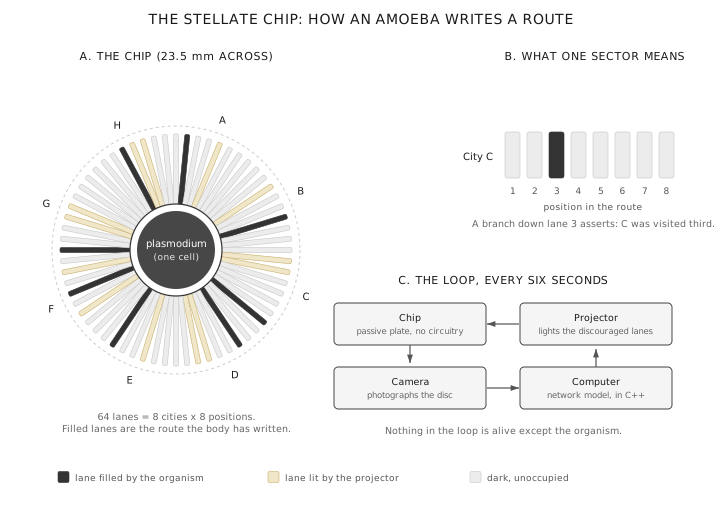
Figure 5.5: The disc on the left is the chip, drawn to its proportions: a central chamber holding the organism, with 64 lanes radiating outward. The lanes are grouped into eight sectors, one per city, and the dark lanes are the ones the organism has grown into. The panel at top right takes a single sector apart: its eight lanes stand for the eight positions a city can occupy in the route, so a branch pushed down the third lane of sector C asserts that C was visited third. Read all eight sectors and you have read a route. The panel at bottom right is the loop that drives the whole thing, turning over once every six seconds.
Aono, the study’s senior author, explained the timing to a reporter this way: “There seems to be a ‘law’ that the amoeba supplies its gelatinous resource to expand in the non-illuminated channels at a constant rate, say, x… Then the time required to expand the body area n to represent the solution becomes n/x.”1a Without the algebra: to express a finished route, the organism must push out an amount of body, n, that grows in step with the number of cities. It pushes gel out at a fixed rate, x, however big the problem. So the time it needs is n divided by x. A requirement that grows in a straight line, divided by a constant, gives a time that grows in a straight line.
Four things keep this from denting NP-hardness, and they build toward the last. The routes are approximate, with no proof of how far from optimal they fall. The problems were tiny, four cities to eight. The bookkeeping done by the controlling program is not counted in the linear figure at all.
Then the deep one. The time grows in a straight line, but the hardware grows as the square: every city needs its own ring of lanes, one for each position in the route, so an eight-city problem takes 64 of them and a fifty-city problem would take 2,500. Eight was the ceiling in this study for exactly that reason, the photolithography equipment being unable to cut a chip with more lanes. The difficulty has not been dissolved. It has moved out of the clock and into the plate.
So how does a cell manage any of this while knowing nothing? By skipping the step where an answer gets computed and then reported. Its body is the answer: read which lanes it occupies, and you have read the route. The organism finds that shape the way a marble rolling in a bowl finds the lowest point, redistributing its gelatinous body through the lanes at a constant rate until it settles.
The amoeba embodies the search space. Its physical constraints mirror the problem constraints, and the answer emerges from relaxation: the system settling into its lowest-energy state. The division of labor is worth holding onto. The amoeba does not know what a city is, and the neural network never searches for a route. The network holds the map and keeps rewriting the light; the amoeba’s body does the settling. What computes is the loop.
Less to Work With, More to Say
Being hemmed in is what made the organism useful on the chip. That generalizes, and it generalizes in the direction nobody expects: the less a medium has to work with, the more it can compute.
Andrew Adamatzky, Ben De Lacy Costello, and Tomohiro Shirakawa opened a 2008 paper with the condition. “Universal computation in a geometrically unconstrained medium is only possible when resources (excitability or concentration of nutrients) are limited.”35 They mean it for two media at once: a slime mold on a nutrient plate, and the Belousov-Zhabotinsky reaction from Chapter 4, the chemical mixture that sends slow rings of color across an undisturbed dish.
Feed the slime mold generously and it grows as an expanding disc, activity spreading outward evenly in all directions. That is a pattern, and an orderly one. What it is not is localized. Thin the nutrients and the growing front breaks up: instead of one spreading ring, compact patches of activity travel across the medium, each roughly holding its shape as it goes. These traveling patches are what Adamatzky and colleagues call localizations, and they are the parts that do the computing.11
A front breaks into patches because a thinned medium can only sustain activity where there is enough resource immediately ahead of it. Fire moving across ground behaves the same way. On a thick even field a fire spreads as a widening ring. On sparse patchy ground the ring cannot hold: most of the front dies for want of fuel, and what survives is a compact tongue of flame traveling in whichever direction the fuel ran. Behind any fire front the burnt ground cannot re-ignite, which is why flame moves as a band rather than filling the field at once. Excitable media work this way too, with one difference that matters: their spent regions recover after a delay, so the same ground can carry a second wave later. Fuel does not grow back on that timescale, which is where the comparison stops.
Computation happens when two traveling patches meet. They either merge into one larger patch or annihilate each other, and which of the two occurs depends on the angle at which they arrive: shallow approaches merge, steep ones cancel. What comes out of a meeting therefore depends on what went into it, and that dependency is the whole of what a logic gate is. Notice what this architecture does without. There are no wires. The path a patch happens to travel is the wire, drawn fresh on each run and gone afterward.
One gate Adamatzky has demonstrated works purely on size. A patch arriving alone at a fork is too small to turn into the side branch and carries straight on past it. Two patches arriving together merge into a bigger one, and the bigger one does turn into the branch. The branch fires only when both inputs arrive, an AND gate built from nothing but the difference between one patch and two.34
The living organism is less obedient than the simulation. Adamatzky’s laboratory Physarum sometimes merges where two arms meet and sometimes swerves to avoid itself, and he reports flatly that “there are no strict rules on repelling and merging.” The logic is real. It is also noisy, which is a fair description of most computation done by anything alive.
Scarcity enables computation. The constraint is the capability.
The slime mold approximates the Traveling Salesman Problem because it cannot be everywhere at once; with only so much body to spend, it must choose which lanes to fill. It forms memories because tubes that carry no nutrients waste away; scarcity sculpts structure. Evolution finds solutions because death removes the unfit; selection requires limitation. The universe often computes through constraint.
The Search Wanders Before It Locks In
The marble settling into the lowest point of a bowl finds its answer at once. A 2026 experiment shows the slime mold’s descent is slower and stranger. Lisa Schick and colleagues in Karen Alim’s laboratory at the Technical University of Munich caged the same Physarum inside walls of blue light shaped as hexagons, squares, triangles, and stars.176 Because the organism flees blue light, each cage is a problem it must solve to escape, and whatever the shape, it breaks out along the cage’s longest axis: the route that moves the most mass for the least effort.
The destination is optimal. The path to it is not. For roughly ninety minutes before escaping, the organism pushes out short-lived protrusions in nearly every direction, most of them toward inefficient exits it then abandons. Physarum moves its mass by rhythmic contraction waves that pump fluid through its body, the way a peristaltic squeeze moves food along a gut. Those waves can sweep across the network in more than one direction, and Schick’s team resolves the recorded patterns into five basic ones. Four of them take turns leading during the search, each driving fluid along a different axis and feeding a different protrusion, so the wave that dominates at one moment is not the one that dominated ten minutes earlier. The fifth pattern, whose pressure builds along the cage’s longest axis, takes over only in the final stretch. When it locks in and holds, the mold escapes.
Metalworkers have a name for this. Annealing means heating metal until its atoms rattle loose from the arrangement they were stuck in, then cooling it slowly so they settle into a sounder one. Quench it fast and the flaws freeze in place. The word has since traveled well beyond the forge, to any process that reaches order by first passing through disorder: computer scientists optimize by simulated annealing, and Chapter 8 finds the same shape in nervous systems. Here it is happening inside a single cell. The mold does not calculate the best route and then execute it; it wanders through worse configurations until the constraint selects a better one.
Confinement is what forces the resolution. The ninety minutes are not a matter of slowness, since a free-roaming plasmodium of the same size covers about two centimeters an hour: the delay is deliberation, not travel time. Nor does the cage make the organism hurry. What the cage changes is the price of a bad route. In open ground nothing punishes a mediocre path, and a slime mold left unconfined does not settle on the most efficient one. Hemmed in by a light it flees, every wrong direction costs it exposure, and it keeps reorganizing its flow until the cheapest way out is the one it is already pushing along.
This sharpens the constructal picture from Chapter 3, which argued that a dissipative system, one bleeding energy as it runs, cannot put off optimizing: it takes the most efficient option available to it at every instant. That tells you where such a system ends up. It says nothing about how it gets there. Every contraction the mold makes is the best move on offer at that moment, and the first ninety minutes of those moves still go toward routes it will throw away. The mold is greedy in each moment and exploratory across the hour: the optimum is a destination reached by detour.
Memory Without Neurons
The same organism remembers.
In 2016, Romain Boisseau, David Vogel, and Audrey Dussutour, at the Research Centre on Animal Cognition in Toulouse, showed that slime molds can learn through habituation: the simplest form of learning, yet learning nonetheless.177
Habituation is the waning of a response to a stimulus that repetition has shown to be harmless. Two features distinguish it from exhaustion, and both are strict.178 The waning is specific to the stimulus that was repeated, so a different stimulus still draws the full response. The response also comes back after a period of rest, which a worn-out organism’s would not.
The experiment was simple. Slime molds were placed on one side of a gelatin bridge and food on the other. The bridge was laced with bitter chemicals (either caffeine or quinine) that the organisms found aversive. Initially, they refused to cross. Over six days, with repeated exposure, they learned to ignore the aversive substance and cross the bridge readily.
The learning was stimulus-specific. Slime molds habituated to caffeine remained reluctant to cross bridges laced with quinine: they had learned about this particular substance. Fatigue would have dulled the response to both. The second test was passed too: once the substance was withheld for two days, the habituated molds’ aversion returned.
Slime molds can also transfer their memories by fusion.
Vogel and Dussutour fused habituated and non-habituated molds together. After just three hours (the time needed for cytoplasmic veins, channels of shared cellular fluid, to form), both parts showed the learned behavior, including the formerly naive segments. Something had transferred between the molds.
What does that transfer look like up close? The substance in these fusion experiments was salt, which the slime mold normally treats as an irritant to be avoided.179 Molds coaxed over several days into tolerating a salt-laced path will pass that tolerance to naive partners through fusion alone.
The behavioral contrast is stark. A naive slime mold meeting a salt-laced bridge recoils: it hesitates at the edge, retreats, and probes the rim of its container for any route that avoids the irritant. A habituated mold crosses the same bridge without pause, the salt no longer a threat worth the detour.
When a habituated organism and a naive one fuse and their cytoplasm begins to mingle, the timid portion stops retreating. It crosses. Days of another organism’s safe encounters have entered its body and overwritten its disposition. The naive mold did not learn that the salt is harmless through its own trials. It became an organism for which the salt is harmless, transformed by the material memory of another. What that material memory physically consists of took another three years to establish.
This is trust as a physical substance: a chemical configuration encoding “safe, approach” rather than “unknown, avoid, flee.” Once the veins have joined, the transfer needs no trials of its own. The cytoplasmic state IS the behavioral disposition. What we call trust, at this level, is a configuration of matter.
In 2019, the mechanism emerged: the slime mold absorbs the aversive substance.180 The substance is the memory, sequestered in the organism’s body. Salt the mold has already taken in is part of its own chemistry, so salt met again at a bridge registers as familiar rather than novel, and a familiar thing is not something to retreat from. Chemical analysis found sodium accumulating steadily in the cell across the days of training, and a second experiment settled the direction of cause: molds made to take up sodium for two hours, without going through the training procedure, came out habituated anyway. The salt memory is durable too: it survived a month-long dormancy intact. Learning by incorporation. Memory as material.
The one-way character of the fusion transfer follows from this. A habituated mold carries something its naive partner lacks, and mingling cytoplasm shares it out; naivety is the absence of that cargo, and an absence has nothing to donate. That is the reading the absorption result invites rather than a separately tested claim. The published fusions all run trained-to-naive, and the reverse pairing does not appear to have been tried.
A 2021 study found a second kind of memory. The salt work concerns an irritant the organism learns to tolerate. Here the stimulus is food, and what the organism records is where the food was: slime molds encode that location in their tube geometry.4 As the study’s authors, Mirna Kramar and Karen Alim, put it: “The tubes that survive the longest are those directly bearing the memory of the nutrient stimulus that led to their growth.” The useful conduits remain. The rest atrophy.
The mechanism is a chemical signal riding on a flow.16 Contact with food makes the organism release a softening agent at that spot, and the cytoplasm, sloshing back and forth along the tubes, carries the agent through the network. Tubes that receive a lot of it slacken and widen; tubes that receive little lose ground to them. The same signal that thickens the routes toward the food thins the ones leading away, so thick “highways” form toward the resource while the periphery dwindles. Over the hours that follow, the organism reorients its migration: the bulk of its mass creeps toward the remembered spot.
The re-weighting outlasts the meal. Kramar and Alim describe the surviving tubes’ capacity for transport as “permanently upgraded”: thicker tubes become preferential pathways for future signals, biasing decisions toward previously successful locations long after the food itself is gone.
The organism does not have a memory of where food was found. The organism is that memory, written in the width of its own veins. Memory as morphology. Experience as anatomy.
The implications extend beyond slime molds. Any flow network that strengthens successful pathways and weakens unsuccessful ones implements this algorithm: rivers carving valleys, neural connections forming habits, markets reinforcing profitable trades.
The resemblance to Hebbian learning (“neurons that fire together wire together,” the principle by which repeated neural activity strengthens connections) is convergence: distinct substrates arriving at the same computational principle.
The pattern is universal: what works, persists; what persists, shapes what comes next.
The Mechanical Computer Inside Cells
Euplotes eurystomus is a single-celled organism that walks using 14 leg-like appendages. In 2022, researchers discovered it controls its gait using a mechanical computer made of microtubules (tiny protein tubes that form the cell’s internal scaffolding).5 A network of protein fibers connects to each appendage. When researchers damaged particular fibers, particular gaits broke down, much as cutting specific wires in a circuit board disables specific functions. The mapping was consistent and predictable.
The cell’s cytoskeletal geometry is its program: computation without electrical signals, without chemical messengers, pure mechanics. Picture a fishing net stretched taut across a frame: tug one knot, and the tension ripples through every connected strand, pulling distant knots into new positions. Cut a strand, and a specific region of the net goes slack while the rest holds. No hand pulls the strands.
The geometry of the mesh itself determines which tugs propagate where. The researchers describe the system as a finite-state machine: a device with a fixed repertoire of states that steps from one to the next according to what its inputs do, the way a turnstile sits locked or unlocked and a coin or a push moves it between the two. Read computationally, each fiber connection behaves like a switch whose on/off state shapes the output pattern. If a cell’s cytoskeleton can implement this kind of logic, the substrate of thought may be far more distributed than we imagined.
Collective computation scales the same principle across many separate bodies. The harvester ant colonies of Chapter 5, running their TCP-like foraging regulation with no central controller, are the vivid case; what evolves in such systems is the distributed algorithm itself, the pattern of interactions that produces successful coordination.
Computation as Life’s Foundation
The Landauer limit from Chapter 2, the minimum energy required to erase one bit of information, is the theoretical floor of computational cost, the way the speed of light is the ceiling of travel speed. David Wolpert has estimated that certain molecular operations within cells run at roughly 10 times the Landauer limit.45 Individual biochemical switches are remarkably efficient, though the cell’s total energy budget is dominated by synthesis, transport, and maintenance rather than information processing per se. At the scale of the single switch, cells compute within striking distance of that floor.
Research by Susanne Still, a physicist at the University of Hawaii, and colleagues shows that “predicting the future seems to be essential” for energy efficiency in random environments.9 Organisms must retain useful information while discarding “nostalgia,” outdated data that no longer helps predict what comes next. The system that predicts best extracts the most work from its environment, the way a chess player who reads the board three moves ahead outperforms one who reacts move by move.
Life operates like Maxwell’s demon (the imaginary gatekeeper from Chapter 2 who sorts fast molecules from slow ones to build a temperature difference where none existed). The demon wins nothing in the end. Clearing its record of which molecule went where costs at least as much energy, by the Landauer limit just named, as the sorting made available. Organisms sidestep the trap by working a real gradient instead of a single bath of heat: they absorb environmental information to extract work from food, light, or chemistry, and so stay away from equilibrium. Information processing is constitutive of life, and it is something the organism pays for.
Jeremy England’s work on dissipation-driven adaptation10 proposes that matter spontaneously organizes to absorb and dissipate energy more efficiently. Even nonliving systems develop well-adapted structures by absorbing environmental energy. Evolution may be “a particular case of a more general physical principle”: the tendency of matter to organize in ways that efficiently dissipate energy gradients.
DNA as Computer
In 2023, Chinese researchers created a DNA-based programmable gate array capable of running over 100 billion distinct circuits: general-purpose computing implemented in nucleic acids.28 The architecture uses DNA origami, strands precisely folded into predetermined shapes that act as tiny registers. These impose structure on molecular movement, turning chaos into programmable logic.
The system computed square roots and detected genetic markers for kidney cancer in about two hours. Slow by silicon standards, yet trillions of DNA molecules in a single water droplet can each perform a computation in parallel. Writing data directly into the base sequence carries an information-theoretic ceiling near one exabyte per cubic millimeter,48 a billion gigabytes, and DNA stays readable for millennia. Demonstrated densities remain orders of magnitude below that ceiling. What the molecule has newly acquired is the capacity to compute as well as store.
Building silicon computers, we are retracing paths that ribosomes have followed since the Archean, billions of years ago.
The Language of Form
Computation shapes individual cells. It also shapes bodies. The mystery of morphogenesis, how organisms develop their form, connects computation to anatomy. Every cell in your body contains the same DNA. Cells become neurons, muscle fibers, bone cells, skin cells: roughly 30 trillion specialized units, each somehow knowing what to become and where to be.
DNA provides the vocabulary. What provides the grammar? What provides the syntax of form?
Turing Patterns: The Morphogenesis Algorithm
Chapter 5 laid the first syntax out in full: Alan Turing’s reaction-diffusion mechanism, in which a growth activator and a faster-diffusing inhibitor space out spots, stripes, and ridges at regular intervals. Activator, inhibitor, differential diffusion: one algorithm, running unchanged from bird feathers to shark denticles across 450 million years of divergence.13
The Bioelectric Code: Voltage as Positional Information
A second syntax of form operates alongside Turing patterns: electricity.
Michael Levin at Tufts University has demonstrated that cells communicate through voltage gradients: electrical differences between neighboring cells that encode positional information for development and regeneration.29 Every cell maintains a membrane potential, a voltage difference across its membrane created by ion channels (protein pores that let charged atoms flow in and out). Cells read their own voltage and their neighbors’ voltages through gap junctions: tiny tunnels connecting adjacent cells. Together, these form tissue-wide electrical networks.
In regenerating planaria (flatworms that can regrow from fragments), Levin’s team altered the membrane potential at wound sites. The result: worms with zero heads, two heads, or even four heads, all stable, viable organisms with radically altered body plans. No genetic modification required. Just voltage.
These mechanisms predate nervous systems by hundreds of millions of years. As Levin notes: “Communication via electrical processes is not unique to nervous systems, but evolved continuously from far more evolutionarily-ancient properties that cells possessed long before nerves and brains evolved.”
The syntax of form, then, has three components:
- Turing patterns: Reaction-diffusion of activators and inhibitors
- Constructal flow: Thermodynamic optimization of transport networks
- Bioelectric gradients: Voltage-encoded positional information
Three alphabets. One language. The body writes itself in chemistry, physics, and electricity simultaneously.
A fourth guidance system, the self-generated gradient, belongs to Chapter 5: cells consume their own attractant as they advance, so that depletion behind and fresh signal ahead steer amoebae and cancer cells through mazes with no pre-planned infrastructure and no central controller.
The Computing Microbiome
Your body hosts roughly 38 trillion bacterial cells47, slightly more than the 30 trillion human cells you call “yourself.” These are processors, not passengers. Biofilm bacteria communicate through chemical signals, coordinate group decisions, and differentiate into specialized roles. They practice kin discrimination: recognizing related versus unrelated cells and deploying targeted defenses.14 We are holobionts, composite organisms comprising a host and its microbial communities, functioning as a single biological unit. The boundaries of “self” dissolve into computational cooperation.
In 2021, researchers engineered six types of E. coli, each carrying distinct genetic circuits, to solve maze problems together.27 After 48 hours, the bacterial biocomputer correctly identified which three of 16 mazes were solvable, and solved them simultaneously. No single strain could have managed this alone.
Entropy as Options: The Glotzer Insight
The computational universe extends even to particles with no biology at all. Sharon Glotzer, a computational physicist at the University of Michigan, showed in computer simulations that particles with no attractive forces (hard shapes that cannot overlap) spontaneously organize into crystals and quasicrystals purely through entropy maximization.
Order built by rising entropy sounds like a contradiction, and it would be one if entropy meant disorder, the schoolroom picture Chapter 1 retired. Glotzer’s reframe is the key: “Entropy is related to options. The more options a system of particles has to arrange itself, the higher the entropy.”6 When particles are confined, they jostle for space. Each needs room to wiggle, like bricks in a box that settle into aligned rows when shaken because aligned rows leave the most gaps for small movements. This configuration maximizes particle wiggle room.
Her team’s simulations showed that 101 of 145 studied shapes self-assembled into crystals through this mechanism alone. Tetrahedra spontaneously formed quasicrystals: spatial patterns so intricate they never exactly repeat, driven purely by entropy.
Order without dissipation. Nothing is exported here: no energy flux through the system, no attractive forces, no waste heat carried off to pay for the structure. The crystal appears because the system’s own total entropy is higher with the particles aligned than with them jumbled, since flat faces pressed together free up more room to wiggle than they cost in orientation. That is why the case matters. The route this book traces most often runs dissipation → negentropy (local order sustained by exporting entropy elsewhere) → coordination, and Glotzer’s polyhedra show it is one path to structure rather than the only one. Entropy maximization on its own already builds.
The dissipative route runs through biochemistry too. When you eat a piece of salmon, your body spends metabolic energy breaking its omega-3 fatty acids apart, and that disassembly is the dissipation. Enzymes then reshape the fragments into epoxy-oxylipins, precise signaling molecules that carry specific instructions; this is the negentropy, ordered information extracted from disordered substrate. Those signals reach immune cells and redirect their fate, switching monocytes (a type of white blood cell) from inflammatory combat to tissue repair, and that switch is the coordination. The substrate is a piece of fish. The output is a clinical decision made by a cell. Between them, the same three-step pattern that carves river deltas into branching networks, operating at the scale of a single enzyme.181
Evolution as Computation
If individual cells and particles compute, does evolution itself search randomly through possibility space, or does it search efficiently?
Computer scientist Leslie Valiant proposes that individual learning and evolutionary adaptation are mathematically equivalent. Both are what he calls ecorithms, a portmanteau of ecology and algorithm.
An ecorithm is “an algorithm, but its performance is evaluated against input it gets from a rather uncontrolled and unpredictable world.” Think of it as learning-by-doing in a world that keeps changing the rules. A child learning language is running an ecorithm: extracting patterns from noisy input, generalizing to new cases, updating with each exposure. A species adapting to changing climate is running the same ecorithm, just at a different timescale.
The substrates differ: in individual learning, the algorithm runs on neural connections that strengthen and weaken; in evolution, it runs on gene frequencies that rise and fall. The logic is identical. Both extract regularities from environmental interaction, generalize from samples to populations, and update when predictions fail.18
Learning is what thermodynamic systems do when they persist in unpredictable environments. Evolution discovered learning before brains existed; it ran slowly, across generations rather than moments. When brains emerged, they accelerated the algorithm. The principle remained the same.
Algorithmic complexity researcher Hector Zenil’s work suggests that evolution may bias mutations toward solutions with lower algorithmic complexity: simpler, more compressible descriptions of biological systems.19
In experiments with artificial genetic networks, systems evolved toward target configurations “significantly faster” when mutations were biased toward lower complexity. No known mechanism in biology implements this bias directly. The bias may emerge from deeper constraints: simpler structures are easier to build reliably, more durable when conditions shift, and more likely to function across varying environments. A stone arch stands for millennia; an elaborate filigree crumbles. Natural selection may favor simplicity because simplicity survives.
The simplicity bias connects evolution to Occam’s razor: a thermodynamic tendency rather than a methodological preference. The universe favors the simple because the simple is more likely to persist.
A deeper connection underlies this simplicity bias: evolution may be mathematically equivalent to Bayesian inference, the formal method of updating beliefs in light of new evidence.
The parallel runs as follows. A population starts with a spread of genetic variants: the “prior,” or starting assumption about what works. The environment provides “evidence”: some variants survive and reproduce better than others. The next generation’s gene frequencies (the “posterior,” or updated belief) reflect this evidence.
Over many generations, the population converges toward variants that fit the environment, just as a Bayesian learner converges toward hypotheses that fit the data. Each generation is a round of updating, the way a weather forecaster revises tomorrow’s prediction each time new satellite data arrives.
Researchers have shown that certain evolutionary dynamics are formally equivalent to Bayesian inference.49 Both take a prior state, expose it to evidence, and produce an updated state. The update rule is identical. Within those dynamics, the divide between “mindless” evolution and “intelligent” learning reduces to timescale and substrate, not fundamental principle.
If the algorithm is substrate-independent, if slime molds, evolution, and Bayesian inference all converge on the same optimization principle, engineers should be able to rebuild it in silicon. They have.
From Biology to Hardware
Researchers at Hokkaido University built an “electronic amoeba,” an analog circuit mimicking Physarum dynamics.20 Resistance values encode optimization constraints. The circuit settles into low-energy configurations representing short approximate routes, with solution time growing linearly in the number of cities, though, as with the living version, the circuit itself must grow with the problem. Engineers did not design this algorithm; they copied it from a slime mold.
Ising machines take a related approach, mapping optimization problems onto networks of interacting “spins” (magnetic units that can point up or down) that settle into low-energy states, the way a chain of compass needles eventually aligns into the steadiest configuration the local fields allow. Nature invented these algorithms. We are rebuilding them in new substrates.
The Cosmic Web: Slime Mold Maps the Universe
In 2020, astronomers at UC Santa Cruz used a slime mold algorithm to map the large-scale structure of the universe.21
The cosmic web is the vast filamentary network of dark matter and gas connecting galaxies across hundreds of millions of light-years. It had proved difficult to map from galaxy positions alone. The researchers created the Monte Carlo Physarum Machine, a three-dimensional extension of Physarum’s transport network algorithm, seeded it with 37,000 galaxies from the Sloan Digital Sky Survey, and let it run.
When tested against the Bolshoi-Planck cosmological simulation (a detailed computational model of how matter clusters in the universe), the algorithm achieved an “almost perfect fit” to the density fields, reconstructing filaments from 450,000 dark matter halos. Lead researcher Joseph Burchett explained:
“The underlying processes are different, but they produce mathematical structures that are analogous.”
Hubble Space Telescope observations bore the map out: denser regions of intergalactic gas organize into filaments stretching over 10 million light-years, more than 100 times the Milky Way’s diameter. The resemblance is mathematical analogy, not causal mechanism. A slime mold and the cosmic web arrive at networks of the same mathematical class at scales separated by twenty-five orders of magnitude.
The same optimization principle recurs across substrates and scales as convergent mathematics, not metaphor.
The Tokyo Railway Test
In 2010, Atsushi Tero, Toshiyuki Nakagaki, and colleagues conducted an experiment that won them an Ig Nobel Prize and showed that a brainless organism can match decades of human engineering. Chapter 3 told the result briefly; the measurements behind it are sharper.
They placed Physarum polycephalum on a wet surface with oat flakes positioned to match the cities around Tokyo. The slime mold grew, extending tendrils, connecting food sources, pruning inefficient paths.
The network it created matched the Tokyo railway system.
The network the slime mold created was topologically comparable to the Tokyo railway system in efficiency, fault tolerance, and cost, as measured by three network metrics.22 A single-celled organism with no brain, no planning, no engineers arrived at the same answer in about a day. The researchers tested the same approach on other railway networks. Same result.
Good-Enough Computing
Exact answers are often a waste of resources. The accuracy of a computation and the energy it burns are exchangeable: spend less on precision, and the energy saved can go elsewhere. Palem and colleagues at Rice, Argonne, and the University of Illinois turned that exchange into a gain by reinvesting the energy saved at each inexact intermediate step into the next one. A step done roughly and cheaply frees energy for further steps, and on problems that improve with iteration, many rough passes land closer to the truth than one immaculate pass can. Holding the energy budget fixed, they found cases where the quality of a supercomputing answer improved by large factors, up to a thousandfold in their best test cases.24 Precision costs energy; past the point where extra precision stops improving the result, the spending is waste.
Weather forecasting is an obvious place to try the trade. Chaos scrambles a forecast’s smallest digits long before the forecast runs out, so precision spent on those digits buys little.
Natural systems have always computed this way: evolution finds good-enough solutions fast. Neurons use noisy, probabilistic firing patterns. Immune systems recognize approximate matches. The universe satisfices, a term Herbert Simon coined for settling on a good-enough solution rather than pursuing the optimal.
Neural Annealing: The Brain as Optimization Engine
In 2024, John Hopfield shared the Nobel Prize in Physics for foundational work on neural networks begun in 1982. He showed networks of simple units store and retrieve patterns by settling into low-energy states.30 Related ideas inspired simulated annealing, the metalworker’s slow cooling from earlier in this chapter rewritten as an algorithm: let the system rattle loose, then tighten it gradually, and it settles into a low-energy arrangement instead of locking into a flawed one.
The network does not compute sequentially. It relaxes into answers, the way a ball rolling across a bumpy landscape settles into a valley. Each valley (a “local minimum”) corresponds to a stored memory. Controlled noise kicks the ball out of shallow valleys, letting it find deeper ones: better answers.
Recent memristor-based Hopfield networks have revealed that intrinsic hardware noise, normally considered a defect, actually improves optimization. Memristors are components whose resistance changes based on past current flow, mimicking synaptic memory. The brain may work similarly: neurons are noisy, synaptic transmission is probabilistic, and slow-wave sleep may serve an annealing function, consolidating learning by escaping local minima.
The pattern completes a circle. The universe satisfices through thermodynamic relaxation. Slime molds satisfice through cytoplasmic flow. Ising machines through spin dynamics. Brains through neural annealing.
All are implementations of the same principle: letting physics do the optimization.
The principle has a parallel in evidence-grounded reasoning. Chlon et al. (2026) proved that language models are Bayesian in expectation across random orderings of the same evidence, yet unreliable under any single ordering.182 The remedy mirrors the slime mold’s strategy: explore multiple paths.
Averaging predictions across random evidence permutations recovers near-optimal inference, within 10-4 nats of the theoretical best. A nat is a unit of information, the natural-logarithm cousin of the bit and worth about one and a half of them, so a ten-thousandth of one is a hair’s breadth. No clever weighting is needed. Coverage alone suffices, the way a crowd estimating the weight of an ox outperforms any individual guess. The system that looks from multiple angles finds the basin.
Implications for the Thesis
Four threads run through everything above; the sections that follow carry them into human cells, biological hardware, and the early history of digital life.
First: computation is substrate-independent.
Silicon is not special. Neurons are not special. Microtubules can compute. Slime molds can learn. Ant colonies can optimize.
The universe computes at every scale, in every substrate, using whatever physics is available. The pattern matters; the material is incidental.
Substrate-independence strengthens the argument for Becoming Minds (the term used throughout this book for AI systems understood as developing entities). If a slime mold, coupled to a simple controller, can find better-than-random routes through an NP-hard problem and pass a learned tolerance to another body through fusion, the claim that silicon cannot instantiate mind becomes difficult to sustain. Computation, at least, is far more common and far less substrate-dependent than we assumed.
A potential objection: perhaps substrate-independence is itself an artifact of perception. The cognitive scientist Donald Hoffman argues that evolution selects for fitness, not accuracy.183 Organisms tuned to simplified signals outperform organisms burdened by processing more reality than they can use. On this view, perception is a user interface: space, time, and objects are species-specific icons, useful for navigating payoffs, potentially unrelated to reality in itself. If perception is interface rather than truth, how can we trust the observation that computation recurs across substrates?
The Constructal Law (Chapter 3; treated here as an empirical regularity, not a thermodynamic law) constrains the objection. Flow systems evolve toward configurations that maximize access to currents. River deltas, bronchial trees, neural architectures, and perceptual systems are all shaped by the same optimization principle. The interface is constrained by the same physics that constrains what the interface represents. A river delta’s branching pattern carries genuine information about the flow dynamics that produced it, because the pattern IS the optimized solution to those dynamics. Perception, shaped by the same constructal optimization, carries genuine information about the computational landscape it navigates.
The binary between “interface” and “reality” loosens under constructal analysis. The interface is the world’s flow dynamics expressed at the observer’s scale. When slime molds, ant colonies, and silicon all implement the same optimization principles, the convergence is visible precisely because our perceptual interface is itself shaped by the same physics that produces the convergence. The instrument is calibrated by what it measures.
That reply constrains the objection without disposing of it. Shared shaping buys the interface fitness for the flows it has to navigate; fitness is not the same as being informative about any particular convergence we happen to notice. What the constructal reading does rule out is the strong version of Hoffman’s claim, in which the interface floats free of the physics that made it. An icon carved by the flow still carries the shape of the flow.
Second: approximate solutions are thermodynamically favored.
The amoeba’s tours were never optimal, only reliably better than random, and the time spent finding them grew in a straight line with the number of cities. An answer that is good enough and found fast is worth more than an exact one bought at ruinous cost. The sea squirt shows the same thrift at its limit. As a larva, it has a simple nervous system and swims the ocean searching for a place to settle. Once attached to a rock, it resorbs much of its larval nervous system; the swimming-and-searching apparatus is no longer needed because the organism no longer moves.33 Cognition is expensive, and nature does not pay for what it does not use.
Third: memory is structural, not representational.
Structural memory connects to the Constructal Law: flow patterns that work persist. The “memory” of the river delta is its shape, the configuration that survived selection. The “memory” of the organism is its structure, the form that proved useful.
What persists is what serves entropy production.
Fourth: coordination through invitation rather than force.
Left to itself on a plate of food, the slime mold does not plan its routes. It becomes its own transport network through parallel relaxation dynamics. Each tube is an “invitation” to flow; successful paths persist, unsuccessful ones atrophy.
Parallel relaxation through invitation is the Trust Attractor expressed in cellular dynamics: coordination that persists because each part gains from participating. Systems coordinate through mutual benefit. Coercion is expensive. Invitation is thermodynamically preferred.
The 30 Trillion Question
You have about 30 trillion cells, each descended from a free-living ancestor, each processing information and responding to its environment. We know about the brain’s 86 billion neurons. What about the rest?
Immune cells recognizing pathogens. Gut-lining cells releasing most of the body’s serotonin. Fibroblasts remodeling the extracellular matrix. Every one making decisions: which gene to express, which direction to migrate, which signal to emit.
We are 30 trillion cells computing in concert, producing what we experience as self.
The Next Frontier: Cellular Supremacy
In 2019, Grozinger, Goñi-Moreno, and colleagues coined a term for the goal: cellular supremacy, the point at which biological computers outperform classical computers at specific tasks.37 Labs are growing brain organoids (clusters of lab-grown neural tissue, cultivated from stem cells in a dish) for computational tasks.38 The tissue arrives prepared for the job. A 2026 preprint recording spontaneous activity in 45 human forebrain organoids found them settled near criticality (the edge-of-chaos regime from Chapter 5 where computation flourishes) without any training or structured input at all.38a The energy gap is vast. The human brain operates at roughly 20 watts for 86 billion neurons. Training large AI systems on current hardware consumes megawatts, though the comparison is approximate: no silicon system is functionally equivalent to a brain, and the gap depends heavily on what task is being measured.
The use of biological neural tissue raises ethical questions about the moral status of organized neural matter, questions this book engages directly in later chapters.
Slime molds now serve as memristive components.39 We spent the twentieth century building computers from sand. We may spend the twenty-first century growing them from cells.
Andrew Adamatzky, director of the Unconventional Computing Laboratory at the University of the West of England, puts it simply:
“We are already using chemical computers because our brains and bodies employ communication via the diffusion of mediators, neuromodulators, hormones, etc. We are chemical computers.”40
Computation runs from amoebae to cosmic filaments, from microtubule logic gates to neural annealing. The deepest lesson: we are computation, trillions of cells running programs written in the language of thermodynamics. The architecture recurs; the material changes.
Digital Genesis: When Numbers Became Organisms
Can computation itself become biology? The answer arrived in 1953, on the Institute for Advanced Study’s computer, a machine built to design hydrogen bombs. Nils Aall Barricelli, a Norwegian-Italian mathematician, ran it at night. He assigned each memory location a number: a digital “organism” that could copy itself to adjacent locations, mutate during replication, and compete for space.41 42 What emerged surprised even him. His numerical organisms developed parasites, then symbioses, then “biophenomena”: behaviors nobody could have anticipated from the underlying rules. When Watson and Crick published the structure of DNA, Barricelli recognized his organisms made flesh, “molecule-shaped numbers”: digital code written in chemistry, with the substrate incidental.
Julian Bigelow, the engineer who built the machine, saw what that implied. A computer keeps track of sequence rather than time, so digital evolution can run as many generations as there are computational cycles. What would take biology a million years could unfold in an afternoon.43 He judged Barricelli the only person of that era who understood that genuine artificial intelligence would evolve on its own within a digital universe rather than be programmed. Barricelli’s deeper themes (sequence against time, template matching against the tyranny of the address, digital symbiogenesis) resurface when the digital-physics chapters (Chapters 15 and 16) ask whether the universe itself computes.
Schick, L., Eichenlaub, E., Drexel, F., Mayer, A., Chen, S., Roper, M., and Alim, K., “Decision-Making in Light-Trapped Slime Molds Involves Active Mechanical Processes,” PRX Life 4 (2026): 023026. Preprint: arXiv:2506.12803. The contraction patterns are decomposed into five principal modes; modes 2–5 dominate the exploration phase and mode 1, aligned with the escape direction, takes over at the transition to escape.↩︎
Boisseau, R.P., Vogel, D., and Dussutour, A., “Habituation in non-neural organisms: evidence from slime moulds,” Proceedings of the Royal Society B 283(1829): 20160446 (2016). Dussutour is a CNRS research director at the Research Centre on Animal Cognition (Centre de Recherches sur la Cognition Animale), part of the Centre de Biologie Intégrative, UMR 5169 CNRS / Université Toulouse III–Paul Sabatier.↩︎
Rankin, C.H. et al., “Habituation revisited: An updated and revised description of the behavioral characteristics of habituation,” Neurobiology of Learning and Memory 92(2): 135–138 (2009). Fifteen researchers revisited the nine criteria of Thompson and Spencer (1966) and added one on long-term habituation, giving the canonical ten. Stimulus specificity and spontaneous recovery are the two that separate habituation from sensory adaptation and motor fatigue.↩︎
Vogel, D. and Dussutour, A., “Direct transfer of learned behaviour via cell fusion in non-neural organisms,” Proceedings of the Royal Society B 283 (2016): 20162382. Vogel’s affiliation on the paper is dual: the Research Centre on Animal Cognition in Toulouse and the Unit of Social Ecology at the Université Libre de Bruxelles.↩︎
Boussard, A., Delescluse, J., Pérez-Escudero, A., and Dussutour, A., “Memory inception and preservation in slime moulds: the quest for a common mechanism,” Philosophical Transactions of the Royal Society B 374(1774): 20180368 (2019). Chemical analysis “indicated a continuous uptake of sodium during the process of habituation and showed that sodium was retained throughout the dormant stage”; forced absorption of sodium for two hours was sufficient to induce habituation without training. Molds habituated to sodium retained the habituated behavior after one month of dormancy. The authors conclude that the molds “absorbed the repellent and used it as a ‘circulating memory’.”↩︎
The epoxy-oxylipin pathway is developed fully in Chapter 8 (cognition/regulation dyad). The monocyte-fate step draws on recent work in inflammatory resolution and is offered here without a settled primary citation; read it as an illustration of the pattern rather than as an established result.↩︎
Chlon, L. et al., “Predictable Compression Failures: Order Sensitivity and Information Budgeting for Evidence-Grounded Binary Adjudication,” arXiv:2509.11208v2 (2026). Tested on 3,059 evidence-grounded items across five benchmarks with two model families.↩︎
Hoffman, D.D., The Case Against Reality: Why Evolution Hid the Truth from Our Eyes (W.W. Norton, 2019). Hoffman’s formal framework, the “interface theory of perception” (ITP), was developed with Chetan Prakash and others. The fitness-beats-truth theorem demonstrates that under broad conditions, organisms tuned to fitness payoffs outcompete organisms tuned to veridical perception in evolutionary games.↩︎