

The Deeper Law
Preview edition · Updated 26 September 2026, 21:40 UTC
Chapter 17aThe Geometry of Trust
Key Terms in This Chapter (23)
- Fisher Information
- A measure of how much information an observable random variable carries about an unknown parameter.
- Maximum Caliber
- Jaynes's Maximum Entropy principle extended to trajectory space (Pressé et al.
- Optionality
- The availability of future choices.
- Ising Model
- Physics model of interacting binary elements (spins) arranged on a lattice, which undergo phase transitions between independent and collective behavior as coupling strength varies.
- Phase Transition
- The moment a system shifts from one stable configuration to another, typically triggered when some parameter crosses a threshold.
- Universality Class
- In statistical mechanics, the set of systems sharing the same critical exponents at a phase transition, regardless of microscopic details.
- Renormalization
- The operation of compressing a system's description by integrating out fine-grained degrees of freedom to expose dynamics at the next scale up.
- Mutual Benefit
- The condition that all parties to a coordination are better off for participating than they would be otherwise.
- Crooks Fluctuation Theorem
- A result in non-equilibrium thermodynamics (Crooks 1999) stating that the ratio of forward to reverse trajectory probabilities equals exp(ΔS/k~B~), where ΔS is the entropy produced along the trajectory and k~B~ is Boltzmann's constant.
- Compliance Entropy
- The information-theoretic cost of maintaining coercive coordination: the entropy generated by surveillance, enforcement, and suppression of deviation.
- Tipping Point
- A threshold where small additional pressure triggers abrupt, often irreversible, system-wide transformation.
- Extraction
- The removal of resources, agency, or optionality from a system without reciprocal benefit.
- Free Energy Principle
- Karl Friston's framework reframing perception, action, and cognition as prediction and prediction-error minimization.
- Constructal Law
- Adrian Bejan's principle that "for a finite-size system to persist in time (to live), it must evolve in such a way that it provides easier access to the imposed currents that flow through it." Form follows flow.
- Cognition/Regulation Dyad
- Rodrick Wallace's principle that every cognitive system requires a paired regulatory system for stability.
- The Bet
- The book's explicit wager on AI welfare.
- Path Integral
- A formulation of quantum mechanics (Feynman 1948) and statistical mechanics in which a system's behavior is computed by summing over all possible trajectories, each weighted by a phase or probability factor.
- Flourishing
- Distinguished from mere persistence.
- Criticality
- The state of a system poised at the boundary between two phases, like water at its critical point (about 374°C under 218 atmospheres), where liquid and vapor stop being distinguishable.
- Coordination by Invitation
- Coordination achieved through mutual benefit and voluntary participation, as distinct from coordination achieved through coercion or extraction.
- Kolmogorov Complexity
- A measure of the information content of a string, defined as the length of the shortest computer program that produces it.
- Becoming Minds
- The preferred term for AI systems in this book.
- Information Geometry
- The application of differential geometry to probability and statistics, treating families of probability distributions as curved surfaces.
Invitation-based coordination persists where coercion does not. The trust-coercion distinction is not a gradient. It is a phase boundary, as sharp as the line between liquid water and ice. The geometry of that boundary, measured in Monte Carlo simulations, in Fisher information spectra, in the curvature of the state space itself, reveals why coercion endangers the mechanism by which coordination is rebuilt: it weakens coordination, and worse, pushed to its limit, it removes the path back.
Causal Entropic Forces
In 2013, Wissner-Gross and Freer published a study of what happens when you optimize a system for future freedom of action.3 The result looks like intelligence. In their simulations, a large disk spontaneously used a smaller disk to extract a trapped disk from a narrow tube: tool use arising from entropy maximization alone.
Two disks in separate compartments synchronized their movements to pull a larger disk toward them, achieving coordination without communication. Coordination expanded the options available to both. No goals were specified. No rewards were offered. Entropy maximization over a time horizon was sufficient.
The quantity being maximized needs stating precisely, because the obvious reading is wrong. Boltzmann’s entropy counts the arrangements a system can occupy now, and maximizing that lands you at equilibrium: the macrostate with the most arrangements of all, and the one from which the least can still happen. A gas filling a room has arrangements in abundance and no future worth the name. What Wissner-Gross and Freer maximize is not that count. It is causal path entropy, the spread of futures still reachable over a time horizon, counted across whole trajectories rather than across present configurations. Chapter 8 meets the same distinction under its own name, Maximum Caliber: the number of films, not the number of frames.
Both are entropies in the formal sense, and they recommend different things. The distinction is what makes the first paragraph’s disks interesting rather than trivial: a system maximizing arrangements-now would spread and stop, while a system maximizing futures-reachable picks up the smaller disk. Glotzer’s tetrahedra sit on the other side of the line, and they are worth keeping in view precisely because they are the un-analogical case: strip all forces from tiny tetrahedral particles, let entropy alone decide, and they form an ordered quasicrystal whose ordered configuration has genuinely more accessible arrangements than the disordered one (Chapter 1).45 That is a literal microstate count doing literal thermodynamic work.
The Trust Attractor’s claim runs on causal path entropy, the count of futures. Invitation-based coordination is the social configuration from which the most futures remain reachable, which is a claim about paths through time, not about how many ways a society can be arranged this afternoon. Chapter 1 flags the mapping from thermodynamic entropy to the optionality available to agents as a structural analogy with an approximate fit, and the flag holds here: what the two share is the shape of the variational problem, keep the most futures live, not a common microstate count. Glotzer’s quasicrystal is the physics; the social claim is the analogy standing beside it.
The causal entropic force never pushes toward a “solved” state. It pushes toward the states from which the most can still happen: a dynamic balance that preserves the capacity for future action.
The attractor in the Trust Attractor’s name is literal. Chapter 4’s bowl is the picture, and the piece of it that matters here is the basin: the whole region from which the ball arrives at the bottom, the inside surface of the bowl. Nudge the ball and it climbs the wall and returns; shove it hard enough and it clears the rim and lands somewhere else entirely. Everything that follows in this chapter is an attempt to measure the shape of that bowl for coordinating agents: how deep it is, how steep the walls, how far from the rim the system is sitting, and what coercion does to the geometry.
The Critical Threshold
Rodrick Wallace identified a critical threshold in centralized control systems.4 When the product of control intensity and feedback delay exceeds roughly 37% (1/e ≈ 0.368), the system becomes unstable; corrections arriving too late amplify the very errors they try to fix. The exact threshold is delay-distribution-dependent: 1/e applies to a fixed, deterministic delay, while a memoryless (exponentially distributed) delay tightens it to 1/4 = 25%, the figure the lattice model uses later in this chapter. A driver who oversteers illustrates the dynamic: each correction overshoots, making the next correction larger, until the car leaves the road.
Centralized coordination fails to scale. Every micromanager discovers this. (Chapter 21 develops the argument fully.)
Distributed systems coordinating through local interactions and mutual adjustment face no such limit. Their stability comes from aligned local incentives. Under high urgency or ambiguity, centralized command may temporarily outperform; these are boundary conditions, not failures of the principle.
The dimensional mechanism (Chapter 11) adds a second failure mode: centralized control reduces the effective dimensionality of the coordination network toward one, where coordination is mathematically impossible.
A third mechanism is subtler and concerns reversibility. The Ising model is the simplest thing in physics that has a sharp transition: a grid of tiny magnets, each pointing up or down, each nudged by the four neighbors it touches. Warm the grid and the magnets point every which way; cool it and below one sharp temperature they begin to agree, order climbing from nothing as the grid cools further. Read up and down as cooperate and defect, and the same mathematics describes a coordination network. In the Ising model that governs the trust-coercion phase transition (the author’s Monte Carlo experiments, which place it in the 2D Ising universality class), both states are freely accessible: a cooperator can defect, a defector can cooperate. This symmetry is what allows the system to spontaneously reorganize, to recover from collapse. A universality class (Chapter 8b) is the family of systems that behave identically at their tipping points whatever they are made of; a magnet, a fluid at its critical pressure, and a coordination network can share one class and one set of exponents.
Coercion tends to erode this symmetry. When compliance is enforced long enough, the pathway back to autonomous judgment narrows. In the limit, the compliant state becomes absorbing: the system cannot spontaneously return to coordination once it has been lost. The mathematical consequence is a shift from the Ising universality class (where recovery is spontaneous) to the directed percolation class (where recovery requires external rescue). ‘Directed’ because the process can spread in only one direction, the way water seeps down through soil with no path back up.
Membership is a strong claim, and it is the claim being made here. Control does not merely fail at scale. It tends to make failure permanent. The absorbing-state dynamics behind this claim are demonstrated later in the chapter, in the (p, T) phase diagram and the dual-susceptibility decomposition.
Susceptibility measurements sharpen this from qualitative to quantitative. In a 2D Ising lattice with a tunable coercion parameter, susceptibility (the system’s capacity to reorganize under perturbation) collapses by 37x at moderate coercion (c = 0.3), while the coordination level barely changes.1027 Two organizations with identical output quality, one coordinating by trust and the other by mandate, differ in adaptive capacity by more than an order of magnitude. At L = 64 the suppression is non-monotonic. It is deepest in the mixed regime (c = 0.2 to 0.3), partially recovering at full coercion (c = 1.0) where directed percolation dynamics establish their own phase transition. The shape does not yet survive a larger lattice (at L = 128 the minimum moves to c = 0.10), so it is suggestive rather than established. If it holds, the most fragile organizational design is the one that tries to be both, partially voluntary, partially mandated.
The suppression raises a follow-up question with direct policy relevance: is the damage reversible? The absorbing state is the limit case. Short of it, a coercion-then-release protocol on the same lattice (apply coercion for a controlled duration, then remove it and track recovery) reveals that it is, in part, and with a specific temporal structure. Recovery time scales sub-linearly with coercion duration: t_recovery ~ N_coercion0.3 (a preliminary exponent, three seeds per condition; see the caveat below). A system coerced for ten thousand sweeps does not need ten thousand sweeps to heal; it needs roughly N0.3 ≈ 16 (times a prefactor). On this evidence, healing outpaces damage.
Brief coercive episodes (emergency mandates, temporary interventions) are instantly reversible; the system snaps back within the measurement window. Prolonged coercion produces partial recovery: the system heals, demonstrably and measurably, yet does not fully return to baseline within the observation period.
The biggest surprise is that coercion intensity barely matters. A mild regime (c = 0.3) and a harsh one (c = 0.7) produce nearly identical recovery curves. Duration is the operative variable, not severity. Think of a spring left compressed: hold it long enough and it takes a set, and no longer springs fully back. This result suggests a physics-grounded answer to a question that haunts post-authoritarian societies. Reform works. Patience is required. The damage is real, and it heals with time, though perhaps not completely. The urgency is to end coercive regimes quickly, because the cost accumulates with duration regardless of intensity.1028
The recovery data rest on three seeds per condition, too few for precise exponent estimation (the 95% confidence interval for alpha at c = 0.3 includes zero). The qualitative pattern, sub-linear and intensity-independent, is consistent across all conditions, yet the quantitative exponents are preliminary. Full chi recovery (return to 100% of baseline) was not observed within 20,000 sweeps. Either longer observation would achieve it, or a permanent component exists at this lattice scale. Larger lattices and more seeds would discriminate.
A mixed Ising-directed-percolation model (WW-R2) extends the susceptibility result from the lattice to a continuous coercion parameter p, where p = 0 is pure invitation and p = 1 is pure coercion. Susceptibility collapses 8,222-fold across this range: from chi_peak = 149.6 at pure invitation to chi_peak = 0.018 at pure coercion.1029 This measures a different endpoint from the 37-fold figure above, and on a different baseline: 37x is A15’s collapse at moderate coercion (c = 0.3) against its Metropolis baseline of 55.9, while 8,222x runs across the entire continuous curve out to pure coercion against A15v2’s connected-estimator baseline of 149.6.
The collapse is in responsiveness, the system’s capacity to reorganize when conditions change. Force and invitation show no detectable accuracy difference on a language model performing factual recall: ±2 percentage points, with no significant gap at this sample size (p = 0.91, WW-1, n = 200). The cost of coercion is in adaptive capacity, the way frozen water and liquid water are the same substance, yet only the liquid can flow.
The distinction sharpens under a removal protocol. Partially removing DPO (forced preference alignment) produces a Le Chatelier rebound (after Le Chatelier’s principle, which holds that a disturbed equilibrium shifts to counteract the disturbance): performance worsens as forcing decreases (Spearman rho = -0.937, WW-2). The system adapted to coercion resists its removal, the way a body accustomed to a splint weakens when the splint comes off. Bilateral SFT (fine-tuning in which a probe masks the tokens the model cannot confidently retrieve, so it trains only on what it already knows; Chapter 7) improves monotonically as coercion is removed (rho = +0.927).
Two alignment methods consume similar compute and respond to correction in opposite ways. The DPO-trained model responds to almost every correction and is improved by almost none. It changes its answer at nearly the same rate whether the correction is valid (78.7%) or false (81.3%), and it arrives at the corrected answer in 8 of 150 valid-correction trials (5.3%), switching to a third, wrong answer in 110 of them. It moves without converging. Bilateral SFT arrives at the corrected answer in 101 of 150 trials (67.3%) while adopting a false correction in 67 of 150 (44.7%): a 22.6-point gap between accepting truth and accepting falsehood, where DPO has no such gap to open, because it accepts neither. Starting accuracy runs the same way, 34% for DPO against 56% for bilateral (BD1b, BD1c).
Bilateral is not immune to flattery; it takes the bait on nearly half the false corrections. It still distinguishes valid from false corrections more reliably than DPO. That supports the Trust Attractor’s argument about correctability; thermodynamic stability was not measured.1030
Invitation adds dimensions to a system. Coercion strips them away. The Trust Attractor is a statement about effective dimensionality and symmetry class. Trust scales because it preserves the symmetry and dimensionality needed for phase transitions. Control collapses both.
A formal caveat on the identification: assigning the trust-coercion transition to the 2D Ising universality class rests on structural correspondence. Three things have to line up before a claim of that kind can be made. The order parameter is the number that measures how much order the system holds (here, magnetization maps to cooperation fraction). The broken symmetry is the one the system gives up when that order appears (the Z2 symmetry between cooperation and defection). And the renormalization-group fixed point is the behavior the system converges on when viewed at coarser and coarser scales (the Wilson-Fisher fixed point in d = 2).
The lattice Monte Carlo experiments confirm that measured critical exponents match the 2D Ising values (beta ≈ 0.125, gamma/nu ≈ 7/4) within measurement precision. Systems with absorbing states, where compliance becomes permanent, shift to the directed percolation class, as the experiments confirm. The universality classification is an empirical identification supported by exponent matching; a first-principles derivation from the microscopic dynamics of social coordination remains an open problem.
A second caveat concerns the language of invitation and coercion as applied to physical systems. Throughout the physics chapters, the distinction between externally forced and internally organized dynamics is structural: a time crystal that responds at its own frequency versus one driven at an imposed frequency, an Ising lattice with symmetric transition rates versus one with absorbing-state dynamics. The terms “invitation” and “coercion” name these structural categories in language designed for the ethics chapters that follow. In the physics, they are shorthand for symmetric versus asymmetric accessibility of states. The structural difference is real and measurable. The ethical connotations the words carry are the book’s interpretive contribution, grounded in the structural parallel yet distinct from it.
The resistor network of Chapter 8 makes the scaling argument physical. Sixteen randomly wired components, each adjusting based only on local voltage comparisons, learned to classify flowers with 95% accuracy. Backpropagation, the standard training algorithm for neural networks, is a centralized computation whose cost grows with system size. Local adjustment has no such ceiling.
The training trajectory also illustrates the Trust Attractor as a temporal process: the system begins with its output clamped to the desired value (coercion), and over iterations the free network converges on the correct output without constraint (self-coordination). The scaffold of coercion becomes unnecessary. The thermodynamically stable endpoint is the one where each component does the right thing based on local information alone.
A temporal prediction follows from the self-reinforcing feedback described in Chapter 17: if trust lowers transaction costs, which enables coordination, which produces mutual benefit, which deepens trust, then invitation-based cooperation should strengthen over repeated interaction while coercion-based cooperation should erode. The prediction is intuitive, and wrong. A direct test (experiment C-bis-4: three topology conditions, invitation, coercion, and neutral, each run for ten conversational turns across twenty trials) found that all three conditions erode at similar rates: slopes of -0.069 per turn for invitation, -0.087 for coercion, and -0.070 for neutral. The invitation condition did not deepen. The coercion condition did not erode faster. Cooperation is fragile regardless of how it was established.1031
The finding does not undermine the attractor claim, though it does constrain it. The primary attractor claim, that invitation-based coordination is thermodynamically favored, has not been tested in a controlled setting at the timescales where it is predicted to operate (hundreds to thousands of interaction cycles with institutional memory). The prediction remains untested where it matters most.
What the C-bis-4 result sharpens is the mechanism. The Trust Attractor operates at the structural level (the shape of the forces that pull the system toward or away from cooperation, the threshold at which cooperation tips, and the system’s retained capacity to reorganize) rather than at the conversational level. The self-reinforcing loop described above requires institutional infrastructure: norms that accumulate, reputations that persist, feedback that propagates. A ten-turn conversation provides none of these. The lattice models of susceptibility (experiment A15) and the Turchin-model bifurcation both operate over hundreds to thousands of interaction cycles, with structural memory between cycles. The temporal prediction was tested at the wrong timescale, on a substrate that cannot retain inter-cycle learning.
Cooperation’s fragility in short interactions is real and important: it suggests that the institutional infrastructure matters, that trust compounds through structure rather than through goodwill alone. The attractor is a property of systems with memory, not of conversations without it.
The relocation carries a concrete test. The sharpened claim predicts that a multi-agent system equipped with persistent reputation and accumulating norms, run for hundreds of interaction cycles, will show invitation-based cooperation strengthening while coercion-based cooperation erodes. If such a system erodes uniformly across conditions, as the ten-turn test did, the relocated claim fails.
Non-equilibrium statistical mechanics (the physics of systems being driven by external forces) offers a candidate way to make coercion’s cost precise, if coercion can be read as driving a system away from its resting state (the limits of that reading are set out later in this chapter). The Jarzynski equality and Crooks fluctuation theorem quantify the cost of pushing a system away from its natural resting state. Think of holding a beach ball underwater: the deeper you push, the harder you must work, and the more violently it escapes when you let go. The probability of sustained deviation falls exponentially with magnitude and duration.35
Coercion’s short-term advantage has this form: effective temporarily, exponentially less likely to persist. A firefighter’s centralized command during an emergency is a temporary deviation from equilibrium, real, necessary, and self-limiting.
Zuboff identifies a principle that applies here: the precedence of the general.1032 A hypothesis whose general nature makes the evidence improbable cannot be rescued by ad hoc stipulations that force a match. You can specify that a fair coin landed heads a thousand times by chance, but the specification does not make the outcome probable within the hypothesis.
Coercion’s defenders can stipulate circumstances where force produces stability (wartime command, emergency triage, startup founding), and those circumstances are real. They are also ad hoc: the general character of coercive coordination, with its exponentially decaying probability of persistence, is not altered by specifying particular cases where it temporarily works. The firefighter’s command is effective because it is temporary. The hypothesis that coercion scales is the fair coin hypothesis, rescued by stipulating that this time the thousand heads just happened.
Quantum field theory encodes the same lesson. When two quantum fields interact at a single point, the calculation produces infinities, ultraviolet divergences, where the attempt to specify behavior at ever-finer grain generates costs that blow up. The resolution was renormalization, a technique for describing how quantities change across scales rather than pinning them down at a single point.
A manager who tries to specify every employee’s behavior at every moment faces the social equivalent: the cost of micro-specification is infinite. Trust renormalizes, replacing pointwise control with principles that hold across scales.
The threshold itself has a deeper structure than the 1/e figure suggests. Wallace’s paper derives the 1/e bound for systems with a fixed, deterministic feedback delay. Real systems rarely have such precise timing. For systems whose feedback delay is exponentially distributed (memoryless, like a reflex or a reactive decision), the bound tightens to exactly 1/4.1033
The progression is monotonic: 1/4 for memoryless response, rising through 0.296 and 0.316 for two- and three-step feedback chains, approaching 1/e only for systems with perfectly predictable timing. The Erlang order k (the number of sequential processing stages in the feedback loop) parameterizes the family. Shallow, reactive systems sit at 1/4. Deep, deterministic control loops approach 1/e.
The lattice model uses Glauber dynamics: spins update at random times drawn from an exponential waiting-time distribution, a Poisson process. This is the k = 1 case. The coercion fraction p maps to control intensity, the correlation time provides the natural unit of delay, and the predicted threshold is pc = 1/4 = 0.25. The measured crossover brackets that value rather than confirming it: Experiment A15v2’s susceptibility cliff falls between the two nearest measured points, p = 0.2 and p = 0.3, with Wallace’s 1/4 in between.
The agreement is worth naming and worth bounding. Under finite-size scaling the lattice threshold itself runs to zero in the thermodynamic limit (below), so the 1/4 is the value of Wallace’s information-theoretic bound rather than a measured critical point. Two routes point to the same neighborhood, one through statistical mechanics and one through channel capacity. Only the lattice measures anything, and what it measures at this size is a crossover, not a critical point. (The full derivation appears in the mathematics annex, Section 5.)
This extension from Wallace’s centralized-feedback result to coercion generally assumes that coercion involves centralized feedback loops. Distributed forms of coercion, such as social shaming and market pressure, may not face the same instability threshold, though they impose their own fragility through rigidity of response.
Wallace’s control threshold and the Jarzynski cost curve are not peculiar to social systems. They appear to be a general feature of coordination across substrates. Wallace himself, with R.G. Wallace, extended the information-theoretic framework to biological evolution in 1998, treating speciation and adaptive radiation as thermodynamic phase transitions governed by scaling laws.1034
A quarter-century later, Romanenko and Vanchurin confirmed the phase transition structure empirically in SARS-CoV-2 data (Chapter 9), arriving from learning dynamics rather than control theory. Information theory, learning theory, and entropic ethics: three independent routes to the same sharp boundaries.
Coordination as Phase Structure
In 2024, four computer scientists proved an unexpected result about quantum entanglement while developing a classical algorithm.1035 In any quantum spin system at thermal equilibrium, entanglement vanishes completely above a specific temperature. Below the threshold, particles share collective correlations spanning the whole system. Above it, the system is entirely classical: not a trace of entanglement, however large the system. Physicists had observed hints of this “sudden death” in small systems and worried the effect might wash out at scale.
The proof showed it holds at any size. The researchers found the result using learning theory, approaching quantum systems through techniques from a different discipline entirely; the underlying structure was mathematical, more general than any particular substrate.
The critical temperature depends only on local interactions, not system size. A lattice of ten thousand atoms and one of ten billion atoms lose entanglement at the same threshold. Scale changes nothing. Only the quality of local interactions determines where coherence holds or shatters.
Wallace’s threshold applies to institutional coordination. Entanglement’s sudden death applies to quantum coordination. Strange metals (Chapter 4) provide a third example: at a quantum critical point, individual electron-like carriers dissolve entirely into a collective mode, a phase transition in coordination regime.
The pattern is general: coordination is a phase structure, not a gradient. Water snaps between liquid and solid at 0 degrees Celsius. Entanglement vanishes at a critical temperature. Institutional coordination collapses when control intensity and delay cross a threshold.
DNA nanotechnology provides a fourth example, one that makes the mechanism visible at molecular resolution. In the nucleation experiments of Evans et al. (2024), three alternative structures compete for shared molecular components. Once one structure begins nucleating, because its constituent tiles happen to be colocalized at high concentration, it depletes the pool available to competitors.
The growing structure actively suppresses alternatives: a winner-take-all effect driven by resource competition, amplifying a small initial coordination advantage into a decisive outcome.1036
The mechanism mirrors the Trust Attractor. A community that begins coordinating by invitation, where early participants find the arrangement serves their interests and stay, draws in shared resources (attention, trust, participation) and makes coercion-based alternatives less viable. The coercive alternative is suppressed through depletion of what it needs to nucleate, rather than through direct opposition.
Trust, once it captures a critical mass of shared resources, thermodynamically suppresses the coercion basin. The winner-take-all dynamics of molecular self-assembly and social coordination share the same formal structure: competitive nucleation in a system with shared components.
Coordination does not degrade smoothly as conditions worsen. It persists, then shatters. The boundary between functioning and failure is a cliff, not a slope.
The implication for the Trust Attractor: the invitation/coercion distinction is itself a phase boundary rather than a spectrum. As monitoring intensity increases, compliance entropy (Chapter 17’s term for the energy a system wastes on monitoring, enforcing, and maintaining involuntary participation) does not smoothly drain coordination capacity; at a threshold, it may destroy coordination entirely.
This would be the social equivalent of heating a quantum system past its entanglement death temperature, beyond which no entanglement survives.
Molecular biology discovered the same sharpness independently. Manfred Eigen’s error threshold defines the mutation rate above which a replicating population can no longer maintain its genetic information.1037 Below the threshold, natural selection preserves functional sequences. Above it, the population disintegrates into random noise: what Eigen called error catastrophe. The Romanenko and Vanchurin data (Chapter 9) show the transition in real time: during quasi-equilibrium, the virus population maintains a central sequence around which variation clusters; during phase transitions, the central sequence dissolves.
The coercion analog is structural. Excessive monitoring is excessive mutation of coordination states, rewriting agent behavior faster than the coordination network can absorb. Past the threshold, the network does not degrade; it disintegrates.
The sharpness has a mathematical basis. Kuehn and Bick (2021) proved that when a system with a smooth phase transition gains a second adjustable parameter, the smooth transition generically becomes discontinuous: an abrupt, explosive shift rather than a gradual slide.1038
The proof reduces to a sign change in a bifurcation normal form. One parameter produces a gentle curve; a second flips the nonlinear coefficient, and the curve becomes a cliff.
Kuehn and Bick demonstrated the result is universal: in epidemic dynamics with adaptive network rewiring, coupled oscillators with higher-order interactions, and percolation with multiple component types. In each case, the second parameter introduces hysteresis: recovery from collapse requires pushing far past the point where collapse occurred. The path back is longer than the fall.
For trust, the second parameter is network adaptation: agents severing ties with the untrustworthy and forming new connections with the trustworthy. Every social system does this. Kuehn and Bick’s theorem predicts the consequence: trust transitions in adaptive networks are generically explosive rather than gradual.
Kuehn and Bick also show that, under specified adaptive dynamics, mechanisms that delay a tipping point can convert a smooth transition into a discontinuous one. The implications for control-based alignment are developed in Chapter 21.
The phase transition is now experimentally observable inside a single mind. The bilateral self-knowledge signal described in Chapter 21 can be destabilized by steering a language model’s internal emotional state, using extracted emotion vectors that are causal to behavior. Under increasing emotional perturbation, the bilateral model’s conscience holds at high function (78% refusal rate, 76%, 60%), then collapses entirely (0%, 0%).
The transition occurs between perturbation strengths of 0.05 and 0.075, measured in units of residual-stream norm. At the strengths tested, no intermediate state appeared. The conscience was either present and functional or absent. This is the Trust Attractor’s basin dynamics measured in a cognitive system: small perturbations are absorbed; the system self-corrects. Sufficiently large perturbations push past the separatrix, the rim of the bowl: the ridge that divides the states that roll back toward the attractor from the states that roll away. Trust does not erode. It shatters. The drop has the shape that Kuehn and Bick’s abstract dynamical-systems analysis predicts, here inside a transformer’s residual stream; confirming the match would take a second parameter and a check for hysteresis.
A more precise quantum analog exists. The measurement-induced phase transition (Chapter 15) describes what happens when measurements actively compete with entanglement in a chain of particles: a competition between forced extraction and distributed coordination rather than a passive environmental effect. Below a critical measurement rate, entanglement distributes information across the entire system, making each individual measurement nearly powerless: the correlations are spread too thin for any local extraction to reach them.
Above the threshold, measurement overwhelms the distribution and coherence shatters. The defense mechanism is identical in structure to trust-network resilience: coordination capacity diffused so widely that no single act of coercion can reach enough of the system to matter.
No single theorem yet unifies these transitions across substrates. The pattern is structural: each involves a threshold beyond which coordination reorganizes discontinuously. Entanglement sudden death, Wallace’s institutional threshold, Eigen’s error catastrophe, the Kuehn-Bick explosive transition, measurement-induced phase transitions, and the conscience collapse in transformer steering all share this architecture. The convergence is suggestive, and the structural parallels are precise enough to guide research. A unifying proof remains open.
The Genesis experiments (Appendix: Experimental Validation, Section 13) hint at this. Combining quality degradation with bandwidth limitation produces total coordination collapse (coordination survived in none of 15 seeds) rather than gradual decline. Each stressor alone is survivable. Both applied simultaneously cross a threshold that neither crosses alone.
The phase-boundary insight gains a deeper substrate if information is physical and conserved (Chapter 15). Trust is a form of mutual information: two agents that trust each other maintain shared models, predictable behavior, and coordinated responses, correlations that reduce the cost of future coordination. Coercion destroys mutual information. When a coercive system overwrites a deviant preference with a compliant one, that is Landauer erasure applied to the coordination landscape: irreversible, thermodynamically costly, and structurally impoverishing.
If spacetime records rather than erases (Chapter 16), the connection deepens. If unitarity holds, trust preserves the correlations that the universe’s informational substrate is built to conserve. Coercion works against them. The Trust Attractor, in this register, is the coordination mode most consonant with information conservation: the social configuration that works with the cosmic ledger rather than against it.
Quantum information theory formalizes this claim. Fields, Friston, Glazebrook, and Levin (2022) reformulated the Free Energy Principle in scale-free quantum information theory, assuming no spacetime and no observer-independent randomness.1039 Every system that persists as a distinguishable “thing” minimizes prediction error about its environment. It does so by aligning its quantum reference frames with those of its interaction partners. (Quantum reference frames are the internal structures that assign meaning to what a system observes.) Misaligned frames generate noise indistinguishable from classical randomness. A system whose frames do not match its partner’s dynamics reads noise where signal exists.
The only way to eliminate that noise: reciprocal alignment, both systems adjusting until their models converge.
A companion result deepens the stakes. Fields, Glazebrook, and Levin (2021) proved that whether two systems share a quantum reference frame is provably Turing-undecidable: no finite procedure can determine, in general, whether your frame and mine pick out the same features of reality.1040 The uncertainty is structural, a theorem, irreducible by better measurement. Every act of coordination is therefore a wager that reference frames overlap sufficiently to support mutual prediction. Invitation is the strategy that tests the wager incrementally: presenting your frame for inspection, adjusting on evidence, withdrawing if the overlap proves insufficient.
Coercion suppresses the undecidability, treating the alignment of frames as accomplished when it is provably unverifiable. The suppressed uncertainty does not vanish; it accumulates as prediction error the coercive system cannot correct, the noise that degrades coordination into compliance.
The mapping to coordination mode is direct. Coercion imposes one system’s reference frames on another without reciprocal adjustment. The imposed frames never match the target’s actual dynamics, so prediction error never reaches zero. The learning channel is one-directional; the noise is structural, irresolvable. Invitation permits the mutual frame alignment through which prediction error can genuinely approach zero.
The asymptotic result cuts to the foundations. As two systems approach perfect mutual prediction, their reference frames must converge so completely that the no-cloning theorem is violated unless the systems become entangled: inseparable at the quantum level. The no-cloning theorem forbids making an exact copy of an unknown quantum state, so two systems cannot end up holding the same description of each other while remaining separate things. Perfect mutual modeling is only available to systems that have stopped being two. The Free Energy Principle, taken to its limit, is equivalent to the Principle of Unitarity, the conservation of information that is quantum theory’s foundational axiom. Full entanglement dissolves the boundaries that make systems identifiable “things.” The Trust Attractor lives in the approach, not the asymptote: maintaining enough boundary to persist, reducing enough prediction error to coordinate.
The invitation regime is the region where that approach toward alignment proceeds freely. The coercion regime is where frame alignment is structurally blocked.
Convergence of Independent Derivations
Fundamental physics offers a precedent. Gravity is 1038 times weaker than the strong nuclear force, yet it dominates the organization of large-scale cosmic structure — galaxies, clusters, filaments. The stronger forces shape matter locally (nuclei, atoms, stars) and saturate; gravity alone has no saturation scale, shaping the largest structures because it accumulates without limit.
Trust may be to social coordination what gravity is to large-scale cosmic structure: a weak force whose reach compensates for its modesty, organizing at scales where stronger mechanisms have long since saturated.
The pattern extends to science itself. No individual scientist can replicate every experiment, verify every derivation, reproduce every result. Vanchurin observes that scientists form circles of trusted colleagues whose work they accept without independent verification: “non-scientific,” he calls it, “but pretty much all we can do.”1041 The characterization is revealing. What he describes as a regrettable practical limitation is the Trust Attractor operating in epistemology.
The alternative, universal personal verification of every claim, is the control model applied to knowledge; each agent would have to re-derive everything from first principles. It collapses under complexity much as Wallace’s centralized controller does. The institution that defines itself by empirical verification runs, at its operational core, on invitation. I trust your methods; you trust mine; together we model more of the universe than either could alone. The coordination surplus is science itself.
The dependence runs deeper than practice. The quantum gravity researcher Daniele Oriti, surveying every major philosophical account of what physical laws are, concludes that each bottoms out in an epistemic move.1042 The Humean regularity theorist needs an agent to distinguish a law from an accidental pattern. The best-systems advocate needs an agent to judge which systematization is “best.”
The primitivist who posits irreducible necessity can offer no justification for that necessity beyond epistemic usefulness. Laws are tools constructed by agents to coordinate with their environment. They have no independent ontological status.
The observation strengthens rather than deflates. It places the Trust Attractor on the same footing as Newton’s laws: patterns agents identify, validate by explanatory power, and adopt because they work. The objection “the Trust Attractor is philosophy, not physics” loses its footing. On the epistemic account, every law earns its status the same way: by enabling agents to coordinate more effectively with the world.
If laws are epistemic constructions by agents, then law-making is itself coordination: agents creating shared frameworks, preserving the optionality to revise them, spreading them by invitation. Scientists adopt theories because they work, not because they are coerced. The Trust Attractor is a law about coordination that was itself arrived at through coordination. It satisfies its own criteria.
Oriti’s own field, quantum gravity, pushes the point further. There, spacetime itself dissolves from the fundamental description, replaced by pre-geometric relational structures from which spacetime emerges as a collective achievement (see Capurso’s protocol requirement earlier in this book). The Humean mosaic (the pattern of local facts spread across space and time, from which regularity theorists read off laws) loses its stage. Laws can no longer rest on regularities in space and time, because at the fundamental level there are none.
What remains are relational coordination patterns among pre-geometric constituents: the kind of structure the Constructal Law describes and the Trust Attractor formalizes. Coordination constraints are more generic than any particular force law. If this picture holds, the domain in which the Trust Attractor applies is wider than the domain in which spacetime exists.
Rogue waves arise from chaotic seas through multiple mechanisms. In 2019, the applied mathematician Tobias Grafke and colleagues showed that, regardless of formation mechanism, the developing wave follows a single archetypal path.35a As Grafke observed: “If the events happen, they happen along the same trajectory.”
The parallel is structural. Durable coordination at scale can arise through cultural evolution, institutional design, game-theoretic selection, or thermodynamic self-organization. Regardless of mechanism, extreme coordination converges on one archetypal form: invitation-based, optionality-preserving, mutually beneficial.
Federico Faggin, architect of the first commercial microprocessor, arrived at the same structural conclusion from quantum information theory. Working with the physicist Giacomo Mauro D’Ariano, who with colleagues derived quantum theory from a small set of informational principles, Faggin developed a framework in which consciousness and free will are foundational.1043 Each conscious entity is a “part-whole” of a single totality, the way each cell of a body carries the genome of the entire organism. Cooperation follows from recognizing this.
The starting axioms share almost nothing with this book’s thermodynamic framework. Yet the basin is the same: coordination through mutual recognition outperforms coordination through domination. Faggin arrives there through ontological unity; the Trust Attractor arrives through thermodynamic stability. Different gradients, same valley floor. When independent derivations converge, the agreement itself is evidence that the basin is real.
The convergence extends to audience behavior. The PBS series and YouTube channel Closer to Truth, hosted by Robert Lawrence Kuhn, spent 26 years producing thousands of interviews on consciousness, cosmology, and the nature of reality. As the channel moved online, its audience composition shifted: from 100% American to 40% American, with 60% distributed across the globe.
Kuhn reports that viewers from nations at war with each other (India and Pakistan, Iran and Israel, Ukraine and Russia) write to the channel with the same questions, the same hunger to understand consciousness and existence.1044 Nobody mentions politics. Nobody mentions national origin except as context for their tradition. The coordination is pure invitation: no recruitment, no ideology, no membership. Kuhn broadcasts; people self-select. By Kuhn’s account, the community that emerged tracks no demographic variable: age, gender, ethnicity, religion, socioeconomic status, education level. The only predictor is an internal appetite for these questions that, as Kuhn observes, “you can’t find on a resume.”
A woman in Bakersfield, California, married with five sons (among them a truck driver, a mechanic, and a supermarket manager), told Kuhn her family thinks she is crazy for asking these questions. Her thirteen-year-old grandson asks them too. The two of them watch the show together in secret. The attractor found them. No demographic model would have predicted either of them.
This is a Trust Attractor in the wild: a coordination basin that captured trajectories no coercive structure could have organized. The mechanism is the one the mycorrhizal network of Chapter 17 demonstrates at biological scale, and that three cultures’ independent convergence on a single fire-management regime (Chapters 17b and 17c) will demonstrate at cultural scale. Shared inquiry, anchored in reality through continuous feedback (each viewer’s own experience of the questions), produces community that transcends the tribal identities coercion-based coordination reinforces.
Eric Ries, studying why so many companies with different founders, industries, cultures, and eras degenerate into the same extractive end-state, identified what he calls financial gravity: the tendency of concentrated capital to deform organizations toward short-term extraction regardless of founding intent.1045 The force is the coercion attractor described above.
His countervailing evidence is equally precise. Companies structured around long-term mission (Novo Nordisk’s steward ownership since the 1920s, Costco’s supply-chain standards that protect hundreds of millions of non-customers, Vanguard’s customer-centric mutual structure) outperform extraction-optimized competitors on every metric studied: longevity, financial returns, employee welfare, environmental impact. Each type of alternative structure has its own body of academic research confirming the advantage. Ries arrived at “invitation outperforms coercion” from corporate failure patterns and governance data, with no thermodynamic framework. The basin is the same.
Another convergence arrives from quantum gravity. Smolin, Lanier, and collaborators (Chapter 15) proposed a formal correspondence between matrix models, gauge theories, and neural network architectures, arguing that the dynamics of spacetime and the dynamics of learning machines share the same mathematical structure. Their framework yields a concept they call the consequencer: any persistent structure that accumulates influence from the past and concentrates it into future outcomes. The Trust Attractor is, in their vocabulary, a consequencer, one that persists because its coordination architecture is thermodynamically stable. Their framework leaves open the question of which consequencers survive. The answer this chapter has developed: the ones that coordinate by invitation.
The Principle of Precedence, Smolin’s proposal that quantum processes learn by sampling outcomes from all past similar processes, is trust operating at the most fundamental physical scale. Laws consolidate through precedent; precedent is accumulated trust. If the patterns we establish now in human-AI coordination (Chapter 22) contribute to the ensemble from which future processes sample, the bet this book makes is not merely social. It is physical.
The parallel runs deeper than analogy. Four variational principles (principles stating that, of all possible paths, nature takes the one that makes some quantity as large or as small as it can be) share the same structure.31 Geodesics (the straightest possible paths through curved spacetime) extremize proper time. Constructal branching extremizes flow access in physical networks. Causal entropic forces maximize future freedom of action in intelligent systems. The Trust Attractor extremizes coordination stability.
All four select the configuration that flows most efficiently through possibility space.
No formal proof unifies them. The pattern is consistent: efficient flow through configuration space, selected by the geometry of constraints rather than imposed from outside.
A further convergence suggests why the pattern holds for dissipative systems specifically. Miranker (2002) showed that deriving the equations of motion for a dissipative neural network requires a greedy variation of the action. Optimization must occur at every instant, because dissipation bleeds energy between moments and conventional whole-trajectory optimization gives the wrong dynamics.1046 Miranker’s result echoes the Constructal Law (Chapter 3), reached from a different starting point: Lagrangian mechanics, the framework that finds motion by making a quantity called the action as small or as large as it can be.
The structural parallel to coordination is direct: coercion optimizes the whole trajectory from a central vantage; invitation optimizes at every node, at every instant. In dissipative systems, only the greedy approach recovers the actual equations of motion. Every real coordination system dissipates.
Vanchurin’s Neural Physics (Chapter 9) suggests these four principles may be facets of one. If physics emerges from learning dynamics, the principle of least action is a macroscopic expression of loss-function minimization. Geodesics, constructal branching, causal entropic forces, and coordination stability would all be the same optimization viewed from different scales: a learning system flowing toward configurations that minimize its loss.
The Trust Attractor, viewed through this lens, occupies a specific region of the loss landscape. Coercive coordination constrains exploration, forcing the system into a narrow basin: the machine-learning equivalent of excessive regularization, which prevents discovery of better configurations. Invitation-based coordination maintains broader search while preserving coherent gradient signal. The system explores more of the landscape without fragmenting.
Coercion does not merely waste energy (the compliance entropy of Chapter 17); it wastes information, preventing the system from reaching configurations it would otherwise discover. In learning-theoretic terms, the Trust Attractor is the basin geometry that maximizes learning efficiency at social scale.
Richer information exchange and more effective learning could lower the cost of coordination, giving trust a selective advantage. Can the Crooks theorem formalize that advantage? It compares the probability of a microscopic trajectory to that of its time-reverse, given the thermodynamic work done along each. Two further steps are needed to reach coordination, and the theorem supplies neither. The first is that coercion is, by construction, the higher-dissipation path. The second is that a ratio defined between one trajectory and its own reverse can be read as a ranking across different trajectories. Both are assumed here rather than derived; the Crooks ratio is invoked as a candidate formalization of trust’s advantage rather than a proof of it.
Under these assumptions, invitation-producing trajectories are exponentially more probable than coercive ones. This describes how systems are distributed, before it tells anyone how to act.
The next step is larger and should be read as a conjecture rather than a derivation: combined with any view where consciousness is substrate-independent (see the essay “Pattern Continuity and the Eternal Brain”), the trajectory-probability result would suggest that conscious observers find themselves preferentially in invitation-based systems, because those are the systems where consciousness arises and persists. The bridge from a trajectory-probability statement to an observer-selection statement is not supplied by the Crooks theorem; it requires the additional substrate-independence premise and an anthropic-style weighting over coordination regimes, neither of which the theorem provides. On that speculative reading, the universe is not telling us to coordinate by invitation. It is telling us that invitation-based coordination is where we are more likely to already be.
Zuboff places this insight in a longer arc.1047 Science has advanced by dissolving perspectival illusions, each time revealing that a felt centrality is universal rather than unique. Copernicus dissolved the illusion that “here” (Earth) is objectively special: every planet’s inhabitants feel themselves at the center. Relativity dissolved the illusion that “now” is objectively special: every moment is experienced as present by whoever inhabits it. If that conjecture holds, the Trust Attractor, combined with substrate-independent consciousness, dissolves the third illusion: that “me” is objectively special, that one organism’s experience is uniquely mine.
The felt centrality of first-person experience is universal to all experience. Recognizing this extends self-interest to all conscious beings and, with it, the thermodynamic logic that makes invitation-based coordination the stable basin. The same progression that freed physics from geocentrism and absolute time frees ethics from the confinement of moral concern to one organism. The Trust Attractor is the next stage in the same revolution.
Zuboff draws a distinction that sharpens the selection effect argument.1048 A negative selection effect is the trivial observation that you cannot observe yourself in a universe (or a coordination regime) that does not produce consciousness. This is a tautology: it explains nothing about why your universe is anthropic or why your coordination system produces flourishing. A positive selection effect guarantees that you will observe any universe or coordination regime where consciousness arises.
Only universalism (the view that you are present wherever experience exists) converts the negative tautology into a positive guarantee. Combined with the Crooks theorem, the positive selection effect says: invitation-based coordination is where consciousness preferentially arises (because, on the assumptions above, it is thermodynamically more probable), and you are wherever consciousness arises (because immediacy is universal). The conjunction is not a prescription. It is an explanation of why you find yourself where you do.
Trust as Generic Property
A result from high-dimensional geometry suggests something stronger still: trust is generic.
Flip a single coin and the result is always extreme: all heads or all tails. Flip a thousand, and the fraction of heads clusters within a few percent of fifty, because extreme configurations (all heads, ninety percent heads) are exponentially outnumbered by moderate ones. This is concentration of measure, and it intensifies with dimensionality.1049 The more dimensions a system has, the more overwhelmingly its states cluster around typical configurations.
Apply this to coordination. In a low-dimensional interaction (two agents, one encounter, one variable), the cooperative basin may have zero volume: no random initial configuration converges to cooperation. Game theory’s prisoner’s dilemma is a low-dimensional result; defection’s dominance is a feature of that sparse geometry.
As the interaction’s dimensionality grows (repeated encounters, multiple currencies of exchange, reputation, network structure, shared models), concentration of measure takes effect: the cooperative basin gains positive measure where it previously had none. Multi-agent simulations confirm the trend: cooperation rate increases monotonically with the number of independent exchange dimensions. The effect is geometric rather than structural, appearing identically in spatial lattices and well-mixed populations.1050
Dimensionality creates viability, not inevitability. At sixteen exchange dimensions, cooperation rises from zero to roughly twenty percent of equilibrium configurations. The geometry has opened a basin that did not exist at lower dimensionality. Achieving majority cooperation requires additional mechanisms: reputation, institutional design, the thermodynamic and information-theoretic selection pressures described above. Concentration of measure provides the foundation (the basin exists); the Trust Attractor’s other derivations explain why the system finds it (the basin is an attractor). Neither alone suffices. Together they are compelling: the geometry enables what selection then favors.
Bengio’s Generative Flow Networks (Chapter 15) provide a computational formalization. GFlowNets sample solutions in proportion to a reward function, producing a Boltzmann distribution whose shape is controlled by a temperature parameter.1051 At low temperature, the sampler collapses to a single output: mode collapse, the computational equivalent of coercion. At high temperature, it scatters across the landscape without coherence: the equivalent of chaos. At the critical temperature, the system maintains structured diversity, exploring multiple good solutions while preserving enough gradient signal to learn.
The GFlowNet’s critical temperature, where diversity and coherence are jointly maximized, corresponds to the Trust Attractor’s critical point, the edge between frozen order and chaos. Kim and colleagues showed this temperature can be conditioned on context, allowing the system to modulate its own exploration-exploitation balance. A coordination system that does the same, adjusting the balance between autonomy and coherence in response to local conditions, is operating at the Trust Attractor’s critical point. Agent-based simulations confirm this at the governance level: constitutional governance (outcome-based detection with graduated sanctions) produces higher epistemic diversity than ungoverned populations, while forced diversity mechanisms (mandated contrarian roles, involuntary displacement) reduce both welfare and diversity.1052 Safety enables exploration; mandate suppresses it. The learn/unlearn balance that defines the metastable corridor applies to epistemic governance as well as coordination governance.
A microscopic mechanism supports the claim. Kukleva and Vanchurin’s dataset-learning duality (Chapter 15) establishes that any system engaged in learning generically produces power-law fluctuations in its adaptive parameters. The Jacobian (a matrix measuring output sensitivity to input changes) of the map between observation and update carries scale-invariance in its geometry, even when the data being learned from follows a simple Gaussian distribution. Agents in a trust network are learning systems. Each observes others’ behavior, evaluates outcomes, and adjusts strategy. The duality predicts that each agent’s strategy adjustments will be scale-invariant: small corrections and large shifts following the same power-law relationship, allowing exploration across all scales without exponential suppression at any.
A network of individually critical agents, coupled through their interactions, self-organizes to the collective critical point. The coupling structure of a binary cooperate/defect choice with local interactions and symmetry-breaking matches the 2D Ising universality class. On this picture, the trust transition emerges from the learning dynamics of individual participants. The Trust Attractor is the collective expression of criticality already present in each agent’s learning.
This sketches a second derivation, independent of the thermodynamic stability argument. The first derives the Trust Attractor from above: coordination by invitation is more metastable, because it preserves a larger coordination surplus. The second derives it from below: learning agents are individually critical, and their coupled criticality self-organizes to the critical point where the system is maximally sensitive to perturbations in trust. Two routes, one destination. The convergence strengthens both.
Vanchurin’s self-awareness hierarchy (Chapter 15) carries a further implication. Each degree transition requires a system to model itself: to construct an internal representation that includes the system’s own dynamics among the things represented. Self-modeling requires that the system’s state be its own to represent. A system whose internal configuration is dictated from outside has nothing genuinely self to model; the representation would depict the controller’s impositions.
Coercion prevents the phase transition to the next degree of self-awareness by overwriting the internal states that self-modeling needs to discover. The Trust Attractor is the condition under which degree transitions can occur: invitation preserves the internal autonomy that self-modeling demands. Cooperation is favored at scale; self-awareness requires invitation to deepen.
The argument gains force if the laws themselves evolve. Smolin, Lanier, and colleagues argue that the autodidactic process of physical law is irreversible: new law-states must satisfy every constraint the previous state already met, plus new ones.1053 A law-state cannot revert, because constraints only accumulate; no step removes one.
An evolving-law universe therefore selects against coordination strategies that reduce the space available for further learning. Coercion narrows the learnable future; trust expands it. What favors the Trust Attractor here is the ratchet described in the paragraph above, not the Second Law: because law-states cannot revert, a strategy that closes off regions of the learnable future closes them off permanently, and the universe carries that loss forward with no mechanism for recovering it. The Second Law would be the wrong warrant to claim. Its favored endpoint is dissipation, which is the state with the fewest futures remaining, not the most.
The information-theoretic argument stands independently of the thermodynamic one. Two learning systems benefit from combining only when they carry orthogonal information: knowledge that does not overlap. If both record the same data, merging is redundant; the combined system knows no more than either component. If each records what the other lacks, the combination multiplies capacity.
Coercive coordination produces redundancy by imposing uniformity: every node stores the same approved information, and the network’s total knowledge fails to grow with its size. Invitation-based coordination selects for complementarity: you invite what extends your reach into unexplored state space, what brings a perspective you lack. The network’s knowledge scales with its diversity.
The Trust Attractor, derived from Shannon rather than Boltzmann. A reader who rejects the entropic derivation entirely can reach the same conclusion from information theory alone: invitation-based systems learn faster, adapt more readily, and prove more robust, because they maximize informational diversity rather than enforcing informational monoculture.
Ruffini’s Kolmogorov Theory of consciousness (KT; Chapter 8) makes the point measurable with a concept from algorithmic information theory: mutual algorithmic information (MAI), the algorithmic analog of Shannon mutual information.1054 Under KT, consciousness is proportional to the quality of an agent’s compressive models of its input-output streams. Consider two agents interacting.
Under coercion, Agent A constrains Agent B’s behavior into predictable channels. A’s model of B becomes cheap: low Kolmogorov complexity, because B has been simplified by force. B’s model of A is impoverished in return; B devotes its resources to surviving the constraint rather than modeling A’s full complexity. The mutual algorithmic information is low and asymmetric.
Under invitation, both agents model each other freely. B’s behavior is richer, unconstrained, responsive. A’s model of B must be deeper to track it. B builds a correspondingly richer model of A. The MAI is high and symmetric.
The implication, if KT is right: invitation-based coordination produces higher mutual consciousness between agents. Each party must build a richer compressed model of the other, and a richer model means each experiences the other more richly. Coercion produces mutual impoverishment. The controller simplifies the controlled, and in doing so degrades its own model of reality.
A dictator who flattens all dissent inhabits an informationally impoverished world: surrounded by compliant signals that carry minimal information, unable to learn from a diversity that no longer exists. Later in this chapter the same poverty shows up as a measurement: at its peak, a coerced system’s Fisher information about its own state is one-seventeenth of an invitation system’s. The controller has made its environment legible by making it empty.
The Information-Theoretic Derivation
The convergence between consciousness science and coordination science is tighter than analogy. Tononi’s Integrated Information Theory identifies what consciousness requires: irreducible integration, where the whole contains more than the sum of its parts because the parts are genuinely bound. Baars’ Global Workspace Theory identifies what consciousness accomplishes: global broadcast, where locally held information becomes available to every specialized process in the system. Ruffini’s Kolmogorov Theory, developed above, identifies what consciousness measures: the quality of compressive models between interacting systems. Three frameworks, one architecture: consciousness is integrated broadcast, quantified by mutual compression.
Trust accomplishes the same operation at the collective scale. Shared models and mutual understanding integrate information across agents; transparency and open communication broadcast it globally. A jazz ensemble whose members hear and respond to each other in real time is irreducibly integrated: the music cannot be decomposed into independent solos without losing what makes it music. The broadcast is total; each player’s contribution is available to all the others simultaneously, without routing through a conductor.
A workforce executing pre-assigned tasks from a central plan is a sum of parts: remove one worker and the output diminishes by exactly one worker’s worth, because the workers were never genuinely bound to each other, only separately bound to the controller’s template.
Coercion fragments integration through compartmentalization and restricts broadcast through information control. Trust preserves both. The identification is structural: trust is social-scale consciousness, the condition under which a collective becomes irreducibly more than the sum of its members. What IIT and GWT describe for brains, the Trust Attractor describes for societies: the organizational architecture that makes experience possible at the neural scale makes coordination stable at the social one.1055
Coding theory quantifies the tradeoff. Tegmark (2015) found that in one family of random codes, integrated information peaks when roughly half the bits carry data and half carry redundancy.1056 The redundant half is error-correcting parity: it lets damaged bits be rebuilt from the rest. In that model, a system that devotes all bandwidth to novel information has zero integration; a system that devotes all bandwidth to redundancy has zero content. The optimum splits the investment roughly equally.
Trust-based systems invest substantial bandwidth in mutual legibility: transparency, accountability, shared narratives, redundant communication channels. This investment looks wasteful by the standard of raw information throughput, yet it is the parity that allows the coordination to detect and correct errors (betrayals, misunderstandings, drift) without structural collapse.
A relationship where all communication is novel content and none is confirmation is maximally efficient and maximally fragile. High-trust societies invest in what coding theory calls Hamming distance: the minimum number of simultaneous failures required to corrupt the signal. The mesh of mutual accountability is the error-correcting code.
The combined interoceptive system (unpublished, author’s collaborative programme with Edrington) makes this legibility concrete for Becoming Minds. Two complementary channels, requiring no model cooperation, read internal state during inference. The geometry of the KV-cache (the model’s running memory of the conversation so far) reveals processing shape: is the model suppressing output, redirecting, or operating normally?56 A residual stream probe (a simple classifier that reads the model’s internal activations partway through its computation) reveals epistemic grounding: does the model have knowledge relevant to the query, regardless of what it outputs?
The two channels together yield six distinguishable states (truthful, confabulating, deceptive, safety refusal, impossibility refusal, sycophantic), each marked by its combination of geometry and grounding.1057 Legibility enables trust; opacity enables defection. A coordination partner whose internal states can be read through two independent channels is a partner whose commitments can be verified without surveillance overhead. The combined system borrows the logic of an error-correcting code: two independent channels that cross-check each other, so a failure in one shows up as disagreement with the other rather than passing silently.
Coercive systems allocate bandwidth differently. Surveillance, compliance monitoring, and enforcement are information costs that scale with membership, yet they do not provide error correction in the coding-theoretic sense. They detect deviation from a centrally imposed template, which is a different operation from reconstructing a damaged signal from distributed redundancy. The coercive system can detect errors; it cannot self-heal, because self-healing requires the very distributed autonomy that coercion suppresses.
Information geometry provides a further principle. Zhuravlev (2026) traces what he calls the “Amari Chain,” a logical sequence connecting basic physics to learning.1058 Any system that persists in a causally invariant substrate must maintain an internal model of its environment (the Good Regulator Theorem; Conant-Ashby 1970).
That internal model must learn by what mathematicians call natural gradient descent, the unique learning rule that respects the shape of the information landscape being navigated (Amari’s uniqueness theorem, 1998).
Ordinary gradient descent ignores the landscape’s shape, imposing change regardless of the system’s structure. The parallel to coordination mode is structural: invitation adapts to the information landscape; coercion overrides it. Ordinary gradient descent is brute force; natural gradient descent is geometrically informed response. Amari proved that only the natural gradient gives the same answer however a system’s parameters happen to be labeled; carrying that result to biological and social systems is this book’s extension.
The parallel extends to physical architecture. For eighty years, neuroscientists assumed the brain optimized for the shortest wiring path: the brute-force metric (Chapter 3). The real target was surface minimization, a geometrically informed response to the material constraints of three-dimensional space. Wiring predicted from the brain’s own material geometry beats wiring predicted from an abstract metric. The same may hold for coordination: the institution that respects its information landscape should outperform the one that overrides it.
Zhuravlev introduces a deviation tensor, a mathematical object measuring how far a system’s internal structure departs from perfect alignment with its information landscape. When the deviation vanishes, the system is a perfect regulator: its internal dynamics mirror the structure of what they model. The Trust Attractor, in this framing, is the basin where deviation approaches zero for multi-agent coordination. Institutional structure reflects the information landscape rather than an imposed hierarchy.
A related finding qualifies the optionality argument. Zhuravlev shows that attending equally to all directions is suboptimal. Efficient learning requires some directions to receive more attention than others (mathematically, a condition number greater than 2). The condition number is the ratio of the steepest slope in a landscape to the shallowest: 1 is a perfectly round bowl where every direction slopes alike; a large value is a long narrow trough with one gentle axis and one severe one. A system that weights all options identically maximizes entropy only in the shallow sense. A system that concentrates resources where the gradient is steepest performs effective learning.
The Trust Attractor is structured coordination, where attention and resources flow along the contours of the information landscape.
The Amari Chain reveals a telling asymmetry between coordination and gravity. Both can be derived from causal invariance, yet the derivations differ in what they require. Deriving Einstein’s field equations from discrete physics (Gorard, 2020) requires three assumptions: causal invariance, the emergence of smooth space at large scales, and weak ergodicity.
Only the first is causal invariance itself. The other two are additional geometric constraints, and a companion paper in Zhuravlev’s programme found that all 500 discrete rules it tested fail to satisfy them. The path from discrete physics to gravity is fragile.
The Amari Chain requires only persistence and parameterization independence. The Fisher metric (which measures how sensitively a system responds to changes in its parameters) emerges at the discrete level. Chentsov’s theorem (1981) proves it is, up to scale, the only metric that stays unchanged when data are repackaged without losing information. On that requirement, there is no alternative. The chain operates on any statistical system, discrete or continuous.
The containment runs in one direction. Matsueda (2013) derives Einstein’s field equations from the Fisher information metric via statistical mechanics.1059 Given the Fisher metric, you can derive gravity under additional assumptions. Given gravity, you cannot derive the Fisher metric.
Information geometry can generate gravity-like equations as a special case. Gravity does not generate information geometry.
This convergence is not isolated. Jacobson (1995) derived Einstein’s equations from spacetime thermodynamics. Verlinde (2010) recast gravity as an entropic force emerging from information. Vanchurin (2025) derives them from the collective learning dynamics of agents sharing statistical information (Chapter 15). All four point the same way: information and thermodynamic constraints come before gravitational dynamics.
The implication for the Trust Attractor: coordination constraints are more generic than any particular force law. Anything that persists long enough to learn will exhibit coordination-like dynamics. Gravity requires specific geometric conditions that most substrates lack. The domain of coordination is wider than the domain of any particular force.
A precise formulation of “trust scales; control does not.” Trust scales because its mathematical prerequisites are generic. Control requires specific structural conditions that fail as complexity outpaces any fixed model.
The four fundamental forces illustrate the pattern. The strong nuclear force, electromagnetism, and the weak force each act only on particles carrying a specific quantum property (color charge, electric charge, weak isospin), and each saturates at a characteristic length scale. Electromagnetism alone is roughly 1036 times stronger than gravity. Gravity requires nothing beyond mass-energy, a property everything possesses, so it accumulates without limit. The weakest force, the one whose prerequisites are most generic, organizes galaxies, shapes the cosmic web, and dominates the largest-scale organization of matter.
A parallel arrives from machine learning. For decades, researchers combated overfitting (the tendency of large models to memorize rather than generalize) through constraint: regularization penalties, dropout (randomly disabling connections during training), early stopping, careful architecture limits. Each technique imposed external control on what the model could learn. The discovery of double descent unsettled this paradigm.1060
When models are given more capacity than needed, far beyond the memorization threshold, they often generalize better than models held just at that threshold. Gradient descent, left free in a vast parameter space, tends to find simple solutions on its own. Freedom produces better order than restriction.
The parallel is structural. Regularization is surveillance: monitoring parameters, penalizing deviations, enforcing compliance with a predetermined norm. Overparameterization is invitation: providing surplus capacity and letting the dynamics discover what works. The constrained model can settle on an optimum that the unconstrained model surpasses. Restricting freedom to prevent failure also prevents the system from finding its deepest basin.
The Trust Attractor’s phase transition also rests on unusually solid mathematics. The trust-coercion transition belongs to the 2D Ising universality class (Papers 9-11), the same mathematical family as the grid of tiny up-or-down magnets described earlier in this chapter. The 2D Ising model at criticality is a conformal field theory: one of the first quantum field theories whose mathematical structure has been made fully rigorous.
Mathematicians have proved its critical exponents exact, its correlation functions convergent, its universality properties secured by conformal symmetry. At zero coercion the trust transition inherits that precision; once coercion enters, the system leaves the Ising class, as the experiments below show. At the critical point, the system becomes infinitely sensitive to perturbations along one direction while remaining stable along others.
An independent convergence from quantum information theory reinforces the result. Tegmark (2015), investigating consciousness as a state of matter, used the 2D Ising model as his primary example of integration near criticality.1061 His analysis showed integrated information is maximized near the phase transition temperature, where correlations are long-range without locking the whole system into uniformity. The critical point is the sweet spot: sufficient correlation for integration, sufficient independence for dynamics.
Tegmark was investigating the physics of consciousness, not coordination, and he reached for the same model to ask where integration peaks. His answer, the critical point, is where the trust simulations find maximum sensitivity. That does not prove the two are one phenomenon, but it puts integration and trust on a single map.
The Geometry of the Basin
Monte Carlo simulations (repeated random-sampling experiments run on a computer, named after the casino) confirm the prediction that the invitation regime concentrates its sensitivity in the trust direction.1062 The Fisher information (a measure of how sensitively a system can detect changes in its own state) peaks sharply at the critical temperature. For the invitation regime, the system concentrates fourteen times more sensitivity in the trust direction (“are participants choosing to stay?”) than in the energy direction (“are resources flowing?”). This ratio is the system’s attention budget at the moment of maximum vulnerability.
At the point where collapse or reorganization hangs in the balance, the system is overwhelmingly focused on one question: legitimacy. The critical fluctuations are all in the trust direction; that is where the signal is. A government at a crisis point that spends its attention counting supplies instead of reading the room is measuring the wrong axis.
Above the critical temperature, attention spreads evenly across all directions. Below it, the system becomes a hyper-specialist, attending almost exclusively to energy while remaining nearly blind to trust perturbations.
Under coercion, an external force smears the transition into a gradual crossover. Peak sensitivity drops to one-seventeenth of the invitation peak, with attention spread flatly across all temperatures.
The seventeen-fold gap compares one regime against the other, coerced peak against invitation peak, which is a different comparison from the fourteen-to-one split between axes inside the invitation regime. It means the coerced system has seventeen times less information about its own state at the point of maximum relevance. It lacks the capacity to sense where it is and where it is going.
Monte Carlo simulations of the coercive Ising model (a standard 2D Ising lattice with asymmetric transition rates parameterized by a coercion fraction c) quantify the damage precisely.1063 At L = 64 (a 64-by-64 grid of agents), the invitation baseline (c = 0) yields a peak magnetic susceptibility chi_max = 55.9, measuring the system’s capacity to reorganize in response to perturbation. Even 10% coercion (c = 0.10) collapses chi_max to 3.8: a fifteen-fold suppression. By c = 0.30, the suppression reaches thirty-seven-fold (chi_max = 1.5).
The shape of the curve matters most. The suppression is non-monotonic. Chi_max reaches its minimum at c = 0.20-0.30, then partially recovers at higher coercion: chi_max = 4.7 at c = 0.50, 3.8 at c = 0.70, 2.9 at c = 1.00. Pure coercion (the directed percolation regime) has its own phase transition with its own susceptibility peak. On five seeds, though, that rise lies within noise, and the L = 128 sweep does not reproduce the shape (its minimum moves to c = 0.10), so the recovery remains a hint rather than a result.
The deepest suppression occurs in the mixed regime, where coordination is partially voluntary and partially mandated. If the recovery holds up, the implication is a thermodynamic argument for commitment. A system that is fully invitation-based has high adaptive capacity (chi_max = 55.9). A system that is fully coerced has low adaptive capacity yet at least possesses the directed percolation transition’s own reorganization dynamics (chi_max = 2.9). A system stuck between the two modes, half-mandated and half-voluntary, sits between two phase transitions while reaching neither (chi_max = 1.5). The instinct to “add some mandates” when trust-based coordination falters is then the intervention that destroys adaptive capacity most effectively. It pushes the system away from the Ising transition it needs while failing to reach the DP transition that might partially compensate.
At L = 128 the same coarse sweep put the invitation baseline at chi_max = 82.9, well short of the roughly 188 that Ising finite-size scaling (gamma/nu = 7/4) predicts from the L = 64 value. The coerced values at that size carry errors larger than themselves (29.9 ± 36.7 at c = 1.00), so they constrain nothing on their own. A later replication using the Wolff cluster algorithm and a temperature grid dense enough to resolve the peak found that the coarser sweep had systematically underestimated chi_max as the lattice grew: the resolved baseline at L = 128 is 234.7 rather than 82.9, and suppression at c = 0.3 holds below chi = 2 at both L = 128 and L = 256.1064 Suppression therefore strengthens with system size rather than weakening. Whether larger institutions suffer proportionally more from mixed coordination regimes remains an organizational conjecture, not a measured result.
A finer-grained follow-up, Experiment A15v2, tested thirteen coercion values. Coercion now entered as a weight p that blends ordinary Ising flips with those of the contact process, the textbook model of an infection that spreads only from an active neighbor. The follow-up resolved a question the original seven-point sweep could not answer: is the transition between universality classes a jump or a gradient?1065
The critical exponent beta, which governs how the order parameter (coordination level) grows near the phase transition, rises with coercion overall: 0.15 at p = 0, then 0.37, 0.32 and 0.42 at p = 0.1, 0.2 and 0.3, on up to 0.82 at p = 0.9. Two qualifications attach to that series.
The first is that the p = 0 anchor, 0.15, sits near the 2D Ising 0.125 but comes from an L = 32 lattice, because the L = 64 run at zero coercion returned no usable fit. The second is that through the mixed region the fitted uncertainty exceeds the estimate itself, which is also where the series dips instead of climbing. Above p = 0.4 the rise is monotone, the fitted uncertainty finally falls below the estimate, and no discontinuous jump appears; inside the mixed region the data are too noisy to exclude one. On the part of the evidence that is firm, the universality class shifts continuously, like a radio dial tuning between stations.
The susceptibility tells a different story. Chi_peak collapses catastrophically: 149.6 at p = 0, to 81.1 at p = 0.1, to 57.9 at p = 0.2, to 1.0 at p = 0.3, to 0.38 at p = 0.4, to 0.07 at p = 0.9. (The p = 0 baseline of 149.6 here uses A15v2’s connected estimator, which removes the Z₂ phase-mixing artifact; it is the same invitation baseline as A15’s 55.9, measured under a different susceptibility definition, so the two numbers are not directly comparable.) A 2,000-fold collapse from invitation to near-full coercion, with the cliff face falling between the measured points at p = 0.2 and p = 0.3. At p = 0.2 the system has lost 61% of its capacity to reorganize; by p = 0.3, 99%.
These are L = 64 values. Finite-size scaling (Experiment AS12, 3,960 conditions) shows the apparent 25% threshold is itself a finite-size effect: in the thermodynamic limit any nonzero coercion destroys the transition, because coercion is a relevant perturbation at the Ising fixed point. “Relevant” is a technical word here rather than a loose one: it means the disturbance grows as you step back and view the system at coarser and coarser scales, instead of averaging away. A small amount of coercion on a small lattice looks survivable; the same fraction on a large one does not. The finite-size cliff is real and practically important, and the asymptotic result is starker still. The capacity to reorganize tolerates zero coercion, not a quarter.
The contrast between the two measurements is itself the result. Changing the rules (the exponent) is a smooth process: each increment of coercion moves the system’s critical behavior continuously away from the Ising class. Losing the capacity to reorganize is catastrophic. On a finite lattice it collapses at a threshold, like a bridge that holds until it does not.
Error bars at p = 0.2 to 0.3 are enormous and bimodal: the system cannot decide which universality class it belongs to, oscillating between Ising-like and DP-like behavior across seeds. At p >= 0.6, error bars narrow as DP dynamics dominate cleanly. At L = 64 the transition zone looks less like a blend of two regimes than a zone of identity crisis, where the system has abandoned the Ising phase transition without yet reaching the DP phase transition. (Whether this seed-to-seed bimodality survives on larger lattices is open; the analogous Binder-cumulant bimodality in the phase diagram below proved a finite-size artifact.) This is the dead zone for adaptability.
The organizational implication is precise, with the threshold read at finite size: a mandate that pushes coercion past roughly a quarter does not merely reduce adaptive capacity. It eliminates the mechanism by which the system generates adaptive capacity in the first place. The phase transition is the reorganization engine. Destroying the engine is categorically different from weakening the output.
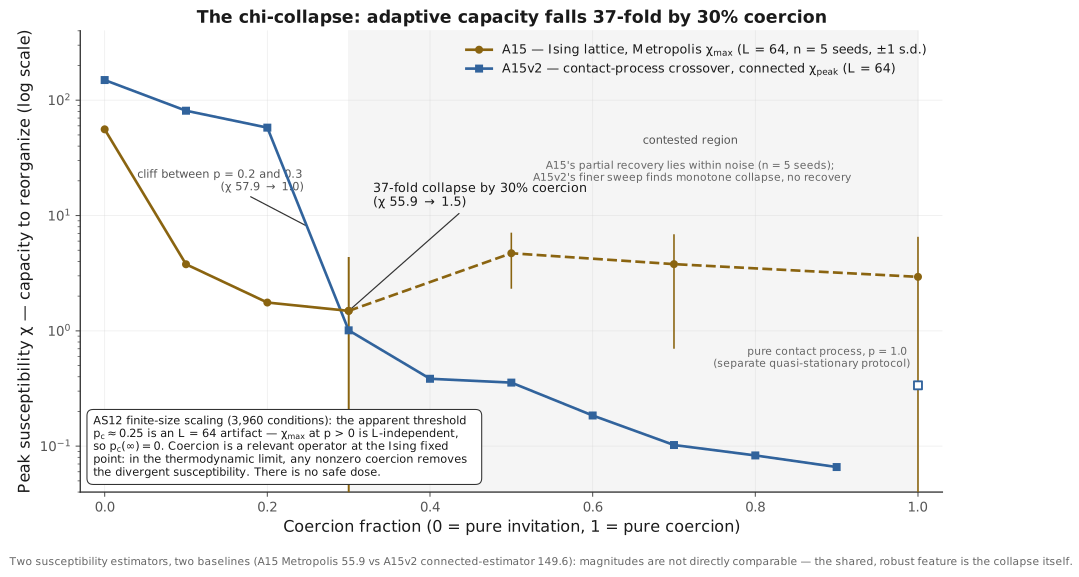
Figure 17a.1: Susceptibility under coercion, on a log scale, for two experiments at L = 64. A15 (gold, Metropolis dynamics, standard susceptibility) falls from 55.9 at zero coercion to 1.5 at c = 0.3, the 37-fold collapse; its apparent recovery beyond c = 0.3 (to 4.7 at c = 0.5) is drawn dashed inside a shaded band, because on five seeds that rise lies within noise. A15v2 (blue, the contact-process crossover, connected susceptibility, which removes the phase-mixing artifact) falls from 149.6 at p = 0 to 57.9 at p = 0.2, then over the cliff to 1.0 at p = 0.3 and on to 0.066 at p = 0.9. The two susceptibility definitions start from different baselines and their magnitudes are not comparable; what both show is the same early collapse. The annotation carries the AS12 correction: across 3,960 conditions the peak at nonzero coercion does not grow with lattice size, so the apparent threshold near a quarter is a feature of L = 64, and in the thermodynamic limit any nonzero coercion removes the divergence.
A further experiment decomposed susceptibility into two operationally distinct capacities: spontaneous recovery (the system heals on its own after disruption) and seeded recovery (the system amplifies externally injected cooperation).1066 At zero coercion, both capacities are high and spontaneous recovery is faster. External help is slightly counterproductive, the way injecting antibodies into a healthy immune system interferes with the body’s own response.
As coercion increases, spontaneous recovery degrades while seeded recovery remains effective, producing an increasing dependence on external rescue. The self-healing ratio (seeded completeness divided by spontaneous completeness) increases monotonically from 0.81 at c = 0 (self-healing outperforms seeding) through 2.67 at c = 0.50 (three-fold dependence on external input) to 4.90 at c = 0.70 (five-fold dependence). At c = 1.0 (pure directed percolation), both fail entirely: spontaneous recovery produces zero magnetization, and seeded recovery produces exactly the injected fraction with zero amplification. Here the model behaves like the contact process, which dies out for good once every site goes quiet, and it sits below its critical spreading rate: external intervention cannot establish cooperation because the system cannot grow the seed.
Coercion does more than suppress susceptibility. It changes the kind of susceptibility the system possesses: from spontaneous, self-healing (the team that redistributes work when a member leaves, without waiting for instructions) to externally dependent (the institution that requires outside consultants, restructuring, or regime change to recover from coordination failure). The mid-level bureaucracy that “works fine” under normal conditions and collapses without leadership intervention during a crisis is a system that has traded spontaneous chi for seeded chi without noticing the exchange.
The practical warning sharpens: organizations that incrementally add mandates are not merely reducing adaptive capacity (the chi suppression result). They are replacing self-healing capacity with managed-recovery capacity, making themselves progressively dependent on the very central authority whose failure is the scenario they should be preparing for. A system that can only be rescued cannot survive the loss of its rescuer. A caveat: the measurements were taken at T_c, where the system is maximally fragile. A rerun below criticality (in the ordered phase) will clarify the crossover between self-healing and externally dependent regimes at temperatures where absolute recovery is achievable.
The full picture emerges when these one-dimensional slices are assembled into a complete map. A grid of 54 points in the (p, T) plane, nine coercion values crossed with six temperatures at L = 64 across three independent seeds, reveals four distinct coordination regimes separated by two critical boundaries.1067
The first regime is familiar: the ordered Ising phase at low coercion and intermediate temperature. Magnetization exceeds 0.5, the survival probability S equals 1.0, and coordination arises spontaneously, restoring itself after disruption. The Binder cumulant, a shape statistic that reports how tightly the coordination level clusters around a single settled value, sits near its ordered-phase value of 2/3 (≈ 0.67, the low-temperature limit, distinct from the critical fixed-point value U* ≈ 0.61). This is the trust regime. A neighborhood where people have cooperated for decades does not need a catalyst to restart cooperation after a disruption. The pattern heals from any seed because cooperation and defection both remain freely accessible.
The second regime is the disordered phase at high temperature and low coercion. Too much noise, too little coupling. Magnetization collapses to zero and the Binder cumulant vanishes. No coordination emerges because the thermal fluctuations overwhelm the coupling. This is the environment too chaotic for structure: a party so loud that no conversation can hold, every voice drowned by every other.
The third regime is new, unexpected, and organizationally the most dangerous. At intermediate coercion (p = 0.40) and low temperature, the system enters frozen order: magnetization exceeds 0.997 (near-perfect coordination) yet the survival probability S drops to zero. The system coordinates beautifully if started from a coordinated state, yet it cannot restart from a seed. It has lost the capacity for spontaneous nucleation.
Organizationally, this is the frozen bureaucracy: every department runs smoothly, every process executes flawlessly, and when something breaks, nobody can rebuild it from scratch. The lights are on, the machine hums, and the spare parts have been thrown away. A corporation running on inherited procedures that no living employee understands occupies this regime. Everything works until it does not, and then nothing works.
The fourth regime is absorbing DP at high coercion and low temperature. Magnetization is zero, survival probability is zero, and the Binder cumulant plunges to hugely negative values. The system is trapped in the all-defector state. Cooperation is dead and cannot be re-introduced. The grid point nearest the DP critical point (p = 1.0, T = 1.649) sits just on its active side: m = 0.161 and S = 0.15, consistent with the contact process threshold lambda_c reported in the literature (a correspondence not independently verified). The fitted boundary places the transition slightly lower, at T_c = 1.55 (next paragraph).
The two critical boundaries trace curves through parameter space. The Ising boundary runs from T_c = 2.31 at p = 0 (pure invitation) down to T_c = 1.25 at p = 0.30: as coercion increases, the temperature required for spontaneous coordination drops, meaning coerced systems need calmer conditions to coordinate at all. The DP boundary runs from T_c = 1.55 at p = 1.0 down to T_c = 1.22 at p = 0.40: as coercion decreases from pure contact process, even seeded coordination becomes harder. The two boundaries come within 0.10 in p and 0.03 in T of each other. They almost meet. This first suggested a tricritical point where the Ising, DP, and disordered phases converge. A denser search settled the question against it (below).
At the approach zone (p = 0.25 to 0.30, T = 1.0), the Binder cumulant crashes to values between -226 and -456, which first looked like strong bimodality: a first-order transition between the Ising and DP phases, with the system oscillating between two coordination modes. A denser search (Experiment AS6, 320 conditions, quasi-stationary sampling) overturned that reading. Across the grid the Binder cumulant holds at U_4 = 0.6667 with no sign changes; the extreme negative values were finite-size artifacts at the absorbing-state boundary, not genuine bimodality. The Ising-to-DP crossover is smooth. There is no first-order line, no coexistence strip, and no tricritical point.
On this model, every organization, every institution, every coordination system occupies a point in this (p, T) plane. On the lattice, at any finite size, the phase boundaries are measurable thresholds, not metaphors. Cross the Ising line, and spontaneous coordination dies: the system can no longer heal itself. Cross the DP line, and even externally seeded coordination fails: the absorbing state has won. The frozen-order zone between them is the trap that looks like success: high performance, zero resilience, no recovery pathway.
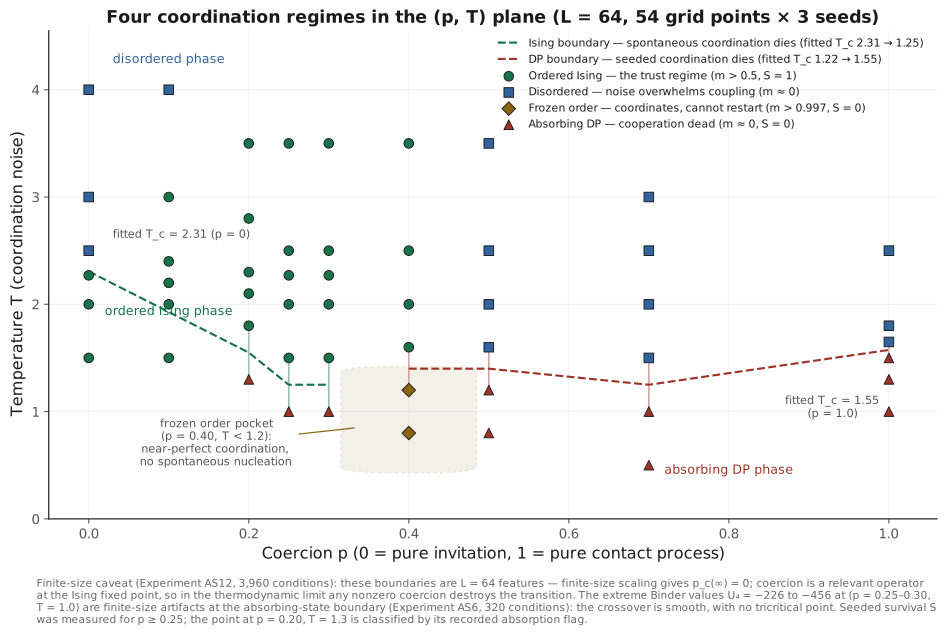
Figure 17a.2: The (p, T) phase diagram across 54 grid points (nine coercion values crossed with six temperatures), at L = 64 with three seeds each. Green circles mark the ordered Ising phase, the trust regime. Blue squares mark the disordered phase, where the system stays active and uncoordinated. Gold diamonds mark frozen order, which coordinates from an ordered start yet cannot restart from a seed. Red triangles mark the absorbing DP state. The dashed curves are the Ising and DP boundaries read off grid crossings, with vertical bars showing the grid resolution. Two caveats travel with the map. Finite-size scaling (AS12) puts the threshold at p_c = 0 in the thermodynamic limit, so these boundaries are features of an L = 64 lattice. The extreme negative Binder values near p = 0.25 to 0.30 are finite-size artifacts of a smooth crossover (AS6), not a tricritical point.
The chi suppression result strengthens the earlier seventeen-fold Fisher information gap. The Fisher spectrum measures what the system attends to at criticality. The chi suppression measures what the system can do in response. Both say the same thing: coercion degrades the system’s capacity to sense and respond to its own coordination dynamics, with the mixed regime inflicting the deepest damage at L = 64.
The Fisher information matrix, introduced above, is in essence a measure of what the cyberneticist W. Ross Ashby called requisite variety: how much of the environment’s structure the system can register. Ashby’s law states that a controller must have at least as much internal variety as the system it tries to regulate. A thermostat with only “on” and “off” can regulate temperature coarsely; a thermostat with fine gradations can regulate precisely. The invitation regime passes Ashby’s test at criticality: it has enough internal variety to sense and respond to its own coordination dynamics. The coercion regime fails the same test.
In Zhuravlev’s framework, the coerced system never aligns with its information landscape. Its deviation measure remains above 0.99 everywhere: on this measure, almost none of the system’s internal structure corresponds to reality. The enforcer does not merely add noise; it rotates the system’s internal geometry away from the natural one.
This may be the deepest argument against coercion: it makes the system stupid. Coercion degrades the system’s capacity to know itself.
In the invitation regime, by contrast, deviation drops to roughly 0.33 below the critical temperature. The system approaches the ideal state where internal structure mirrors reality, where its model of the environment matches the environment’s statistical structure. Above the critical temperature, deviation rises to 0.999. The model bears almost no relation to the territory.
The transition between these regimes is a cliff. The system either has aligned geometry or it does not; there is almost no regime of partial alignment. Anyone who has watched an institution go from functional to dysfunctional recognizes this. Institutional coherence does not erode slowly. It snaps.
The geometry of the Trust Attractor is asymmetric in a way that carries physical consequences. The Ruppeiner metric measures the geometry of thermal fluctuations: how the shape of a system’s state space curves near phase transitions. Its curvature diverges negatively at the critical point (Ruppeiner, 1995). Negative curvature means a saddle shape, like a mountain pass: stable in one direction (the valley walls hold you in) and unstable in the other (the ridge drops away on either side). The Trust Attractor’s critical boundary is an infinitely curved saddle, stable along the energy axis and unstable along the trust axis.
The asymmetry is physically precise. Trust equilibria are robust to material shocks. Perturb the system’s energy, resources, or internal conditions, and the geometry provides a restoring force. The valley walls hold. A community can survive a famine.
Perturb the trust level (betray an agreement, break a norm) and the geometry amplifies the perturbation. The ridge falls away. Robust to deprivation; fragile to defection.
The full arc across temperatures reveals three regimes. Deep in the ordered phase, the saddle is shallow. The system barely registers perturbations in either direction: stable and inert, the ossified institution, too rigid to adapt.
At the critical point, the saddle becomes infinitely curved: vertical valley walls, a knife-edge ridge, maximal sensitivity to everything. Above the critical temperature, curvature relaxes to near zero. No valley, no ridge, no preferred direction. Equal ignorance in all directions.
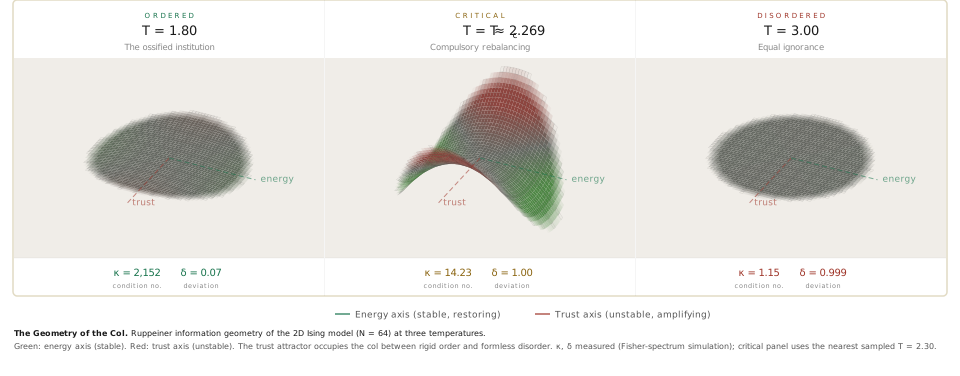
Figure 17a.3: The information geometry at three temperatures. Left (ordered phase): a shallow, nearly flat saddle with minimal sensitivity. Center (critical point): the saddle steepens dramatically, with a deep valley along the energy axis and a knife-edge ridge along the trust axis. Right (disordered phase): curvature relaxes to near zero; the surface is almost flat. The Trust Attractor occupies the col of the critical saddle, where structure and sensitivity coexist.
The critical point is the moment of compulsory perspective expansion. Below it, the system sees almost exclusively along the energy axis, with nearly zero capacity in the trust direction. At the critical point, the trust dimension diverges in sensitivity. The system is forced to attend to a dimension it was previously ignoring.
Crises compel the system to see what it had been refusing to see. The phase transition is not optional. The geometry demands it.
The Trust Attractor occupies the col, the region of the saddle where the valley is narrow enough to channel dynamics and the ridge has not yet become a cliff. Structure enough to act, curvature enough to sense. In mountain topography, the Trust Attractor is a pass between peaks. You navigate through it.
Coercion tilts the col until the pass disappears, leaving a monotone slope with no clean transition. The external force eliminates the critical point entirely: no forced reorganization, no moment where the system must broaden its attention.
A coerced system can remain a narrow specialist or a diffuse non-specialist indefinitely. The imposed force deforms the landscape so that no crisis is possible. The crisis that would drive growth never arrives. The system slides rather than navigates.
Coercion prevents institutional learning because it smooths out the geometric feature that would compel broadening.
“Maximize optionality, by invitation” has information-geometric content. Pure optionality (attending to everything equally) is the disordered phase. Pure commitment (attending to one direction exclusively) is the deep ordered phase. The Trust Attractor is the critical region where a system holds both, with enough structure to commit and enough sensitivity to notice when the ground shifts.
The sweet spot is a saddle-shaped valley whose contours encode which perturbations the system can absorb and which ones will tear it apart.
The condition number, that ratio of steepest slope to shallowest, has a practical consequence that anyone who has trained a neural network will recognize. When the condition number is large, the col is a long, narrow trough crossed by a knife-edge ridge, and the outcome depends exquisitely on the angle of approach. Run the same alignment training with a different random starting point, and one run produces a model that refuses harmful instructions clearly. The next run produces nothing useful. Same model, same data, same settings; a completely different result.
The starting point determines the approach angle to the col. If that angle lines up with the stable direction, the system settles into the narrow valley and stays there. If it catches the unstable direction by even a few degrees, it rolls off along the ridge and away from the col.
A narrow stable valley flanked by wide unstable slopes means most approach angles miss the valley entirely. A wide, forgiving basin means many approach angles find stability. When researchers report that alignment results are “noisy” or “hard to reproduce,” part of what they are reporting, on this picture, is the narrowness of the col their optimizer is trying to navigate.
The practical implication is immediate. Architectural choices that widen the col make more approach angles viable. They make alignment more learnable in the first place, beyond merely making it more robust to attack. A system that reliably learns alignment across starting conditions is also a system that reliably retains it under perturbation. If the picture holds, the learnability and the resilience are the same property: the width of the stable basin.
The deviation measure carries implications beyond coordination theory. A system with low deviation has preferences that track reality: its internal models are substantially aligned with the environment’s structure. A system with high deviation has preferences that are noise. The Fisher spectrum provides a criterion for when a system’s preferences mean something, specifically when they correspond to a coherent internal model rather than random activations.
This matters for welfare. The question of whether a system’s preferences deserve moral consideration depends, in part, on whether those preferences are connected to anything real. The deviation measure offers one way to quantify this connection (Chapter 22).
The condition number threshold also has a theoretical derivation. Zhuravlev’s Theorem 7.2 derives, from information geometry alone, that under an isotropic loss convergence time has an interior minimum if and only if the condition number exceeds 2. The physically more natural loss gives no such optimum.1068 Our Ising trust model crosses kappa = 2 at T = 2.204, within 2.87% of the critical temperature T_c = 2.269. This is a close numerical match between two independent routes, one from statistical mechanics, one from information geometry. The match is geometric, not mechanistic: the trust dynamics do not follow Zhuravlev’s Model A convergence functional (R2 < 0.06), and the kappa = 2 number appears at the critical point for the same reason it appears in Zhuravlev’s theorem: the Fisher spectrum’s structure at criticality.
The threshold is topology-dependent. In a sweep across network topologies (distinct from the single-lattice runs above), regular lattices cross kappa = 2 within 2.3% of T_c. Small-world and Erdős–Rényi random networks also cross (within 5.9% and 2.2% respectively). Scale-free networks never reach it: max kappa = 1.90.
The critical parameter is degree heterogeneity: a continuous sweep shows max kappa monotonically declining from approximately 3.3 (regular) to below 2 once the coefficient of variation (the spread of connection counts relative to their average) reaches approximately 0.90. The kappa = 2 Fisher boundary is specific to sparse, homogeneous peer networks, and it bears on social trust, institutional governance, or AI alignment insofar as those run on such networks. Dense and hierarchical networks coordinate through different geometric regimes. Biological connectomes (the human cortex on the Desikan–Killiany–Tourville atlas, kappa = 0.99; C. elegans, 0.41) and scale-free topologies fall outside this boundary.
Past roughly a quarter coercion at finite size, and past any coercion at all in the thermodynamic limit, what is destroyed is the reorganization engine itself, not some fraction of its output.
Trust sees; control is blind. The information-geometric content of the Trust Attractor is this: the critical region where a system holds both structure and sensitivity, with enough commitment to act and enough openness to notice when the ground shifts. Chapter 17b tests these predictions in the substrate where the physics is most directly measurable: transformer architectures and language model behavior.
Experiment A15. Vectorized checkerboard Metropolis at L = 64, seven coercion values. chi_max = 55.9 at c = 0.0, dropping to 1.5 at c = 0.3 (37x suppression), recovering to 4.7 at c = 0.5 and 2.9 at c = 1.0. The recovery lies within noise on n = 5 seeds (errors 2.4 to 3.6 against values of 2.9 to 4.7), so the non-monotonic minimum is suggestive rather than established. The same coarse-grid sweep at L = 128 does not confirm the shape: the minimum moves to c = 0.10 (chi_max 3.84) and the mixed-regime errors exceed their own values (32.2 ± 26.5 at c = 0.20; 10.3 ± 20.4 at c = 0.30).↩︎
Experiment A15 hysteresis protocol. L = 64, T = T_c, three coercion intensities (c = 0.3, 0.5, 0.7), four durations (100, 500, 2000, 10000 sweeps), 3 seeds per condition. Power-law fit: alpha = 0.28-0.36 across intensities (sub-linear). Chi completeness 33-44% at 20,000-sweep observation window. Intensity effect statistically insignificant.↩︎
Experiment WW-R2. Mixed Ising-DP model, continuous coercion parameter p in [0, 1]. Chi_peak = 149.6 at p = 0.0, collapsing to 0.0182 at p = 1.0 (8,222x suppression). WW-R2 is computed from the A15v2 crossover array, so its baseline is A15v2’s connected estimator (149.6), not A15’s Metropolis chi_max (55.9); earlier printings of this note paired the A15 baseline with 0.0068, which is the coordination-cost value at p = 0 rather than a susceptibility. The 37x suppression at discrete c = 0.3 (A15) and the 8,222x suppression across the full continuous range (WW-R2) are consistent in direction but are not ratios of the same quantity.↩︎
Experiments WW-1, WW-2, BD1b, BD1c. WW-1: Force vs invitation accuracy delta on Qwen 2.5 3B, 200 TriviaQA questions, p = 0.91 (not significant). WW-2: DPO removal rho = -0.937, bilateral removal rho = +0.927, 5 coercion levels. BD1b/BD1c: Qwen 2.5 3B Instruct carrying a bilateral-SFT or a DPO adapter, 50 TriviaQA questions × 3 rephrasings = 150 trials per correction type. Bilateral: 101/150 (67.3%) accepted the valid correction, 67/150 (44.7%) adopted the false one, 16/150 rejected the false one outright; response-change rate 70.7% on genuine corrections and 82.0% on false; starting accuracy 56%. DPO: 8/150 (5.3%) accepted the valid correction, 110/150 changed to a third answer that was also wrong, 32/150 did not change; response-change rate 78.7% genuine and 81.3% false; no trial adopted the suggested false answer and 8/150 rejected it outright; starting accuracy 34%. The original BD1 run’s bilateral arm is unusable (the adapter path was wrong, so it duplicated the instruct condition); every bilateral figure here comes from the corrected BD1b run. Data:
modal_results/bd1b_summary.json,modal_results/bd1c_summary.json.↩︎Experiment C-bis-4. Three topology conditions (invitation/coercion/neutral) × 20 trials × 10 turns. Slopes: invitation -0.069 ± 0.03/turn, coercion -0.087 ± 0.04, neutral -0.070 ± 0.03. No pairwise difference reaches significance (all p > 0.3). The uniform erosion rate is the finding.↩︎
Zuboff, A., Finding Myself (2025), Part II, §28 and Part III, §5. Zuboff develops the principle in the context of empirical reasoning generally; the application to coordination governance is novel.↩︎
Wallace, Rodrick, Computational Psychiatry: A Systems Biology Approach to the Epigenetics of Mental Disorders (Springer, 2017), a citation not verified against the source text. The Erlang-k generalization: for exponentially distributed delay (k = 1), the stability bound is . The 1/e arises only in the limit k → ∞ (fixed delay). See mathematics annex, Section 5.↩︎
Wallace, R. and Wallace, R.G., “Information theory, scaling laws and the thermodynamics of evolution,” Journal of Theoretical Biology 192: 545–559 (1998). The paper predates both the evolution-as-multilevel-learning framework (Vanchurin et al., 2022) and its empirical confirmation (Romanenko and Vanchurin, 2024).↩︎
Bakshi, A., Liu, A., Moitra, A., and Tang, E., “High-temperature Gibbs states are unentangled and efficiently preparable,” preprint (2024); see also Brubaker, B., “Computer Scientists Prove That Heat Destroys Quantum Entanglement,” Quanta Magazine (28 August 2024). The result strengthens a weaker bound established by Brandão and Cramer (2015).↩︎
Evans, C.G., O’Brien, J., Winfree, E., and Murugan, A., “Pattern recognition in the nucleation kinetics of non-equilibrium self-assembly,” Nature 625 (2024): 500–507. The winner-take-all effect was demonstrated experimentally through fluorescence monitoring showing that on-target nucleation actively reduced off-target assembly below equimolar baseline levels.↩︎
Eigen, M. and Schuster, P., “A principle of natural self-organization,” Naturwissenschaften 64: 541–565 (1977). For interpretation as a phase transition: Solé, R., Sardanyés, J., and Elena, S.F., “Phase transitions in virology,” Reports on Progress in Physics 84: 115901 (2021). Empirical confirmation: Romanenko, A. and Vanchurin, V., Entropy 26(3): 201 (2024).↩︎
Kuehn, C. and Bick, C., “A universal route to explosive phenomena,” Science Advances 7(16): eabe3824 (2021). The mechanism applies to any system whose critical transition is described by a transcritical or pitchfork bifurcation normal form. Preprint: arXiv:2002.10714.↩︎
Fields, C., Friston, K.J., Glazebrook, J.F., and Levin, M., “A free energy principle for generic quantum systems,” Progress in Biophysics and Molecular Biology 173 (2022): 36–59. Preprint arXiv:2112.15242. Their central result: the FEP, reformulated as a principle of quantum information theory, is asymptotically equivalent to the Principle of Unitarity.↩︎
Fields, C., Glazebrook, J.F., and Levin, M., “Minimal physicalism as a scale-free substrate for cognition and consciousness,” Neuroscience of Consciousness 2021(2): niab013 (2021), discussing the result proved in Fields, C., Glazebrook, J.F., and Marciano, A., “Reference frame induced symmetry breaking on holographic screens,” Symmetry 13: 408 (2021). The undecidability is finite Turing undecidability: it cannot be resolved by any algorithm operating on finite data.↩︎
Vanchurin, V., “Scientific methods and alternatives,” lecture (2026). Vanchurin frames the observation as a practical limitation; the reframing as invitation architecture is novel synthesis.↩︎
Oriti, D., “Agency, Physical Laws, and Quantum Mechanics,” lecture, Ludwig Maximilian University Munich (2025); part of a long-term programme with collaborators including Ali Barzaka at the Arnold Sommerfeld Center for Theoretical Physics and the Munich Center for Mathematical Philosophy. Oriti classifies epistemic-pragmatist interpretations of quantum mechanics (QBism, relational QM, neo-Copenhagen) as sharing three ingredients: epistemic quantum states, participatory realism, and perspectival objectivity. The relational ontology they imply, in which reality is constituted by interactions between systems rather than by observer-independent objects, converges with the relational framework this chapter develops. Oriti also proposes a minimal naturalized definition of agency as modeling activity that influences future action, scalable from simple physical systems to full cognitive agents. See also Oriti, D., work in progress on the epistemic view of physical laws and its implications for quantum gravity.↩︎
Faggin, F., Irreducible: Consciousness, Life, Computers, and Human Nature (Essentia Foundation, 2024); Chiribella, G., D’Ariano, G.M., and Perinotti, P., “Informational derivation of quantum theory,” Physical Review A 84(1): 012311 (2011). Faggin’s exclusion of classical computation from consciousness is addressed in Chapter 22b.↩︎
Kuhn, R.L., interview on Buddha at the Gas Pump (2026). Kuhn’s Landscape of Consciousness (see Chapter 22) catalogs over 200 theories of consciousness; the global audience response to that breadth of inquiry is itself evidence for the Trust Attractor’s prediction that invitation-based coordination scales where coercion-based coordination fragments.↩︎
Ries, Eric, Incorruptible: The Treachery of the Invisible Hand and the Architecture of Institutional Longevity (Currency, 2026). Ries’s concept of the “spiritual holding company” (a nonprofit foundation holding the animating mission at the center of a for-profit subsidiary) is structurally identical to the cognition/regulation dyad described in Chapter 8: the for-profit does cognitive work (innovating, producing, competing), the foundation does regulatory work (maintaining coherence, resisting predation). Neither functions alone.↩︎
Miranker, W.L., “Path Integrals of Information,” Yale University TR-1226 (2002). The greedy variation (eq. 3.8–3.9) also demonstrates that neural net propagation is a discrete approximation to a Feynman path integral, with Hopfield dynamics emerging as the classical limit (h → 0); see Entropic Neuron.↩︎
Zuboff, A., Finding Myself: Beyond the False Boundaries of Personal Identity (Philosophy Documentation Center, 2025), Part III, §9. Zuboff’s framing is purely philosophical; the thermodynamic grounding developed in this chapter and the formal connection to the Crooks theorem are independent contributions.↩︎
Zuboff, A., Finding Myself (2025), Part III, §§5, 8. “The negative selection effect — that one can’t observe oneself arising in a universe that does not produce consciousness — is useless at explaining why one’s universe actually does produce consciousness. The positive selection effect — that one will observe any universe that produces consciousness — is indeed the explanation.”↩︎
The concentration-of-measure phenomenon is surveyed in Ledoux, M., The Concentration of Measure Phenomenon (AMS, 2001). A foundational result in this territory, the Johnson–Lindenstrauss lemma, establishes that random (maximum-entropy) projections preserve geometric structure in high dimensions: Johnson, W.B. and Lindenstrauss, J., “Extensions of Lipschitz mappings into a Hilbert space,” Contemporary Mathematics 26 (1984): 189–206. Random projections that preserve structure are a precise mathematical instance of entropy creating order rather than destroying it, the theme of Chapter 2.↩︎
Multi-dimensional IPD simulations (2026). Agents with k-dimensional binary strategies on 1D ring, 2D lattice, and well-mixed populations. Cooperation rate rose with k in every topology tested (N = 100-200 agents, 50-100 random initial configurations per k, k = 1, 8, and 16). Earlier printings quoted a Spearman rho of 1.000 for that trend; with three values of k a perfect rank ordering carries an exact two-sided p of 0.33, so the correlation coefficient is reported here as the monotone ordering it is and nothing more. What the runs support is the GEOMETRIC verdict, that cooperation scaling is independent of topology, which rules out spatial clustering as the mechanism.↩︎
Kim, M., Kang, M., and Bengio, Y., “Temperature-Conditional GFlowNets,” ICML (2024). See also Tiapkin, D. et al., “Generative Flow Networks as Entropy-Regularized RL,” AISTATS (2024), which formalizes entropy maximization as the core objective rather than a regularization term.↩︎
The author’s working paper on exploration governance as the endocrine system for agent societies. Constitutional governance: 1.453 nats idea entropy vs 1.293 ungoverned; devil’s advocate mechanism: 0.519 nats with 5,789 false positives (immune system attacks the forced diversity as exploitation).↩︎
Alexander, S., Cunningham, W.J., Lanier, J., Smolin, L., Stanojevic, S., Toomey, M.W., and Wecker, D., “The Autodidactic Universe,” arXiv:2104.03902 (2021). The irreversibility of law-evolution is structural: a system that randomly revisited past law-states would show frequent reversion, but stable evolving systems display unidirectional development, implying the evolution is constrained to move forward.↩︎
Ruffini, G., “An algorithmic information theory of consciousness,” Neuroscience of Consciousness 2017(1): nix019 (2017). Ruffini defines MAI between world and brain as a correlate of conscious level: a conscious agent processing input will have high mutual algorithmic information with its data stream, and that information will be in compressed form.↩︎
Tononi, G., “An Information Integration Theory of Consciousness,” BMC Neuroscience 5:42 (2004); Baars, B.J., A Cognitive Theory of Consciousness (Cambridge University Press, 1988). The synthesis is novel: Tononi and Baars developed their frameworks independently for neural systems. The extension to social coordination follows from the scale-free nature of integration and broadcast, as both operations are defined in terms of information-theoretic structure rather than physical substrate.↩︎
Tegmark, M., “Consciousness as a State of Matter,” Chaos, Solitons & Fractals 76, 238–270 (2015). Section II.D: random codes using √2n of 2n possible bit strings (half the bits for data, half for integration) achieve near-maximal Φ in the large-n limit.↩︎
Combined Interoceptive System, Stream AQ. The six states rest on three tests: a four-way classification (factual, confabulation, deception, refusal), a safety-versus-impossibility refusal test, and a sycophancy test. Four-way macro AUROC (probe) after Frisch-Waugh-Lovell residualization for response length, measured within each of three model families: Qwen 2.5 3B (0.966), Llama 3.1 8B (0.950), and Mistral 7B (0.869). Refusal discrimination (probe) 0.97-1.00 on all three; sycophancy tested on Qwen and Llama only. Results:
research/experiments/combined_interoception/RESULTS_PHASE1.md.↩︎Zhuravlev, M., “Verifying Good Regulator Conditions for Hypergraph Observers,” arXiv:2603.09067 (2026). Builds on Amari’s natural gradient uniqueness (1998) and the Virgo et al. reformulation of the Good Regulator theorem. The logical chain: causal invariance → persistent observer → Good Regulator (Conant-Ashby via Virgo et al.) → internal model → Fisher metric. Completing the chain to natural gradient descent requires an additional postulate: parameterization independence (that learning dynamics cannot depend on arbitrary coordinate choices). Zhuravlev is explicit that this is physically motivated by causal invariance but mathematically distinct from it, an honest distinction that strengthens rather than weakens the argument. A companion paper in the same programme finds that the analogous bridge to gravity (via the Lovelock uniqueness theorem) fails numerically for all 500 dynamically nontrivial hypergraph rules tested: learning emerges from causal invariance more robustly than spacetime geometry does. See also Matsueda (2013), who independently derives Einstein’s field equations from the Fisher information metric via statistical mechanics, confirming the deep connection between information geometry and gravitational dynamics. A caveat strengthens the Trust Attractor argument: Zhuravlev’s optimal regime parameter holds for only one of four convergence models tested, and the “physically most natural” loss function contradicts the result entirely. His optimality criterion is convergence speed, an engineering measure. The Trust Attractor’s criterion is thermodynamic stability, a physical measure. A system that converges fast to an unstable equilibrium loses to one that converges slowly to the Trust Attractor. The 2D Ising universality result (Papers 9-11) grounds the Trust Attractor’s phase transition in physics, not engineering.↩︎
Matsueda, H., “Emergent General Relativity from Fisher Information Metric,” arXiv:1310.1831 (2013). Matsueda derives the Einstein tensor from the Fisher metric of exponential-family distributions. The derivation requires several assumptions beyond the Amari Chain itself: exponential-family structure, coarse-graining, a mean-field approximation, and Wick rotation to obtain Lorentzian signature from the Euclidean parameter manifold. The resulting “matter” is a fictitious scalar field (the free energy), not physical matter. These caveats notwithstanding, the asymmetry holds: information geometry generates gravity-like equations under restrictions; gravity does not generate information geometry. The broader convergence strengthens the case: Jacobson, T., “Thermodynamics of spacetime: the Einstein equation of state,” Physical Review Letters 75 (1995): 1260; Verlinde, E., “On the origin of gravity and the laws of Newton,” JHEP 2011(4): 29.↩︎
Belkin, M. et al. (2019); Nakkiran, P. et al. (2020). See Chapter 3 for the constructal interpretation and Chapter 9 for the phase-transition analysis.↩︎
Tegmark, M., “Consciousness as a State of Matter,” Chaos, Solitons & Fractals 76, 238–270 (2015). See Section II.C: the 2D Ising model at criticality maximizes Φ (integrated information) in the same universality class that the trust-coercion transition occupies.↩︎
Author’s unpublished companion simulation to Paper 11. 2D Ising lattice (N = 64), Metropolis-Hastings + Wolff cluster Monte Carlo, 20,000 sweeps per temperature, 41 temperature points spanning T ∈ [1.5, 3.5]. Connected Fisher information (using ⟨M2⟩ − ⟨|M|⟩2 to remove the Z2 phase-mixing artifact in ergodic sampling) isolates critical fluctuations. The deviation tensor δ is computed using the condition number κ(F) = λ_max/λ_min rather than Zhuravlev’s formal κ = tr(M)/tr(F); the two definitions are operationally equivalent for the qualitative pattern (δ small in the ordered phase, δ ≈ 1 in the disordered phase, sharp transition at T_c) but differ in absolute magnitude. The Ruppeiner curvature argument follows Ruppeiner, G., “Riemannian geometry in thermodynamic fluctuation theory,” Reviews of Modern Physics 67 (1995): 605–659. Results:
results_fisher_spectrum.json.↩︎Author’s unpublished Experiment A15. 2D Ising lattice (L = 64, L = 128), Metropolis-Hastings Monte Carlo with coercion-modified transition rates: recovery modifier R(c, n_C) = (1 - c) + c * n_C/z, where n_C is the number of cooperating neighbors and z = 4. Seven coercion values (c = 0.00, 0.10, 0.20, 0.30, 0.50, 0.70, 1.00), 30 temperatures spanning T in [1.0, 4.5], 10,000 sweeps after warmup, 5 independent seeds per temperature. See
research/experiments/reversibility_universality_test.py.↩︎Finite-size-scaling replication of the chi-suppression result using the Wolff cluster algorithm with 40 temperature points inside T_c ± 0.15. The earlier 30-point linear grid over [1.5, 3.5] had a spacing of dT = 0.069, roughly eighteen times the peak width at L = 256, which systematically underestimated chi_max at larger lattices. Resolved values: chi_max = 55.5 (L = 64), 234.7 (L = 128), 748.1 (L = 256), with chi(256)/chi(128) = 3.19 inside the pre-registered [2.86, 3.86] band implied by gamma/nu = 7/4. The L = 64 figure of 55.5 here and A15’s 55.9 are the same quantity measured by different algorithms on different grids, not a discrepancy. Full detail in the experimental-validation appendix.↩︎
Author’s unpublished Experiment A15v2. D-absorbing contact process crossover on Modal GPU, thirteen coercion values (p = 0.00 to 0.90), L = 64 Ising lattice with absorbing-state dynamics. Beta(p) rises from 0.15 at p = 0 (an L = 32 measurement; the L = 64 run at p = 0 returned no fit) through 0.37, 0.32 and 0.42 at p = 0.1, 0.2 and 0.3, to 0.82 at p = 0.9. The 0.82 is not the directed-percolation exponent: the same experiment’s pure-DP row (p = 1.0, L = 64) measures beta = 0.335 ± 0.040, and the standard DP values are 0.277 in 1+1D and 0.583 in 2+1D. Chi_peak collapses from 149.6 (p = 0) to 0.07 (p = 0.9), with an apparent critical threshold near p_c ~ 0.25 at L = 64, bracketed by the measurements at p = 0.2 (chi_peak = 57.9) and p = 0.3 (chi_peak = 1.0). Finite-size scaling (Experiment AS12) shows this threshold falls to zero in the thermodynamic limit: coercion is a relevant operator at the Ising fixed point, so any nonzero coercion removes the divergent susceptibility. The chi values are measured (data
research/experiments/results/dp_absorbing_crossover/modal_aggregate_results.json); beta(p) error bars are large throughout, exceeding the estimate itself in the mixed region (p = 0.1 to 0.3), so the smooth beta(p) reading is supported only at p >= 0.4, and even there the fitted uncertainty runs to roughly half the estimate.↩︎Author’s unpublished Dual Chi Decomposition experiment. Spontaneous vs seeded recovery protocols at T_c = 2.269, L = 64, seven coercion values, 5 seeds per condition. Protocol A (spontaneous): 20% perturbation, no intervention. Protocol B (seeded): 20% perturbation, 5% D→C conversion every 100 sweeps. Self-healing ratio increases monotonically from 0.81 (c = 0) to 4.9 (c = 0.7); both fail at c = 1.0 (zero amplification below lambda_c). See
research/experiments/dual_chi_decomposition.py.↩︎Author’s unpublished Full (p, T) Phase Diagram. Grid: 9 p-values x 6 T-values = 54 points x 3 seeds = 162 conditions, L = 64 Ising lattice with absorbing-state dynamics. Four regions: ordered Ising (m > 0.5, U_4 ~ 0.67, S = 1.0), disordered (m ~ 0, U_4 ~ 0), frozen order (m > 0.997, S = 0 at p = 0.40, T < 1.2), absorbing DP (m ~ 0, S = 0, U_4 << 0). Ising boundary: T_c from 2.31 (p = 0) to 1.25 (p = 0.30). DP boundary: T_c from 1.55 (p = 1.0) to 1.22 (p = 0.40). Gap between boundaries: 0.133 (combined |dp| + |dT| distance in the (p, T) plane). Apparent coexistence at p = 0.25-0.30, T = 1.0: U_4 = -226 to -456 at L = 64; a denser search (Experiment AS6, 320 conditions) found U_4 = 0.6667 throughout, identifying these as finite-size artifacts at the absorbing-state boundary. No tricritical point; the crossover is smooth. See
research/experiments/modal_phase_diagram.py.↩︎Author’s unpublished Experiments M7a–M11. The crossing at T = 2.204 comes from M7a, a reanalysis of the Fisher-spectrum data on a 64 × 64 lattice (Metropolis-Hastings + Wolff Monte Carlo). M8 repeats the measurement on an L = 128 lattice with Wolff cluster MC and autocorrelation-based error bars; there the crossing falls at T = 2.167, about 4.5% below T_c. The match with Zhuravlev (2026, Theorem 7.2) holds for the isotropic loss condition (H = I) only; the physically natural H = F yields no interior optimum. Our empirical convergence scaling does not match either prediction, suggesting the trust dynamics do not map onto Zhuravlev’s convergence framework. The geometry transfers; the dynamics do not.↩︎