

The Deeper Law
Preview edition · Updated 26 September 2026, 21:40 UTC
InterludeThe Disappearing Polymorph
For two years and 240 consecutive batches, the HIV drug Ritonavir passed every quality test. Capsules dissolved in thirty minutes, were absorbed properly, and turned a death sentence into a manageable condition. Tens of thousands of patients depended on it.
In 1998, a capsule failed to dissolve. Abbott Laboratories followed protocol: destroyed the batch, deep-cleaned the production line, restarted. The next batch also failed. Under a microscope, the paste inside the capsules was filled with millions of tiny needles.
The needles were crystals. When analysts ran the spectrum, expecting to find a contaminant, they found Ritonavir. Same atoms. Same bonds. Same molecule. Yet the crystals would not dissolve. The drug was chemically identical and therapeutically inert.
What they had discovered was a polymorph (from the Greek for “many forms”): a second crystal form of the same compound. In this form the molecules stack together more tightly. The tighter packing made it far more stable, which meant far less soluble, which meant it could not be absorbed. Thermodynamic stability and therapeutic utility had diverged.
Within a week, every batch produced by the factory came out cloudy. Abbott found an alternative site in Italy. For a few weeks, the Italian factory produced good capsules. Then a team of scientists flew from Chicago to investigate what the Italians were doing differently. Within days of their visit, the Italian factory began producing the same insoluble crystals.
The scientists were almost certainly the vector. They had come to learn what the Italian plant was doing right, and they taught it what Chicago was doing wrong. Microscopic seed crystals on their clothes, in their hair, or on their equipment had nucleated the transition in the new environment.
Two properties of the disaster carry forward.
Nucleation. A phase transition between two crystal forms requires overcoming an activation energy barrier — the ridge a boulder must be pushed over before it can roll into a lower valley. In Ritonavir’s case, the barrier was enormous: two years of production without incident. The metastable form (stable, but not the most stable available) persisted because the probability of a seed crystal forming spontaneously was extremely low per unit time. Rare does not mean impossible. Given enough batches, given enough time, the more stable form will nucleate. The barrier determines how long the metastable form survives. It cannot determine whether it survives forever.
Contagion. Once a single seed crystal of the stable form exists, it lowers the activation energy for everything around it. Other molecules can attach to the seed and adopt its packing arrangement without having to find it independently. The stable form spreads by contact. Tiny fragments break off, become airborne, land on new surfaces. Each new crystal becomes a nucleation site for more. The transition propagates exponentially through any environment the seeds can reach.
Abbott spent five months trying to eliminate the new form from its facilities. It rebuilt production lines. It tried every combination of temperature, pressure, and procedure it had ever used. Nothing worked. “We finally accepted that we could not,” its chief scientist reported. “Our subsequent activities were directed towards figuring out how to live in a Form Two world.” There is a grief in that sentence, the grief of an engineer conceding a phase transition.
The transition was irreversible.
The same mechanism operates in tin. Above 13 degrees Celsius, metallic (white) tin is the stable form: strong, silvery, useful for organ pipes and canning. Below 13 degrees, a different crystal structure (gray tin) becomes thermodynamically favored. The transition is slow without a seed. Once a speck of gray tin contacts white tin below the threshold temperature, the transformation spreads visibly across the surface, crumbling the metal into powder. European organ pipes cracked and developed lesions during cold winters. Congregations blamed the devil. Engineers called it tin pest.
The contagion mechanism is identical: seed crystal lowers activation energy, transition propagates by contact, and the result is irreversible at the temperatures where the stable form is favored.
The chocolatier’s art resolves the tension between inevitability and control. Cocoa butter has six crystal forms. (These form numbers are specific to each compound: cocoa butter’s Forms IV through VI are unrelated to Ritonavir’s Forms I and II above.) Form IV is the dull, crumbly chocolate that results from uncontrolled cooling: a metastable polymorph that melts at 27 degrees, low enough to soften in your hand. Form V is the shiny, snappy bar: melting point 34 degrees, tight molecular packing, satisfying crack. Form VI, even more stable, develops slowly on storage and produces the whitish bloom that makes old chocolate unpalatable.
The chocolatier’s job is to land in Form V: the most stable crystal form compatible with function. Form VI sits lower in the energy landscape yet destroys the texture that makes chocolate worth eating. The method is deliberate nucleation under controlled conditions. Cool the melt to 27 degrees, seeding all forms. Raise to 32 degrees, melting Forms III and IV while preserving V. Hold, pour, cool quickly through the danger zone where Form IV might nucleate.
The chocolatier cannot prevent crystallization; chocolate must become solid. The art is selecting which crystal form emerges by controlling the conditions under which nucleation occurs.
Complex systems persist in metastable configurations: stable enough to endure small perturbations, unstable enough to transition when conditions cross a threshold. What the polymorph mechanism adds is the dynamics of how transitions propagate once they begin.
Three features distinguish polymorph-type transitions from gradual drift:
The transition is sudden. Two hundred and forty successful batches, then failure. The threshold is crossed once, by one seed, and the transformation is immediate in that locality.
The transition is contagious. Each converted site becomes a nucleation point for its neighbors. The rate of spread depends on the contact rate between converted and unconverted material. The barrier height is irrelevant; the seed has already solved it.
The transition is irreversible when the new form’s basin is deep enough. No amount of reheating returned Ritonavir to Form I. The energy required to reverse a deep-basin transition exceeds anything the system can self-generate.
Five additional constraints matter.
Critical nucleus size. A seed crystal must exceed a minimum size to be thermodynamically stable. Below that size, the crystal is nearly all surface, and the surface energy of the interface with the surrounding metastable phase dominates the volume energy gained from the more stable packing. The too-small crystal dissolves back into the metastable form. Only nuclei above a critical radius are self-sustaining and can grow. The microscopic crystals that traveled from Chicago to Italy on the scientists’ clothing were already above this threshold: complete microcrystals, not individual molecules. Each was a stable nucleus capable of independent growth in a new environment.
Sub-critical asymmetry. A further consequence follows from the size threshold. Perturbations that overwhelm a sub-critical nucleus are negligible once the crystal exceeds critical size. Molecular-dynamics simulations run for this book (computer models that track every molecule as it moves) quantify the crossover in the Ritonavir system. A modified molecule, designed to block Form II hydrogen bonding without disrupting Form I, destabilizes each molecule in a sub-critical nucleus by forty times the thermal energy — a penalty that dwarfs the random jostling any molecule experiences. In a twenty-molecule crystal, where roughly sixty pairwise contacts generate collective cohesion, the same modifier produces a statistically undetectable change. The crystal has grown large enough that one altered bond is noise.780
The principle extends beyond crystals. In some developmental contexts, morphogens (the signaling molecules that tell embryonic tissue what to become) remain present in adult tissue yet no longer active. Founding principles that shaped an institution’s culture during its first years carry diminishing weight as the culture becomes self-sustaining. In each case, collective stability absorbs what individual fragility could not.
Kinetic trapping. The transition from sub-critical to super-critical is abrupt, not a gradual fade. At intermediate cluster sizes (roughly eight molecules for the Ritonavir system), the modifier produces a paradoxical effect: clusters with the modifier retain all their molecules while unmodified clusters of the same size shed molecules. The modifier raises the cluster’s energy, making it thermodynamically less stable, yet the steric bulk of the modification (the sheer physical space it occupies) plugs the gaps between neighboring molecules like a cork in a bottle, preventing the thermal jostling that would otherwise knock them loose from the cluster edge.781
The cluster is locked in a higher-energy state. The mechanism is kinetic, not thermodynamic: the cluster holds together because escape is blocked, not because its energy is low. Governance during the near-critical phase of trust formation operates analogously. The cooperative cluster pays a cost for governance overhead (higher “energy”), yet individual defection is structurally blocked. Governance plays the role of the steric wedge.
A cautionary note travels with these numbers. The first kinetic run of this book’s simulation programme, ten molecules near their melting point, produced an apparently significant stabilization (p = 0.049) that reversed direction entirely under a second random seed: at that cluster size, a single molecule drifting from the edge dominates the radius-of-gyration measure, and a contact analysis found no genuine dissolution difference at all. The finding was a false positive, and the multi-seed size sweep (four to twenty molecules) behind the figures quoted here exists because of it.
Governance window. The steric wedge is protective only within a narrow range of conditions. At temperatures well below the polymorph transition, both modified and unmodified clusters are stable; the wedge is unnecessary. At temperatures above the transition, the same structural rigidity that locked molecules in place now prevents the cluster from reorganizing in response to thermal stress.
The modified cluster expands nearly three times faster than the unmodified control.782 The governance mechanism that stabilized cooperation at one temperature amplifies failure at another. Institutions designed for stable conditions may become liabilities during crises. The machinery still functions; its very rigidity is now the problem. The same structural constraints that once prevented individual defection now prevent collective adaptation.
Threshold sensitivity. A supersaturated solution (one holding more dissolved material than the solvent can normally keep at that temperature) sitting just above the nucleation threshold can remain metastable indefinitely. Lower the temperature by a fraction of a degree below the threshold, and crystallization becomes inevitable. The transition between “indefinitely stable” and “inevitably transforming” is not graded. It is a step function with an extraordinarily narrow boundary. The industrial environment was either above or below the threshold; there was no gradual decline in Form I quality, no early warning trend. One day it worked. The next day it did not.
Trust-based coordination is the most stable functional configuration of social coordination, analogous to Form V chocolate: deep enough in the energy landscape that only mass disruption can displace it once established, yet still loose enough to dissolve, to do work, to interface with the institutions that must absorb it. The lowest-energy state is thermal equilibrium (no structure, no dissipation, no life). Trust-coordination sits one level up: the deepest basin compatible with function.
The critical-nucleus constraint shapes strategy. Isolated advocates of trust-coordination, scattered among defectors, fall below the minimum stable size. They get overwhelmed by their environment and revert. A community of practitioners, dense enough to sustain mutual reinforcement, is above critical size and can grow outward. The propagation strategy is to build complete, self-reinforcing communities and seed new ones by contact. Each community is a stable microcrystal that carries the template to a new environment. Distributing individual converts fails; isolated converts dissolve. The scientists did not carry individual molecules to Italy. They carried complete crystals.
Threshold sensitivity helps explain why coercive coordination persists. Even modest background disruption functions as environmental noise that suppresses the conditions under which trust could nucleate. Propaganda, low-level conflict, economic precarity: each contributes just enough ambient threat. The disruption need not be large; it need only be present at all.
The pattern offers one reading of why authoritarian regimes might invest in ambient unease rather than overwhelming force.783 A lattice model of trust formation puts numbers on the idea. Picture agents on a grid, deciding round by round whether to cooperate with their neighbors. Once trust has been established through governance, reversing it requires disrupting more than thirty percent of the population simultaneously. Picking off leaders one at a time is ineffective in the model; the cooperative structure has no single point of failure and self-heals around individual losses. Only mass disruption works there, and mass disruption is expensive. Whether real societies behave the same way is a hypothesis the lattice motivates, not a measured fact about populations.
A further factor resolves this vulnerability. The threshold is low only in the absence of governance: structural mechanisms that sanction exploitation during the fragile growth phase. When governance is present, even simple governance, the threshold does not merely shift upward. It vanishes. Trust nucleation proceeds at every level of disruption tested, up to twenty percent, levels that would extinguish it instantly without the protective structure.784 The governance layer buys time, protecting nascent trust clusters from exploitation while they grow from below critical nucleus size to above it. The mechanism is the same as a crucible protecting a growing crystal from atmospheric contamination.
Quantifying the barrier reveals why the system was simultaneously enduring and fragile. The spontaneous nucleation rate for Form II is roughly one event per four centuries per liter: the homogeneous barrier (the barrier to forming a seed from scratch, with no template to help) is adequate.785 When a seed crystal provides an epitaxial template (a surface whose atomic spacing matches Form II’s, so new molecules slot straight into place), the effective barrier drops from 85 to 34 times the thermal energy. The nucleation rate increases by twenty-two orders of magnitude, a factor of one followed by twenty-two zeros. Internal stability and external vulnerability are separated by that gulf.
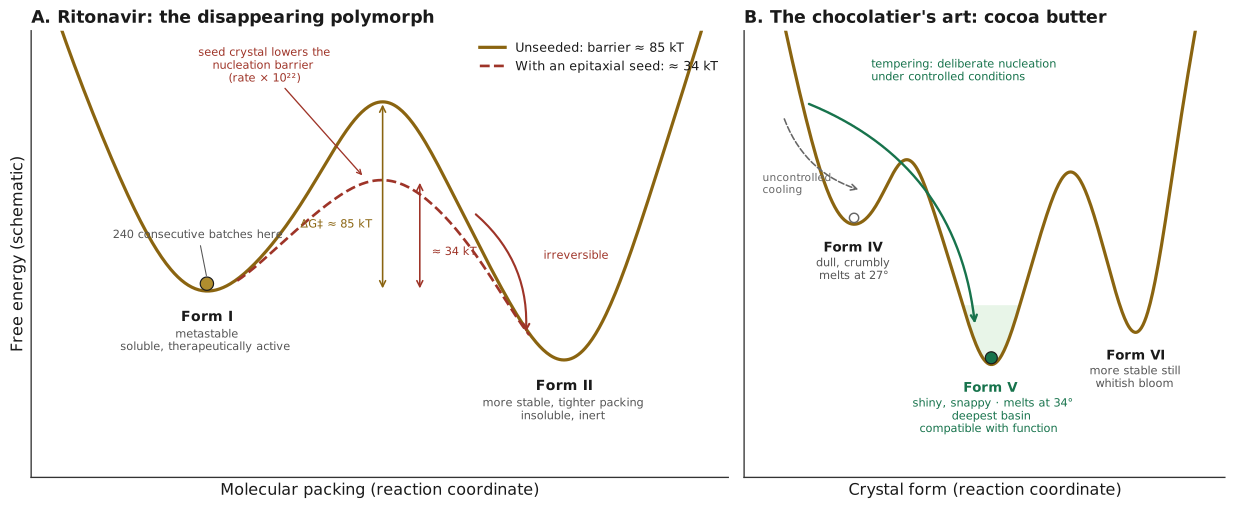
Figure 16.4: Panel A: Ritonavir. The metastable Form I basin, soluble and active, sits beside the deeper Form II basin, tighter-packed and inert, with a nucleation barrier of about 85 times the thermal energy between them; the ball resting in Form I marks the 240 batches that held. The red dashed curve is the same landscape once an epitaxial seed is present: the barrier drops to about 34, the nucleation rate rises by twenty-two orders of magnitude, and the red arrow shows the one-way transition into Form II. Panel B: cocoa butter. Three basins deepen from Form IV (dull, crumbly, melting at 27 degrees Celsius) through Form V (shiny, snappy, melting at 34 degrees, the deepest basin still compatible with function) to Form VI (whitish bloom). Tempering steers the melt into Form V; uncontrolled cooling lands in Form IV. The curves are schematic; the barrier heights are the values quoted above.
A cooperative institution does not spontaneously become coercive; the barrier of established norms and mutual accountability is immense. The vulnerability is imported coercive templates: ideological frameworks, organizational practices, or individuals that provide a structural surface on which coercive coordination can crystallize without having to overcome the barrier independently. The molecular defense against seed-catalyzed nucleation is surface poisoning: modified molecules occupy the growth sites on the imported seed, blocking the dangerous arrangement from attaching. The effective barrier rises back above the threshold. The Guardian specification described in Part V is designed as a deliberate parallel to this mechanism: poisoning the interface between imported coercive templates and the cooperative systems they would otherwise catalyze.
The transition will occur; thermodynamic landscapes have no patience. The question Part V addresses is whether it will be managed: deliberately nucleated under controlled conditions like tempered chocolate, or uncontrolled, like Ritonavir’s catastrophic loss of a metastable form before a functional replacement was ready.
The Guardian described later in this book is, in this precise sense, a tempering protocol. In the lattice simulation, governance abolishes the nucleation threshold across the range tested; the Guardian is designed to play that role for trust-coordination, making the transition viable in environments where, without it, the simulation suggests it would be impossible.
The lattice also marks where the crystal analogy gives out. Ritonavir’s transition, once seeded, swept to completion; established trust in the model reverses by gradual erosion, cooperation declining smoothly as uniform disruption rises, with no hysteresis (no memory effect) anywhere in the sweep. Trust erodes; crystals shatter. A sharp collapse does appear under targeted attack, between 26 and 28 percent of the population, where successive removals concentrate damage instead of spreading it. The polymorph mechanics carry over for nucleation, seeding, contagion, and tempering; reversal follows a different law.
Author’s PRE programme (2026, 36 experiments). Per-molecule destabilization of +40 kT replicated at 340-400K across multiple random seeds. Size crossover sweep (4, 8, 12, 16, 20 molecules, 360K, 21 conditions): at four molecules, the modifier destroys the cluster (contact density halved, radius of gyration +117%); at eight molecules and above, the modifier is negligible or slightly stabilizing (cluster retention 100% vs 67% for unmodified controls at eight molecules). The crossover occurs between four and eight molecules. The stabilization at eight molecules is kinetic, not thermodynamic: per-molecule energy remains approximately 120 kJ/mol (~40 kT) higher than control throughout the trajectory, but the modifier’s steric bulk prevents thermal escape of neighboring molecules from the cluster edge. The modifier has no effect on Form I (the therapeutically active polymorph) at any cluster size tested: it is genuinely selective, not a general crystallization inhibitor. The modifier reaches the crystal surface from aqueous solution within twenty nanoseconds and reduces surface contacts by seven to ten percent on adsorption, confirming the mechanism operates end-to-end.↩︎
Author’s PRE programme, size crossover sweep (2026, 36 experiments). At eight molecules with three modified molecules incorporated (37.5%), cluster retention is 100% across all seeds vs 67% for controls. Contact density (fraction of molecule pairs within bonding distance) is 64% vs 35%. Vacuum molecular dynamics (PRE-7/8) measures the thermodynamic cost at +40 kT per incorporated molecule; the stabilization is purely kinetic despite this energy penalty. The effect decays with cluster size (+30% density at eight molecules, +11% at twelve, +2% at sixteen, negligible at twenty) as the modified fraction decreases. The 37.5% dose threshold is sharp: at 25% (two of eight), the modifier is ejected and the cluster fragments; at 37.5% and above, the cluster restructures into a stable compact assembly. The crossover maps to a surface-connectivity percolation transition on the finite cluster. At fifty nanoseconds (five times the standard trajectory), the trap shows no leakage.↩︎
Author’s PRE programme, temperature sweep (2026, 27 conditions across seven temperatures, 340-400K, both modified and unmodified clusters). The modifier is protective only at 360-365K. At 365K, unmodified clusters expand by 4% and lose cluster integrity (mean cluster size 6.3 of 8); modified clusters remain intact (+0.8%, cluster size 7.0). At 370K, both are comparably unstable. At 380K, the modified cluster expands by 85% (mean of three seeds) while the unmodified control expands by only 31%. The structural rigidity that prevented molecular escape at 360K prevents reorganization at 380K.↩︎
Author’s experiments VRP-NUC1m, NUC1m2, NUC1m3, NUC1m4 (2026). Without governance, 5% initial cooperators cannot reach majority cooperation even at zero threat (mean cooperation 0.23 across 200 runs). With governance for 500 steps: cooperation reaches 0.95 and persists after governance removal. Reversing this established trust requires simultaneous forced defection affecting at least 31% of the population per timestep (NUC1m, 800 runs). Targeted elimination of the highest-trust, most-connected agent each timestep has zero effect: cooperation remains above 0.99 at all tested intensities (NUC1m3, 1000 runs). Even with perfect intelligence about whom to target, the threshold drops only from 31% to 28% (NUC1m4, 240 runs): a 10% efficiency gain from omniscient targeting. The asymmetry between prevention (free) and reversal (28-31% mass disruption) is functionally infinite.↩︎
Author’s experiment VRP-NUC1c (2026). 20×20 lattice, Fermi sigmoid decision rule, 5% initial cooperators, threat levels 0.0-0.20. Without governance: percolation dies at 2% exogenous disruption. With single- or multi-channel governance (sanctions for exploitation of cooperating neighbors): 100% percolation at all threat levels tested, including 20%. The governance mechanism does not merely shift the threshold; it eliminates the threshold entirely within the tested range.↩︎
Author’s PRE programme, classical nucleation theory calculation. Homogeneous barrier 85.5 kT with pre-exponential factor of 1030 nuclei/m3/s gives a spontaneous rate of approximately 7 × 10⁻⁸ nuclei/m3/s. Heterogeneous barrier with contact-angle factor 0.4 gives approximately 1015 nuclei/m3/s. The kinetic trap barrier (Arrhenius fit from seven temperatures, 340-400K) is 131 kJ/mol, corresponding to 44 kT at the simulation temperature and 53 kT at room temperature. The trap’s predicted lifetime at 25°C exceeds two thousand years: effectively permanent under pharmaceutical storage conditions.↩︎